
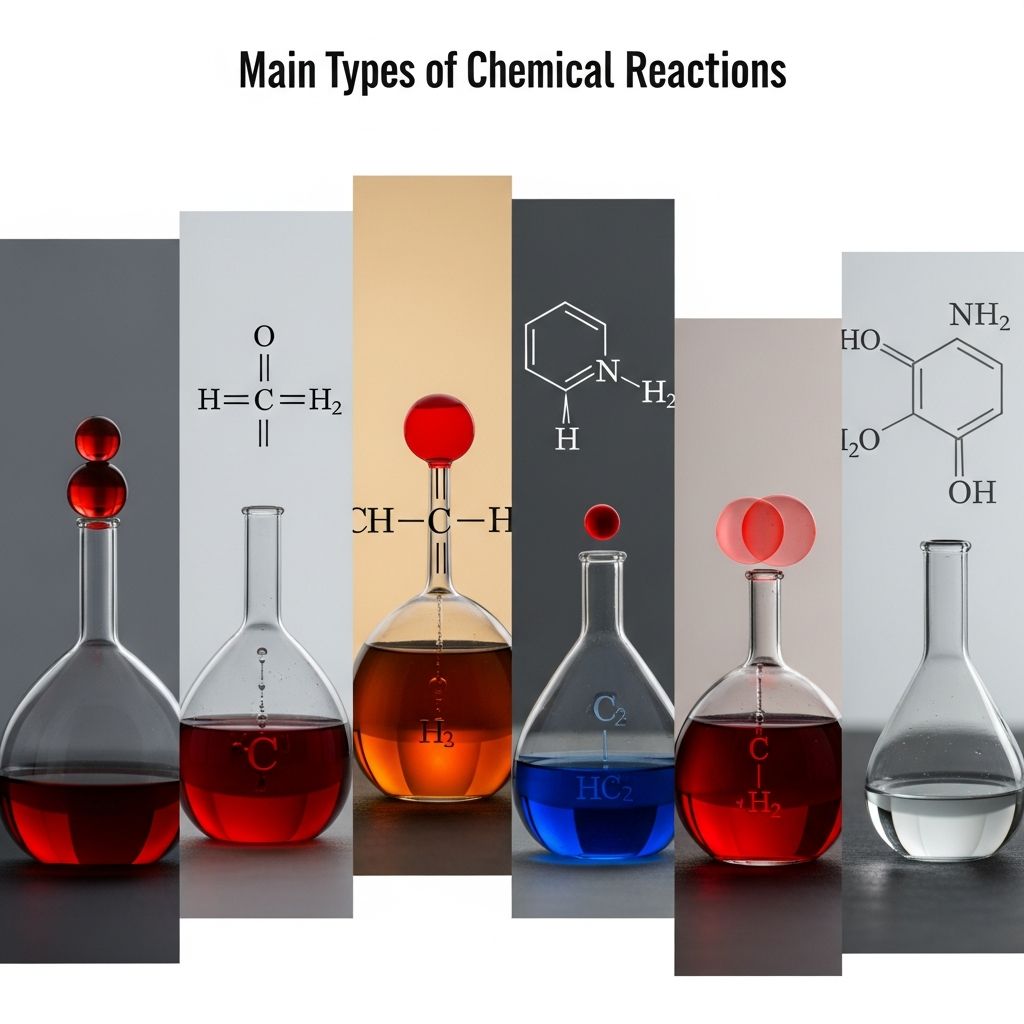
Chemical reactions form the foundation of chemistry, transforming substances into new materials through bond breaking and forming. Understanding their classifications helps predict outcomes, balance equations, and apply concepts in labs and industry. This article delves into the core categories, providing clear definitions, equations, and examples drawn from reliable educational sources.
Why Classify Chemical Reactions?
Classifying reactions simplifies the vast array of chemical processes into manageable groups based on patterns in reactants and products. Most sources agree on five primary types: synthesis (or combination), decomposition, single displacement, double displacement, and combustion, though subtypes like redox and neutralization exist. These categories aid in education, research, and practical applications like drug synthesis or fuel combustion.
Reactions occur everywhere—from digestion in the body to rusting metal. Recognizing patterns allows chemists to anticipate products without trial and error.
Synthesis Reactions: Building Complexity
Synthesis reactions, also called combination reactions, involve two or more reactants merging to form a single, more complex product. The general form is A + B → AB. These are often exothermic, releasing energy as bonds form.
A classic example is the formation of sodium chloride: 2Na + Cl₂ → 2NaCl. Here, sodium metal reacts with chlorine gas to produce table salt. Another is the rusting process simplified as 4Fe + 3O₂ → 2Fe₂O₃, though real rusting is more complex.
In industry, synthesis produces ammonia via the Haber-Bosch process: N₂ + 3H₂ → 2NH₃, vital for fertilizers. These reactions build polymers, metals, and pharmaceuticals.
Decomposition Reactions: Breaking Down Compounds
The opposite of synthesis, decomposition reactions break a single compound into two or more simpler substances. Represented as AB → A + B, they often require energy input like heat or light.
- Thermal decomposition: CaCO₃ → CaO + CO₂ (limestone to quicklime).
- Electrolytic: 2H₂O → 2H₂ + O₂ (water splitting).
- Photolytic: 2H₂O → 2H₂ + O₂ under UV light.
These power explosives like TNT decomposition and are key in analytical chemistry for identifying compounds.
Single Displacement Reactions: Element Swaps
Single displacement, or single replacement, occurs when one element replaces another in a compound. The form is A + BC → AC + B, where A is more reactive than B.
Activity series dictate reactivity: potassium tops metals, fluorine leads halogens. Example: Zn + CuSO₄ → ZnSO₄ + Cu (zinc displaces copper). This demonstrates in displacement reactions where reactive metals liberate less reactive ones from solutions.
Applications include metal extraction and batteries, like zinc-carbon cells.
Double Displacement Reactions: Ion Exchanges
Double displacement involves two compounds exchanging ions: AB + CD → AD + CB. Often in aqueous solutions, they form precipitates, gases, or neutral molecules.
Neutralization is a subtype: HCl + NaOH → NaCl + H₂O. Precipitation example: AgNO₃ + NaCl → AgCl↓ + NaNO₃. These drive water treatment and qualitative analysis.
Combustion Reactions: Energy from Oxygen
Combustion reactions feature a fuel reacting with oxygen, producing CO₂, H₂O, and heat/light. Hydrocarbons follow CₓHᵧ + O₂ → CO₂ + H₂O.
Methane burns as CH₄ + 2O₂ → CO₂ + 2H₂O. Complete vs. incomplete combustion yields CO or soot if oxygen is limited. Essential for engines, these are rapid, exothermic.
Redox Reactions: Electron Transfers
Many reactions are redox (reduction-oxidation), involving electron gain/loss. Oxidation loses electrons; reduction gains them. All displacement and combustion are redox.
Example: 2Mg + O₂ → 2MgO (Mg oxidized, O reduced). Crucial in corrosion, batteries, and metabolism.
Real-World Applications Table
| Reaction Type | Application | Example Equation |
|---|---|---|
| Synthesis | Fertilizer production | N₂ + 3H₂ → 2NH₃ |
| Decomposition | Limestone calcination | CaCO₃ → CaO + CO₂ |
| Single Displacement | Metal refining | Zn + CuSO₄ → ZnSO₄ + Cu |
| Double Displacement | Water softening | Ca(HCO₃)₂ + 2NaOH → Ca(OH)₂ + 2NaHCO₃ |
| Combustion | Power generation | C₈H₁₈ + 25/2O₂ → 8CO₂ + 9H₂O |
Overlaps and Special Cases
Reactions can fit multiple categories. Combustion may be synthesis if oxygen combines with elements. Acid-base are double displacement. Precipitation specifies insoluble product formation.
Frequently Asked Questions (FAQs)
What are the five main types of chemical reactions?
Synthesis, decomposition, single displacement, double displacement, and combustion.
How do you identify a synthesis reaction?
Two or more reactants form one product, like A + B → AB.
Are all combustion reactions exothermic?
Yes, they release heat and light rapidly.
What drives single displacement reactions?
Reactivity series; more reactive elements displace less reactive ones.
Can reactions belong to multiple types?
Yes, e.g., some combustion is also synthesis or redox.
Advanced Insights for Students
Balancing equations is key: ensure atom counts match on both sides. Le Châtelier’s principle predicts shifts in reversible reactions. Kinetics studies speed; thermodynamics, feasibility.
In labs, safety matters: combustions need ventilation, displacements avoid strong acids without gear.
Modern chemistry expands types: photochemical (light-driven), like photosynthesis: 6CO₂ + 6H₂O → C₆H₁₂O₆ + 6O₂. Electrochemical in fuel cells.
References
- Different Types Of Chemical Reactions — The Chemistry Blog, Chemicals.co.uk. 2023-05-15. https://www.chemicals.co.uk/blog/different-types-of-chemical-reactions
- Types of Reactions — Sketchy MCAT Lessons. 2024-02-10. https://www.sketchy.com/mcat-lessons/types-of-reactions
- Different Types of Chemical Reactions — BYJU’S. 2023-11-20. https://byjus.com/chemistry/types-of-chemical-reactions/
- Patterns of Chemical Reactivity: The Five Types — Pearson Channels, Intro to Chemistry. 2024-01-05. https://www.pearson.com/channels/intro-to-chemistry/study-guides/patterns-of-chemical-reactivity-the-five-types
- Types of Chemical Reactions — ChemistryTalk. 2023-08-12. https://chemistrytalk.org/types-of-chemical-reactions/
- Chemical Reaction — Wikipedia (primary sources referenced). 2026-03-28. https://en.wikipedia.org/wiki/Chemical_reaction

Medha Deb is an editor with a master's degree in Applied Linguistics from the University of Hyderabad. She believes that her qualification has helped her develop a deep understanding of language and its application in various contexts. Medha specializes in the areas of beauty, health, sports, and wellness and is committed to ensuring that the content on the website is…