
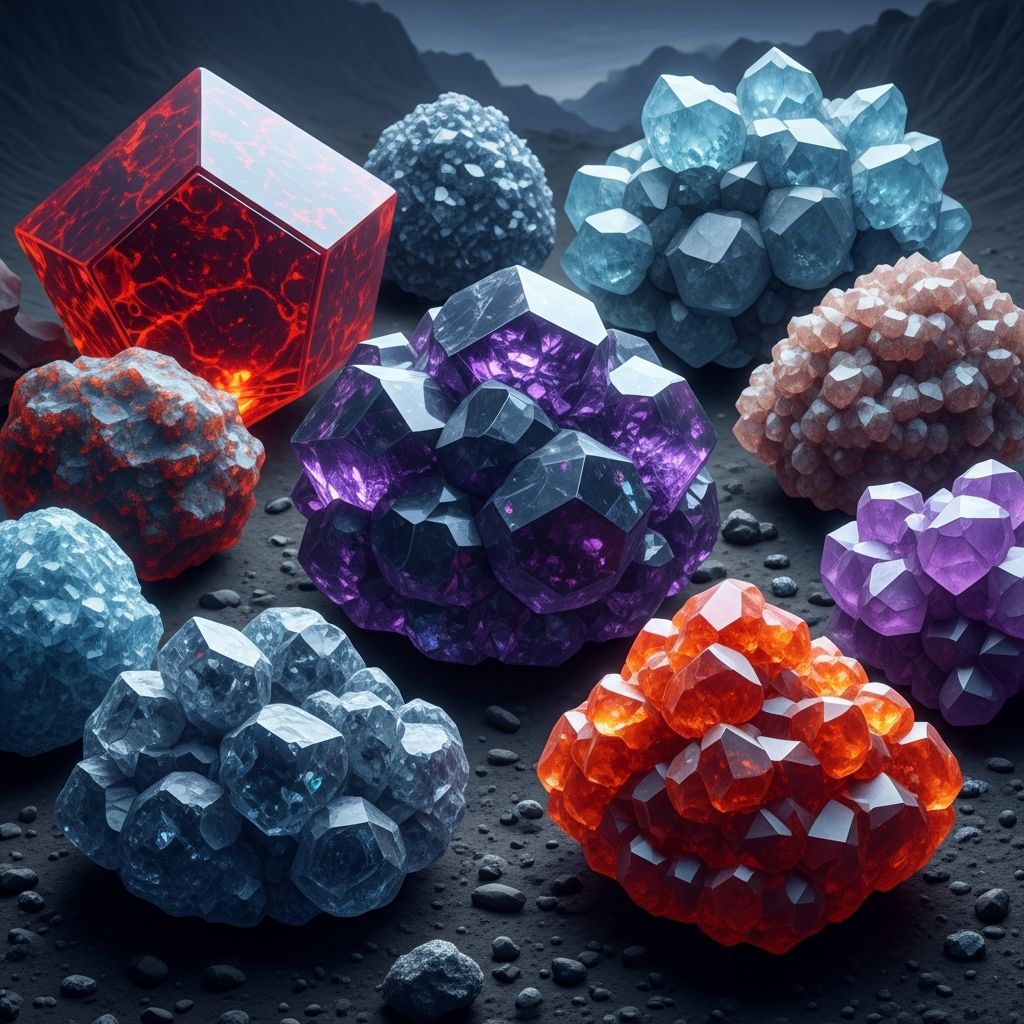
Crystals represent ordered arrangements of atoms that produce distinctive geometric shapes and unique physical properties. Understanding how these structures are classified helps scientists, jewelers, and enthusiasts appreciate their diversity and applications, from electronics to decorative arts.
Foundations of Crystal Symmetry
The core of crystal classification lies in their internal atomic lattices, defined by symmetry operations that repeat patterns in three dimensions. These symmetries group crystals into seven distinct **crystal systems**, each characterized by specific unit cell parameters like edge lengths (a, b, c) and angles (α, β, γ).
- Cubic system: All sides equal (a=b=c), all angles 90°. Highest symmetry, common in metals like gold and table salt (NaCl).
- Tetragonal system: a=b≠c, angles 90°. Examples include rutile (TiO2) and zircon.
- Orthorhombic system: a≠b≠c, all angles 90°. Seen in topaz and sulfur.
- Hexagonal system: a=b≠c, α=β=90°, γ=120°. Quartz and calcite exemplify this.
- Trigonal (Rhombohedral) system: a=b=c, α=β=γ≠90°. Tourmaline and hematite fit here.
- Monoclinic system: a≠b≠c, α=γ=90°, β≠90°. Gypsum and orthoclase feldspar.
- Triclinic system: All sides and angles unequal. Lowest symmetry, as in turquoise and feldspar varieties.
These systems arise from the 32 possible point groups, combinations of rotation axes, mirror planes, and inversion centers permitted by natural laws.
Structural Bonding Types in Crystals
Beyond symmetry, crystals form through different atomic bonding mechanisms, influencing hardness, conductivity, and solubility. This classification divides them into four primary categories.
| Bonding Type | Key Characteristics | Examples | Applications |
|---|---|---|---|
| Ionic | Electrostatic attraction between cations and anions; brittle, high melting points | Halite (NaCl), fluorite (CaF2) | Salt production, optics |
| Covalent Network | Strong directional covalent bonds throughout; extremely hard, insulators | Diamond (C), quartz (SiO2), silicon | Cutting tools, semiconductors |
| Molecular | Weak van der Waals or hydrogen bonds between molecules; soft, low melting | Ice (H2O), dry ice (CO2), naphthalene | Refrigerants, solvents |
| Metallic | Delocalized electrons in metal lattice; ductile, conductive | Copper, gold, iron pyrite | Wiring, jewelry |
Ionic crystals dissolve easily in water due to ion hydration, while covalent networks like diamond resist cleavage except along specific planes.
Formation Processes Shaping Crystals
Crystals emerge from various geological and artificial processes, each imparting unique traits. Natural formation occurs via cooling magma (igneous), mineral-rich water evaporation (evaporites), or metamorphic pressures.
- Igneous crystals: Grow slowly in molten rock, yielding large specimens like amethyst geodes or pegmatite beryl.
- Sedimentary crystals: Precipitate from solutions, forming halite beds or limestone calcite.
- Metamorphic crystals: Recrystallize under heat/pressure, producing garnets or kyanite.
- Biogenic crystals: Form in organisms, such as pearl nacre or coral aragonite.
- Synthetic crystals: Lab-grown via flux, hydrothermal, or vapor methods for gems like cubic zirconia or YAG lasers.
Evaporite deposits, like those in the Dead Sea, yield massive gypsum (selenite) crystals up to 11 meters long.
External Habits and Morphological Features
Crystal **habits** describe external shapes influenced by growth conditions, faces, and twinning. Common habits include prismatic, tabular, dendritic, and fibrous.
- Prismatic: Elongated with parallel faces, typical of beryl (emerald).
- Tabular: Flat, plate-like, as in mica or selenite.
- Dendritic: Branching, like manganese oxide inclusions in limestone.
- Acicular: Needle-like, seen in natrolite.
- Massive/granular: No distinct faces, common in pyrite or malachite.
Twinning occurs when lattices intergrow at specific angles, forming star sapphires (rutile needles) or staurolite crosses.
Prominent Crystal Families and Varieties
Certain mineral groups dominate collections due to beauty and utility. Quartz, with over 100 varieties, spans habits from drusy to scepter.
- Quartz family: Clear quartz (rock crystal), amethyst (purple), citrine (yellow), smoky quartz, rose quartz. Hexagonal system, used in watches and healing.
- Garnet group: Almandine (red), pyrope, grossular (green tsavorite). Cubic, birthstone favorites.
- Feldspar group: Orthoclase (moonstone), plagioclase (labradorite iridescence), amazonite.
- Calcite varieties: Optical (Iceland spar), manganoan, aragonite pseudomorphs.
- Other notables: Fluorite (cubic, fluorescent), tourmaline (hexagonal prisms), opal (amorphous silica).
Labradorite’s schiller effect arises from light diffraction in layered plagioclase.
Crystals in Modern Technology and Industry
Precise crystal structures enable advanced applications. Piezoelectric quartz generates voltage under pressure, powering watches and ultrasound devices. Semiconducting silicon crystals underpin microchips.
- Laser crystals: Nd:YAG (neodymium-doped yttrium aluminum garnet) for cutting and medicine.
- Optical uses: Birefringent calcite in polarizers; synthetic sapphire windows.
- Superconductors: High-Tc cuprates with perovskite structures.
Diamond anvil cells use synthetic diamond to achieve extreme pressures for research.
Metaphysical Perspectives on Crystal Types
Beyond science, crystals are valued for purported energetic properties. Clear quartz amplifies intentions, selenite cleanses auras, and amethyst promotes calm. These uses stem from color, vibration, and historical lore, though not scientifically validated.
| Crystal | Associated Chakra | Key Property |
|---|---|---|
| Amethyst | Crown | Intuition, sobriety |
| Rose Quartz | Heart | Love, compassion |
| Citrine | Solar Plexus | Abundance, confidence |
| Black Tourmaline | Root | Protection, grounding |
Frequently Asked Questions (FAQs)
What distinguishes natural from synthetic crystals?
Natural crystals form geologically over millennia, often with inclusions; synthetics are lab-produced rapidly with perfect clarity for consistency.
Can all crystals be classified by color?
No, color is superficial (impurities/light); true classification relies on atomic lattice and bonding.
Why do some crystals exhibit twinning?
Twinning happens when growth errors align lattices symmetrically, creating composite forms like penetration twins in feldspar.
Are amorphous solids like opal crystals?
Opal is amorphous (no long-range order), classified as mineraloid despite crystalline appearance.
How do crystal systems affect properties?
Higher symmetry (cubic) often yields isotropy (uniform properties); lower symmetry (triclinic) shows anisotropy.
Collecting and Identifying Crystals
Enthusiasts identify crystals via hardness (Mohs scale: talc=1, diamond=10), streak, cleavage, and luster. Tools like refractometers measure refractive index. Popular collecting sites include Herkimer diamond mines (quartz) and Mexican geodes.
Safe handling: Avoid inhaling dust from cutting; store away from sunlight to prevent fading.
References
- Crystals Types (Alphabetical List) — FossilEra.com. 2023. https://www.fossilera.com/crystals
- List of gemstones by species — Wikipedia (sourced from mineralogical references). 2024-01-15. https://en.wikipedia.org/wiki/List_of_gemstones_by_species
- Crystal Stone Types — CrystalAge.com. 2023. https://www.crystalage.com/online_store/stone_type/
- Top 20 Crystals + Meanings | Ultimate Guide to Healing Stones — Wild Mountain Crystals. 2024. https://wildmountaincrystals.com/blogs/wild-mountain-blog/top-20-most-popular-healing-crystals-the-ultimate-guide
- 250+ Crystals & their Meanings: A Complete Guide — New Moon Beginnings. 2023. https://newmoonbeginnings.com/crystal-meanings/

- Integrated M.A. in Applied Linguistics, University of Hyderabad
- 5+ years in editorial, instructional, SEO, and research-based writing
Sneha is a relationships and lifestyle writer with a strong foundation in applied linguistics and certified training in relationship coaching. She brings over five years of writing experience to theskillvault, crafting thoughtful, research-driven content that empowers readers to build healthier relationships, boost emotional well-being, and embrace holistic living. Her writing and insights reflect the belief that beauty, happiness, and wellness…