
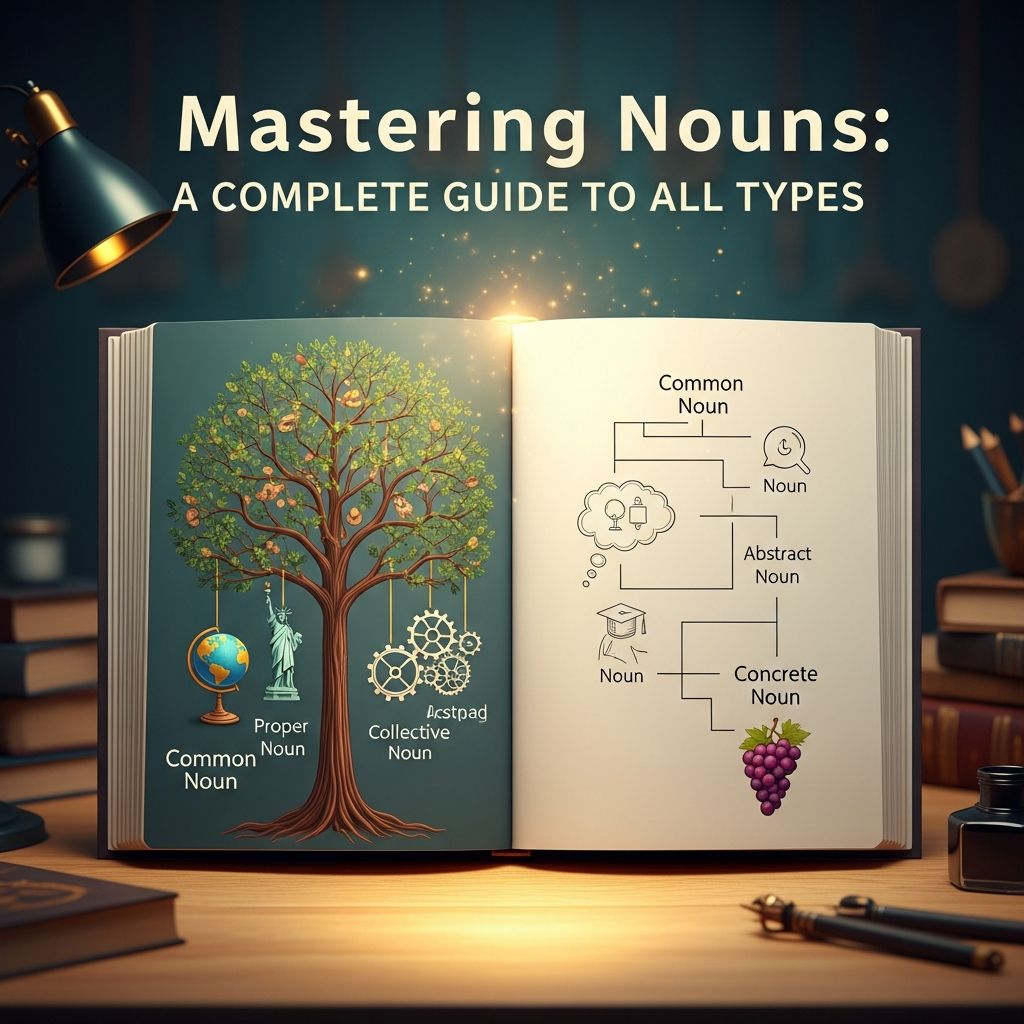
Nouns serve as the building blocks of sentences, naming everything from tangible objects to intangible ideas. Understanding their various categories helps learners construct clearer, more precise communication. This guide breaks down each type with definitions, examples, and tips for identification and usage.
Foundational Categories: Common and Proper Nouns
At the core of noun classification lie common nouns and proper nouns. Common nouns refer to general items, people, places, or concepts without specificity. Words like “dog,” “city,” or “teacher” fall into this group and typically do not require capitalization unless starting a sentence.
In contrast, proper nouns identify specific entities and always begin with a capital letter. Examples include “Rover” (a particular dog), “New York” (a specific city), or “Ms. Smith” (a named teacher). Recognizing the difference is essential for correct writing, as misusing capitalization can confuse readers.
- Spot common nouns in everyday descriptions: house, book, child.
- Identify proper nouns by names: Eiffel Tower, Harry Potter, Monday.
Teaching tip: Create a classroom chart dividing words into these categories to reinforce recognition.
Physical vs. Conceptual: Concrete and Abstract Nouns
Concrete nouns represent items detectable by the senses—sight, touch, taste, sound, or smell. Think of “apple” (visible and edible), “velvet” (tactile), or “thunder” (audible). These nouns ground language in the physical world.
Abstract nouns, however, denote ideas, emotions, qualities, or states that exist beyond sensory perception. Terms like “love,” “freedom,” “honesty,” or “curiosity” exemplify this type. They often end in suffixes such as -ness, -ity, or -ment, though not always.
| Type | Examples | Sensory Test |
|---|---|---|
| Concrete | Chair, rain, pizza | Can you see, touch, or taste it? |
| Abstract | Beauty, anger, wisdom | Can you physically experience it? |
Exercise: Challenge learners to list five concrete nouns from their surroundings and five abstract nouns describing their feelings.
Quantity and Number: Singular, Plural, and Irregular Forms
Singular nouns name one entity, such as “cat” or “book.” Plural nouns indicate more than one, usually formed by adding -s or -es: “cats,” “boxes.” Most follow this regular pattern.
Irregular plurals defy the norm, changing form entirely: “child” becomes “children,” “mouse” to “mice,” or “goose” to “geese.” Some remain unchanged, like “sheep” or “deer.” Mastery requires memorization and context clues.
- Regular: Dog → Dogs
- Irregular: Man → Men, Foot → Feet
- Invariable: Fish → Fish (often)
Practice activity: Provide a list mixing regular and irregular forms for students to pluralize correctly.
Ownership Indicators: Possessive Nouns
Possessive nouns show belonging or relationships by adding an apostrophe and sometimes -s. For singular nouns, use ‘s: “the dog’s bone.” For plural nouns ending in -s, add only ‘: “the dogs’ bones.” Irregular plurals like “children’s toys” follow the singular rule.
Common pitfalls include confusing possessives with plurals (“it’s” vs. “its”) or contractions. Clear rules prevent errors in professional writing.
Quick quiz: Rewrite “the car of my friend” as “my friend’s car.”
Group Dynamics: Collective Nouns
Collective nouns describe groups functioning as a unit: “team,” “family,” “flock,” or “army.” They take singular verbs when acting together (“The team wins”) but plural when individuals are emphasized (“The team are arguing among themselves”—British English variant).
Fun examples: A “pride of lions,” “murmuration of starlings,” or “congress of baboons.” These enrich vocabulary and add color to descriptions.
- People groups: Jury, audience, committee
- Animal groups: Herd, swarm, pod
- Object groups: Bunch, stack, fleet
Advanced Structures: Compound, Countable, and Uncountable Nouns
Compound nouns merge two or more words: “toothbrush,” “mother-in-law,” or “ice cream.” They can be hyphenated, separate, or closed-form.
Countable nouns can be quantified: “one book, two books.” Uncountable nouns (mass nouns) cannot: “water,” “information,” “furniture.” Use quantifiers like “some,” “much,” or “a piece of.”
| Countable | Uncountable |
|---|---|
| Apple/Apples | Sugar |
| Idea/Ideas | Advice |
Gerunds, verbs acting as nouns (“swimming is fun”), add versatility.
Practical Applications: Identifying Nouns in Sentences
To apply knowledge, scan sentences for nouns. Start with capitals for proper nouns, then check sensory qualities, number endings, apostrophes, or group terms. Worksheets with themes like superheroes or zoo trips make practice engaging.
Activity: In “The team’s captain celebrated the victory with joy,” identify: team (collective), captain (common), victory (abstract), joy (abstract).
Teaching Strategies for Effective Noun Mastery
Educators can use scavenger hunts: Hunt for nouns in the environment, categorizing them on-site. Mini-books let students illustrate types personally. Daily routines, like labeling breakfast items, build habits.
For digital learners, interactive quizzes or slideshows progress from basic to advanced. Games like noun categories during car rides reinforce without screens.
- Scavenger hunts for real-world spotting
- Mini-books for creative ownership
- Sensory games: “Touch it or feel it?”
- Scattergories-style tables for brainstorming
Frequently Asked Questions (FAQs)
What are the primary types of nouns for beginners?
Start with common (general terms like “dog”), proper (specific like “Buddy”), concrete (touchable like “ball”), and abstract (ideas like “happiness”).
How do you form possessive nouns correctly?
Add ‘s to singular nouns (“cat’s”) and ‘ to plurals ending in s (“cats'”); use ‘s for irregular plurals (“children’s”).
What’s the difference between countable and uncountable nouns?
Countable can be numbered (“cars”), uncountable cannot (“traffic”—use “some traffic”).
Can collective nouns be singular or plural?
Yes, singular for unity (“team wins”), plural for individuals (“team argue”).
How to teach abstract nouns to young kids?
Use emotions or stories: Discuss “bravery” in a hero tale, contrasting with concrete actions.
Interactive Worksheet Ideas
Design tables for categorization:
| Word | Common/Proper | Concrete/Abstract | Singular/Plural |
|---|---|---|---|
| London | Proper | Concrete | Singular |
| Happiness | Common | Abstract | Uncountable |
Encourage expansion with sentences using each type.
References
- Types of Nouns Lesson & Worksheets — Hey Natayle. 2023. https://heynatayle.com/product/types-of-nouns/
- Types of Nouns: Fun Grammar Activities for Kids — Outschool. 2024. https://outschool.com/homeschool/types-of-nouns
- Nouns Teaching Resources — Teach Starter. 2024. https://www.teachstarter.com/us/learning-area/nouns-us/
- Noun Worksheets, Lessons, and Tests — eReading Worksheets. 2023. https://www.ereadingworksheets.com/languageartsworksheets/parts-of-speech-worksheets/noun-worksheets/
- Noun Worksheets & Lessons — Ashleigh’s Education Journey. 2023. https://www.ashleigh-educationjourney.com/noun-worksheets/

Medha Deb is an editor with a master's degree in Applied Linguistics from the University of Hyderabad. She believes that her qualification has helped her develop a deep understanding of language and its application in various contexts. Medha specializes in the areas of beauty, health, sports, and wellness and is committed to ensuring that the content on the website is…