
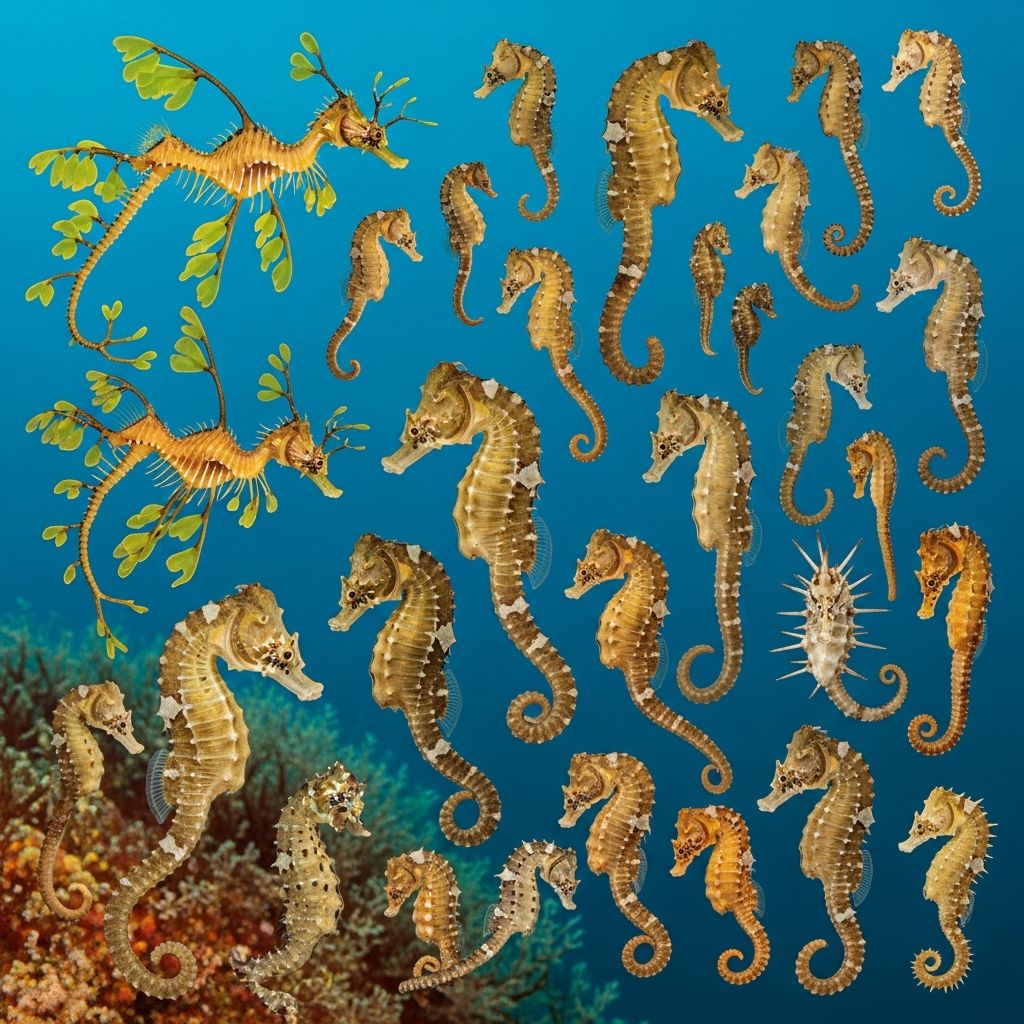
Seahorses, belonging to the genus Hippocampus, captivate marine enthusiasts with their distinctive horse-like heads, curled tails, and extraordinary reproductive behaviors where males carry the young. Currently, 46 species are recognized, though their masterful camouflage often complicates identification and discovery, with several found only recently.
The Biology and Adaptations of Seahorses
These bony fish thrive in diverse environments, from shallow seagrass beds to deep coral reefs. Lacking caudal fins, they rely on prehensile tails to anchor to vegetation or corals against currents. Their diet consists of tiny crustaceans sucked through tubular snouts, and they can change color for camouflage or communication.
Seahorses exhibit monogamous pair bonds in many species, performing daily greeting dances. Males pouch the eggs provided by females, nourishing and protecting embryos until live birth. This unique paternal care sets them apart in the animal kingdom.[10]
Size Spectrum: From Pygmies to Giants
Seahorse sizes vary dramatically, influencing their habitats and vulnerabilities. The tiniest, pygmy seahorses, measure under 2.5 cm, while giants reach over 35 cm.
| Category | Species Example | Max Size | Habitat |
|---|---|---|---|
| Tiny Pygmies | H. bargibanti, H. denise | ~2 cm | Gorgonian corals, Indo-Pacific |
| Mid-Sized | H. capensis, H. reidi | 10-15 cm | Estuaries, reefs |
| Large Species | H. abdominalis | 35 cm | Australia, New Zealand |
This range allows specialization: pygmies blend seamlessly with coral polyps, while larger forms withstand stronger currents.
Spotlight on Remarkable Species
The Colossal Bigbelly Seahorse (Hippocampus abdominalis)
Dominating as the largest species, the bigbelly seahorse grows to 35 cm, featuring a prominent pot-like abdomen that aids buoyancy in temperate waters around Australia and New Zealand. They cling to seagrasses in harbors and bays, thriving in moderate currents. Listed as Least Concern, their size makes them resilient yet still faces habitat loss threats.
Elusive Knysna Seahorse (Hippocampus capensis)
Among the rarest, this species inhabits only three South African estuaries: Knysna, Keurbooms, and Swartvlei. Reaching 12 cm, it sports colors from green to black, anchoring in eelgrass against fast flows. Fully protected due to extinction risks from pollution and development.
Pygmy Wonders: Bargibanti and Denise’s Seahorses
Pygmy seahorses represent extremes in miniaturization. H. bargibanti, discovered on gorgonian fans at 25-35 m depths, matches its host’s red or yellow hues perfectly. H. denise lives among diverse corals Indo-Pacific wide. Nine pygmy species exist, many newly described, growing to just 2 cm.
Robust Reef Dwellers: Lined and Brazilian Seahorses
Hippocampus erectus (lined seahorse) reaches 25 cm in Western Atlantic seagrasses, available in vibrant morphs like yellow and red from breeders. Sleek H. reidi (Brazilian) graces warm reefs with long snouts and graceful forms, popular in aquaria for hardiness.
Prickly and Widespread: Spiny and Yellow Seahorses
The spiny seahorse (H. histrix) boasts dark-tipped spines, favoring deep seagrass and corals below 15 m, first noted in Hawaii decades ago. Yellow seahorses (H. kuda complex) span 23 countries from Persian Gulf to Hawaii, adaptable and common in trade despite pressures.[10]
Global Distribution and Preferred Habitats
- Indo-Pacific: Richest diversity, hosting pygmies, H. kuda, H. barbouri (VU) on reefs and mangroves.
- Australia/New Zealand: Bigbelly and narrow-bellied (H. angustus) in temperate bays.
- Atlantic: H. erectus, H. reidi in seagrasses; European H. guttulatus (long-snouted, DD).
- Africa: Knysna and West African (H. algiricus, VU) in estuaries.
- Pacific Islands: Fisher’s (H. fisheri) around Hawaii.
Most prefer structured habitats like seagrasses, mangroves, and corals, vulnerable to degradation.
Conservation Status and Threats
Many species face peril: 5 Vulnerable, several Data Deficient per IUCN. Over 20 million caught annually for aquaria, medicine, curios, targeting H. kuda, H. histrix. Habitat destruction from coastal development, trawling, and climate change exacerbate risks. Protected areas and CITES Appendix II aid some, like Knysna.[10]
| Status | Examples | Primary Threats |
|---|---|---|
| Vulnerable (VU) | H. erectus, H. barbouri, H. algiricus | Overfishing, habitat loss |
| Data Deficient (DD) | H. guttulatus, H. debelius | Lack of data |
| Least Concern (LC) | H. abdominalis, H. bargibanti | Localized pressures |
Care in Aquariums: Selecting Suitable Species
Aquaculture supports sustainable keeping. Hardy choices include H. erectus, H. reidi, H. kuda, H. comes—large, current-tolerant, bred in captivity. Provide refugiums with macroalgae, live foods like enriched brine shrimp, and stable parameters (72-78°F, 1.020-1.025 sg). Avoid wild-caught to prevent disease and support conservation.
- Pair bonding: Introduce as couples.
- Feeding: Multiple daily sessions.
- Tank size: 30+ gallons per pair.
Recent Discoveries and Taxonomy Challenges
With 14 species named in the last decade, including H. pontohi (2008), camouflage hinders surveys. Molecular studies refine classifications, like splitting H. kuda complex. Ongoing research by IUCN and Project Seahorse updates the 46-species count.
Frequently Asked Questions (FAQs)
What is the smallest seahorse species?
Pygmy seahorses like H. denise and H. bargibanti max out at 2-2.4 cm, living on corals.
Which seahorse is the largest?
The bigbelly (H. abdominalis) reaches 35 cm in Australian waters.
Are all seahorses endangered?
No, but many are Vulnerable or Data Deficient due to trade and habitat loss; e.g., Knysna is critically rare.
Can seahorses be kept in home aquariums?
Yes, captive-bred H. erectus or H. reidi succeed with proper setup; avoid wild specimens.
How many seahorse species exist?
46 recognized, with potential for more via ongoing discoveries.
Protecting Seahorse Populations
Conservation demands reduced trade, habitat restoration, and research. Initiatives like Project Seahorse promote sustainable aquaculture and marine protected areas. Enthusiasts can advocate by choosing captive-bred and supporting anti-trawling efforts. These iconic fish symbolize ocean health—preserving them ensures biodiversity for future generations.[10]
References
- Types of Seahorses and How They Differ — Hastings Aquarium. 2023. https://hastingsaquarium.co.uk/blog/animal-stories/types-of-seahorses-and-how-they-differ/
- Choosing Seahorse Species for the Reef — TFH Magazine. 2022. https://www.tfhmagazine.com/articles/saltwater/a-seahorse-reef-part-two-choosing-your-seahorses-full-article
- There are 49 different species of seahorses — Els Van Den Borre. 2021. https://www.elsvandenborre.be/duiken-wist-je-dat-zeepaardjes-EN.html
- Different Types Of Seahorse Species: The 8 Most Extreme — Citrus Reef. 2023. https://www.citrusreef.com/blogs/news/types-of-seahorse
- Seahorse Species — IUCN Seahorse Specialist Group & Project Seahorse. 2025-02-15. https://www.iucn-seahorse.org/seahorse-species
- All Seahorse Species in the World — YouTube (Ocean Channel). 2020. https://www.youtube.com/watch?v=wJIp42xOHtI
- How Many Seahorse Species? — Smithsonian Ocean. 2024. https://ocean.si.edu/ocean-life/invertebrates/how-many-seahorse-species

- Integrated M.A. in Applied Linguistics, University of Hyderabad
- 5+ years in editorial, instructional, SEO, and research-based writing
Sneha is a relationships and lifestyle writer with a strong foundation in applied linguistics and certified training in relationship coaching. She brings over five years of writing experience to theskillvault, crafting thoughtful, research-driven content that empowers readers to build healthier relationships, boost emotional well-being, and embrace holistic living. Her writing and insights reflect the belief that beauty, happiness, and wellness…