
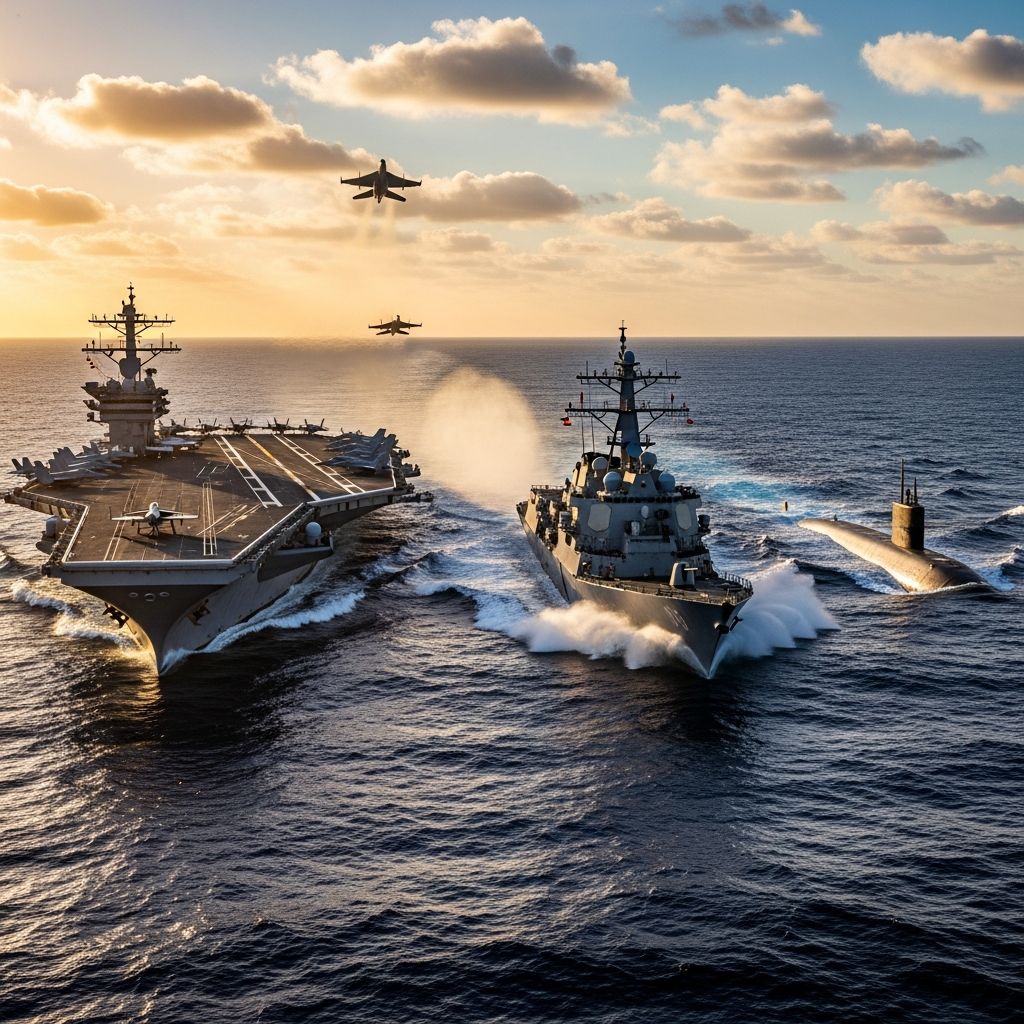
The United States Navy maintains one of the world’s most formidable fleets, comprising specialized vessels designed for diverse missions ranging from power projection to underwater stealth operations. These ships form the backbone of American maritime strategy, enabling global presence, deterrence, and rapid response capabilities.
Supercarriers: The Heart of Naval Power
Aircraft carriers represent the pinnacle of naval engineering, serving as mobile airbases that launch and recover dozens of fighter jets, helicopters, and support aircraft. The Nimitz-class carriers, with USS Nimitz (CVN-68) as the lead ship commissioned in 1975, have defined U.S. naval supremacy for decades. These nuclear-powered behemoths displace over 100,000 tons and measure more than 1,000 feet in length, capable of sustaining operations for extended periods without refueling.[10]
Transitioning to the future, the Gerald R. Ford-class introduces advanced electromagnetic catapults and improved stealth features, enhancing sortie generation rates by up to 30%. These carriers support strike missions, reconnaissance, and humanitarian aid, projecting air power thousands of miles from U.S. shores.
- Key Features: Nuclear propulsion for unlimited range; capacity for 75+ aircraft; robust defensive systems including close-in weapon systems (CIWS).
- Missions: Offensive strikes, fleet air defense, and command centers for carrier strike groups.
Guided Missile Cruisers: Versatile Guardians
Ticonderoga-class cruisers are multi-role combatants excelling in air defense, anti-submarine warfare, and surface engagements. Equipped with the Aegis combat system, these ships feature phased-array radars that track hundreds of targets simultaneously, launching SM-2, SM-3, and SM-6 missiles for theater ballistic missile defense.
With 22 active units like USS Antietam (CG-54) and USS Shiloh (CG-67), they serve as flagships for battle groups, providing layered protection against aerial threats. Their versatility extends to naval gunfire support for amphibious operations using 5-inch guns.
| Class | Displacement | Armament | Speed |
|---|---|---|---|
| Ticonderoga | 9,600 tons | 122 VLS cells, 2x 5″ guns | 32+ knots |
Destroyers: Agile Multi-Mission Warriors
Arleigh Burke-class destroyers form the numerical backbone of the surface fleet, with over 70 ships in service. These vessels excel in anti-air, anti-surface, and anti-submarine roles, armed with Tomahawk cruise missiles, Harpoon anti-ship missiles, and vertical launch systems (VLS).
Recent Flight III variants incorporate the AN/SPY-6 radar for superior detection ranges. Ships like USS Barry (DDG-52), USS Benfold (DDG-65), and USS Carl M. Levin (DDG-120) demonstrate ongoing modernization. The Zumwalt-class pushes boundaries with stealth design, railguns (in testing), and advanced automation, though only three were built due to cost overruns.
- Advantages: Stealthy tumblehome hulls; endurance for independent operations; helicopter hangars for ASW.
Submarines: Silent Hunters of the Deep
U.S. Navy submarines divide into attack (SSN) and ballistic missile (SSBN) types. Virginia-class attack submarines, with nine active, feature pump-jet propulsors for quiet running and Virginia Payload Tubes for extra Tomahawk capacity. They conduct intelligence gathering, special operations support, and strike warfare.
Seawolf-class, including USS Seawolf and USS Jimmy Carter with its multi-mission platform extension, offers unmatched speed (35+ knots submerged) and eight torpedo tubes for Mk 48 torpedoes. Ohio-class SSBNs ensure nuclear deterrence with Trident II D5 missiles, while Columbia-class replacements are under construction.
Strategic Role: Submarines provide persistent undersea presence, countering adversary fleets without detection.
Amphibious Assault Platforms: Marine Corps Enablers
Wasp-class amphibious assault ships (LHD) are the largest of their kind, functioning as mini-carriers for Marine Expeditionary Units. USS Wasp, commissioned in 1989, supports helicopter vertical envelopment and landing craft operations, participating in combat and humanitarian missions.
America-class (LHA) like USS America (LHA-6) emphasizes aviation with enlarged hangars and flight decks. San Antonio-class LPDs such as USS Anchorage (LPD-23) and USS Green Bay (LPD-20) transport troops, vehicles, and MV-22 Ospreys.
Specialized Support and Combatants
Littoral Combat Ships and Frigates
Freedom and Independence-class LCS address near-shore threats with modularity for anti-submarine, surface warfare, or mine countermeasures missions. With 8 Freedom-class and 12 Independence-class active, they operate MH-60 helicopters and unmanned vehicles. Future versions are reclassifying as frigates.
Mine Countermeasures Vessels
Avenger-class minehunters like USS Chief (MCM-14), USS Patriot (MCM-7), and USS Pioneer (MCM-9) use sonar, video, and remote detonators on wooden-fiberglass hulls to neutralize mines.
Patrol and Expeditionary Ships
Cyclone-class patrol craft handle coastal interdiction, upgraded with advanced sensors. Harpers Ferry-class dock landing ships support amphibious launches. Blue Ridge-class command ships (USS Blue Ridge, USS Mount Whitney) serve as fleet flagships until 2039. Expeditionary Mobile Bases like USS John L. Canley (ESB-6) provide at-sea basing.
Historical Context and Future Directions
Navy ship classifications have evolved from 1920s categories like battleships and auxiliaries to modern focus on carriers, submarines, and networked combatants. Today’s fleet emphasizes distributed lethality, unmanned systems, and hypersonic weapons.[10]
Challenges include sustaining industrial base for 355-ship goals, integrating AI for decision-making, and countering peer competitors like China’s growing navy.
Frequently Asked Questions
What is the largest U.S. Navy ship class?
America-class and Wasp-class amphibious ships are among the largest displacement vessels after carriers, supporting Marine air-ground operations.
How many aircraft carriers does the U.S. Navy operate?
Currently 11, with 10 Nimitz-class and 1 Gerald R. Ford-class, forming carrier strike groups.
What roles do destroyers play?
Multi-mission: air defense, anti-submarine, land attack with Tomahawks, and escort duties.
Are there stealth ships in the fleet?
Yes, Zumwalt-class destroyers feature angular designs reducing radar cross-section.
What is an SSBN?
Ballistic Missile Submarine, Nuclear-powered, carrying strategic nuclear missiles for deterrence.
References
- U.S. Navy Ship Classes: A Close Look at Classifications — USAMM. 2023. https://www.usamm.com/blogs/news/u-s-navy-ship-classes-a-close-look-at-classifications
- United States Navy ships — Wikipedia. 2026-04-01. https://en.wikipedia.org/wiki/United_States_Navy_ships
- By Class – Commander, Naval Surface Force, U.S. Pacific Fleet — U.S. Navy SURFPAC. 2026. https://www.surfpac.navy.mil/Ships/By-Class/
- Understanding US Navy Ship Designations — Pearl Harbor.org. 2024. https://pearlharbor.org/blog/understanding-us-navy-ship-designations/
- 2024 ships and submarines of the United States Navy — RTX. 2024-03-28. https://www.rtx.com/-/media/rtx/news-images/2024/03/28/4538063_rmd_2024shipsubposter_digital_v7.pdf
- Classification Of Naval Vessels — U.S. Naval Institute. 1945-11. https://www.usni.org/magazines/proceedings/1945/november/classification-naval-vessels

Medha Deb is an editor with a master's degree in Applied Linguistics from the University of Hyderabad. She believes that her qualification has helped her develop a deep understanding of language and its application in various contexts. Medha specializes in the areas of beauty, health, sports, and wellness and is committed to ensuring that the content on the website is…