
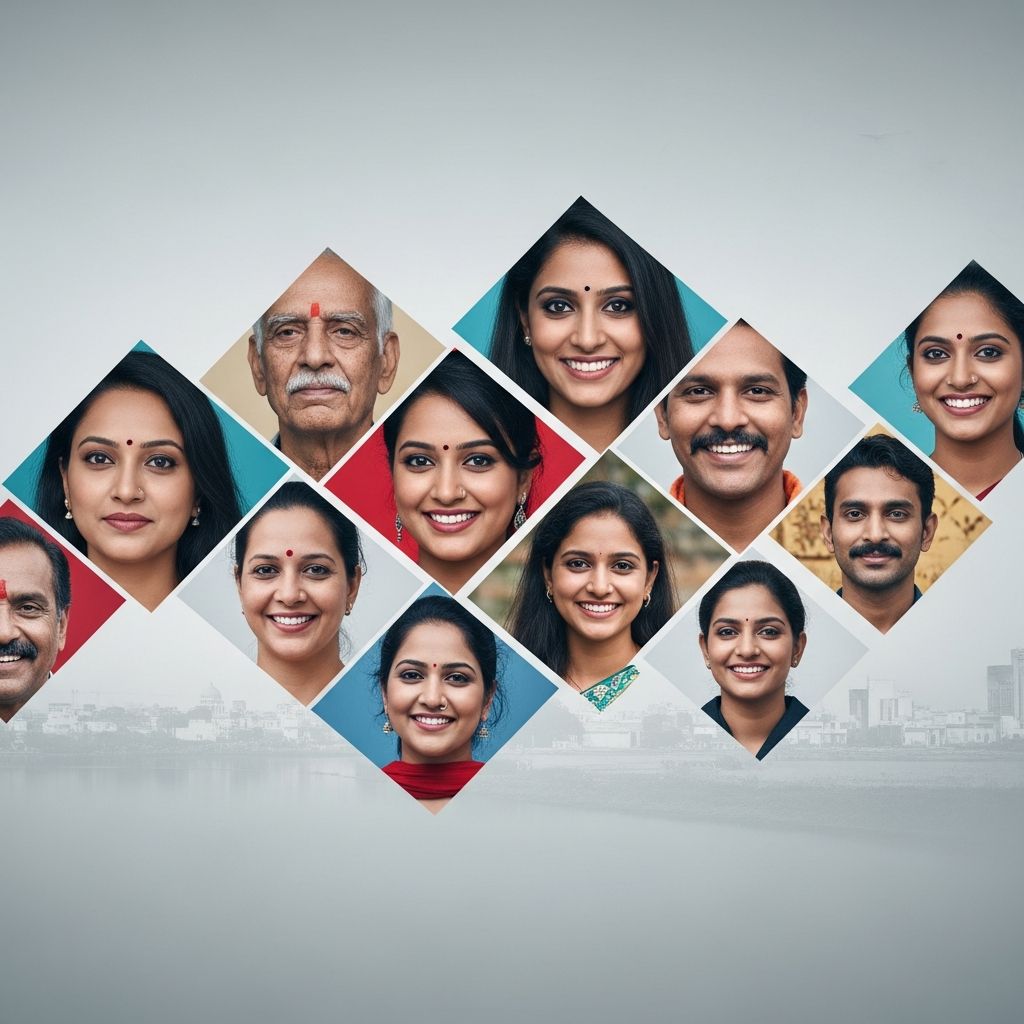
India’s vast demographic scale and cultural richness create one of the most complex social environments on earth, and that environment powerfully shapes how people think, feel, and behave in everyday life.
Understanding personality in India means looking beyond individuals to the historical, religious, and linguistic forces that have influenced how communities relate to authority, family, work, and change.
The Many Indias Within India
India is often described as a single nation, but in practice it contains layers of overlapping identities built around region, language, caste, religion, and class.
- Population scale: More than a billion people, making India the world’s second-most populous country.
- Ethnic variety: Thousands of ethnic and tribal groups with long histories of migration and intermarriage.
- Linguistic complexity: Hundreds of living languages are spoken, with 22 scheduled languages officially recognized by the Constitution.
- Religious diversity: Large populations of Hindus, Muslims, Christians, Sikhs, Buddhists, Jains and others coexist, often with different customs and value systems.
These overlapping layers of identity create very different local cultures. A young professional in Mumbai may navigate personalities shaped by global capitalism and film culture, while a farmer in rural Assam lives in a social world structured around village networks, local language, and agrarian traditions.
Language, Thought, and Self-Expression
Language is not only a tool of communication in India; it is also a marker of belonging and a filter for how people frame relationships and emotions.
- Multiple scripts and vocabularies give people access to different cultural worlds: classical texts in Sanskrit or Tamil, religious teachings in Arabic, Persian, or Pali, and modern media in Hindi, English, and regional tongues.
- Code-switching between local languages and English is common in cities, and people may present slightly different sides of themselves depending on the language they use.
- Indirect communication is often preferred in many Indian settings, especially when dealing with elders or superiors, which shapes how disagreement and negative feelings are expressed.
Because of this, a single person’s personality can appear more deferential and formal in their mother tongue, but more direct and analytical when speaking English in a professional context.
Language Families and Social Worlds
| Language Family | Examples | Regions Where Common | Social & Cultural Associations |
|---|---|---|---|
| Indo-Aryan | Hindi, Bengali, Marathi, Punjabi | North, West, East India | Large media markets, political influence, strong literary traditions. |
| Dravidian | Tamil, Telugu, Kannada, Malayalam | South India | Distinct regional identities, classical literature, proud linguistic nationalism. |
| Others | Bodo, Manipuri, Santhali, etc. | North-East & tribal regions | Strong community bonds, oral traditions, unique rituals and norms. |
Religion, Values, and Inner Life
India’s religious landscape is both ancient and densely populated. Religions strongly influence moral values, ideas about duty, and concepts of the self.
- Hindu traditions have shaped ideas about karma, dharma (duty), and life stages, often encouraging acceptance of complexity, tolerance of ambiguity, and a cyclical view of time.
- Islamic influences emphasize community, modesty, and devotion, with daily practices like prayer structuring time and social expectations.
- Sikh, Buddhist, Jain, and Christian communities add further diversity, each with their own ethics of service, nonviolence, spiritual discipline, or charity.
Because religion often intersects with family and community life, many people learn early to balance personal desires with obligations to kin, deities, and religious institutions.
Family Structures and Social Expectations
Family remains one of the central organizing forces of life in India, and it plays a major role in shaping personality from childhood onwards.
- Extended families are common, with grandparents, aunts, uncles, and cousins playing active roles in decision-making and childrearing.
- Respect for elders teaches children to control impulses, listen more than they speak in formal situations, and consider the impact of their behavior on family reputation.
- Collective identity means that family goals often take precedence over individual preference, especially in marriage, education, and career choices.
This environment can foster strong skills in negotiation, compromise, and empathy within the group. At the same time, it can make highly individualistic self-expression feel risky, particularly in conservative or rural communities.
Work, Ambition, and Adaptability
India’s economy involves agriculture, manufacturing, and services, with rapid growth in information technology, finance, and creative industries.
- Rural livelihoods still employ a substantial share of the population, encouraging traits like endurance, practical problem-solving, and reliance on local networks.
- Urban professional life rewards assertiveness, time management, and technical competence, especially in globally connected sectors such as IT and finance.
- Migration from villages to cities pushes many people to reconcile traditional expectations with new opportunities, often creating hybrid identities.
The coexistence of intense competition for exams and jobs with strong family obligations encourages a particular blend of ambition and responsibility. People often learn to pursue personal success while presenting it as serving the family or community’s interests.
Tradition Meets Modernity
Modern India is shaped by both ancient civilizations and recent waves of globalization and technological change.
- Ancient achievements in architecture, mathematics, and medicine remain a source of pride, from historical temples to the Taj Mahal, from early concepts of zero to longstanding Ayurvedic practices.
- Global media and education expose young Indians to international norms around autonomy, gender roles, and career choice.
- Digital life connects urban and even many rural youth to online communities that may differ sharply from local expectations.
The tension between continuity and change produces diverse personality strategies. Some people double down on tradition, others embrace radical change, and many blend the two—observing religious festivals while working in global corporations or consuming global pop culture.
Regional Personality Patterns
Although individuals vary everywhere, certain broad patterns often emerge across regions because of shared history, language, and economic structure.
- North India: Public life is strongly shaped by politics and religious festivals, and communication can be more direct in many settings, particularly in bustling cities.
- South India: Long literary and educational traditions often place a high value on scholarship and professionalism, alongside strong ties to language-based regional identities.
- East and North-East: Rich artistic, musical, and tribal heritage supports tight-knit communities with distinct cultural norms and a strong sense of regional uniqueness.
- West and coastal regions: Major trade hubs and global-facing cities foster entrepreneurial attitudes and comfort with multicultural environments.
These patterns influence what kinds of personality traits are admired—whether it is assertive leadership, quiet diligence, creativity, or community service.
Education, Gender, and Emerging Identities
Expanding education and changing gender roles are significantly reshaping self-concepts in India, especially among younger generations.
- Mass education and standardized curricula encourage analytical thinking and familiarity with national narratives, while also bringing more people into contact with scientific and global perspectives.
- Rising female education and employment gradually alter expectations around marriage, mobility, and independence, allowing more women to assert preferences about career and family.
- New urban lifestyles—including shared housing, online dating, and flexible work—enable experiments with identity that might be difficult in tightly monitored village contexts.
At the same time, many families still expect children to balance personal choice with duties to parents and kin, leading to complex negotiation between traditional obedience and modern self-assertion.
Common Strengths in the Indian Social Context
- High tolerance for uncertainty: Navigating crowded cities, variable infrastructure, and complex bureaucracies encourages flexibility and improvisation.
- Social intelligence: Growing up in extended families, dense neighborhoods, and diverse classrooms helps people read social cues and manage many relationships simultaneously.
- Resilience under pressure: Competitive exams, financial constraints, and rapid social change require emotional endurance and persistence.
- Capacity for synthesis: Many Indians routinely combine multiple cultural influences—local traditions, national narratives, and global trends—into a single, coherent life story.
Challenges and Tensions
- Role conflict: Individuals may feel pulled between expectations as obedient children, modern professionals, caregivers, or community representatives.
- Urban stress: Overcrowding, noise, pollution, and long commutes can contribute to chronic stress and limit opportunities for solitude.
- Inequality: Gaps in income, education, and access to services can restrict how freely people can pursue their preferred paths.
- Stigma around mental health: In many communities, emotional difficulties are still hidden, which may delay help-seeking.
Despite these challenges, awareness of mental health and well-being is growing, especially in cities and among younger, educated populations.
Practical Tips for Interacting Across Indian Cultures
- Expect diversity: Avoid assuming that one interaction represents all of India; ask open questions about local customs and preferences.
- Show respect for elders and titles: Using appropriate forms of address and being attentive to hierarchy are usually appreciated.
- Be patient with indirectness: A polite “we will see” may sometimes mean “no”; look for nonverbal cues and context.
- Recognize time as flexible: In some settings, relationships and obligations may take precedence over strict punctuality.
- Share about yourself: Personal storytelling often helps build trust and bridges cultural gaps.
Frequently Asked Questions (FAQs)
Q: Why is India described as culturally diverse?
A: India is home to hundreds of languages, multiple major religions, and thousands of ethnic and tribal communities, each with its own customs, festivals, and social norms. This layered diversity means daily life can look very different from one region or social group to another.
Q: Does religion control personality in India?
A: Religion strongly shapes values, family rituals, and community expectations, but it does not fully determine personality. Many people blend religious teachings with modern education, global media, and personal experiences to develop their own outlooks.
Q: Is Indian society individualistic or collectivist?
A: Traditionally, Indian society has emphasized collective identities based on family and community. However, urbanization, education, and economic change are giving individuals more room for personal choice, especially in cities and among younger generations.
Q: How important is English for social mobility and identity?
A: English is widely used in higher education, business, and national-level communication, giving speakers access to professional opportunities and international networks. Using English can also signal a cosmopolitan identity, though local languages remain central to emotional expression and belonging.
Q: Are there big personality differences between urban and rural India?
A: Urban environments tend to reward assertiveness, specialization, and comfort with diversity, while rural settings often prioritize community cohesion, local knowledge, and deference to elders. Still, migration and media are constantly blurring these distinctions.
References
- Key facts about the religiously and demographically diverse states of India — Pew Research Center. 2021-12-13. https://www.pewresearch.org/short-reads/2021/12/13/key-facts-about-the-religiously-and-demographically-diverse-states-of-india/
- Cultural Diversity in India — Jawaharlal Nehru College, Pasighat (PDF). 2019-01-01. https://www.jncpasighat.edu.in/file/ppt/geo/cultral_diversity_in_%20india.pdf
- The Cultural Diversity of India — Tiyara, Inc. 2022-06-01. https://www.tiyara.org/blog/the-cultural-diversity-of-india
- Explained: The Cultural Diversity of India — Indiatimes. 2021-10-20. https://www.indiatimes.com/explainers/news/explained-the-cultural-diversity-of-india-607412.html
- India – People — Encyclopaedia Britannica. 2024-01-15. https://www.britannica.com/place/India/People
- About Indian Culture — Delaware Commission on Indian Heritage & Culture. 2020-05-01. https://india.delaware.gov/about-indian-culture/
- India – Language, Culture, Customs and Etiquette — Commisceo Global. 2023-03-01. https://commisceo-global.com/country-guides/india-guide/

Medha Deb is an editor with a master's degree in Applied Linguistics from the University of Hyderabad. She believes that her qualification has helped her develop a deep understanding of language and its application in various contexts. Medha specializes in the areas of beauty, health, sports, and wellness and is committed to ensuring that the content on the website is…