
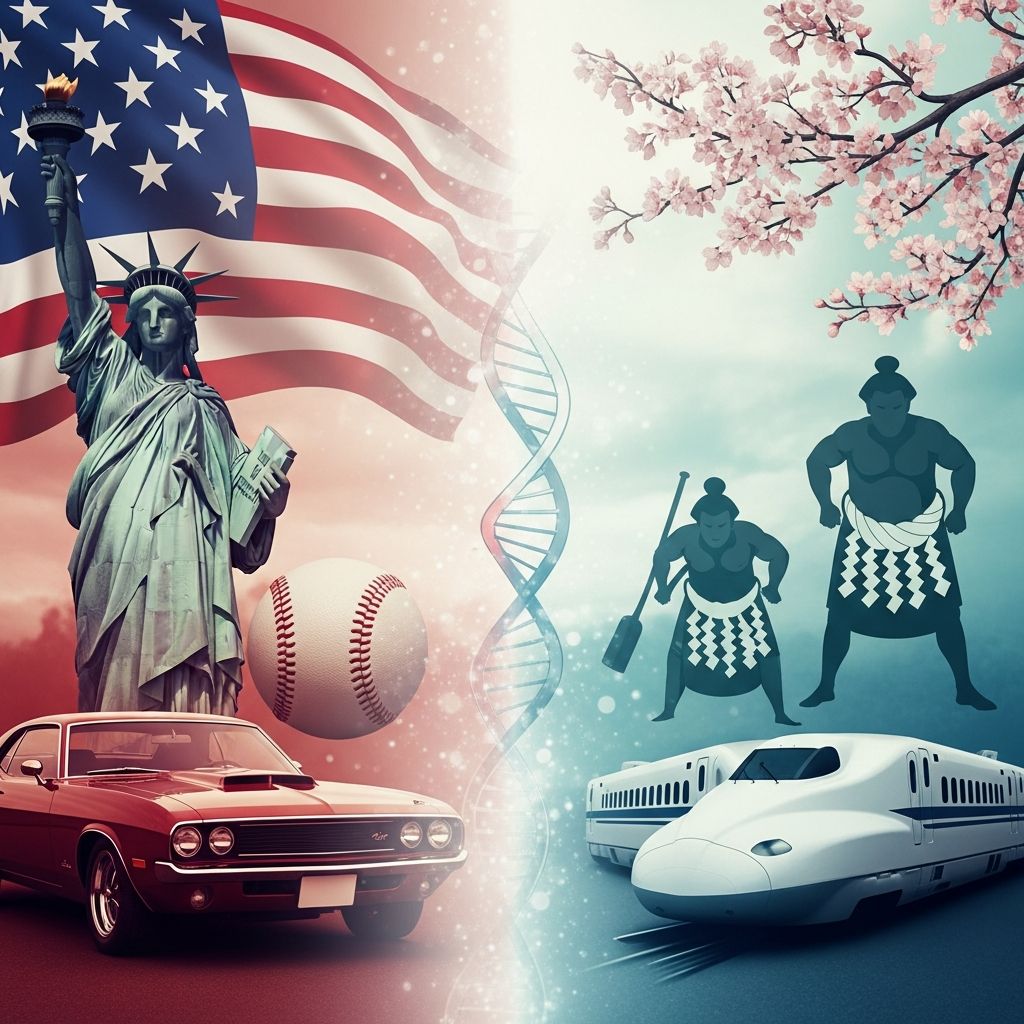
The United States and Japan are often contrasted as examples of two very different cultural worlds. From how people see themselves, to how they relate to others, to how they approach school and work, these societies highlight distinct ways that personality and culture intertwine. Understanding these differences can deepen empathy, improve cross-cultural communication, and help explain why people behave the way they do in different countries.
1. Cultural Foundations: Individualism and Collectivism
One of the most powerful lenses for comparing the United States and Japan is the distinction between individualism and collectivism. In cross-cultural psychology, individualistic cultures emphasize personal autonomy and self-expression, while collectivistic cultures stress social harmony, group loyalty, and interdependence.
- United States: Often ranked among the most individualistic societies. People are encouraged to “be themselves,” pursue personal goals, and stand out from the crowd.
- Japan: Frequently described as a collectivistic or interdependent culture, where individuals are expected to align with group expectations and maintain social harmony.
These underlying values shape how people think about identity, success, obligations, and even basic emotions such as pride and shame.
2. Self-Concept and Identity
Personality is deeply connected to how people answer the question, “Who am I?” The United States and Japan often foster contrasting self-concepts.
2.1 Independence vs Interdependence
Researchers describe two broad tendencies: independent self-construals and interdependent self-construals.
- United States – Independent Self: People tend to describe themselves in terms of internal traits and preferences (“I am creative,” “I like challenges”). Personal rights and self-esteem are central. Authenticity often means acting in line with one’s own wishes, even if this conflicts with others.
- Japan – Interdependent Self: People more often define themselves through social roles and relationships (“I am a daughter,” “I am part of this team”). Fitting in and fulfilling obligations to family, school, or company are highly valued.
2.2 Emotion and Social Harmony
- In the United States, open emotional expression and assertiveness are widely accepted, sometimes even rewarded in school and work settings.
- In Japan, emotional restraint is often seen as a sign of maturity and consideration. People may downplay personal feelings to avoid disturbing others, reflecting a cultural focus on harmony and modesty.
3. Everyday Social Behavior
The contrast between individualism and collectivism becomes very visible in daily routines, public behavior, and etiquette.
3.1 Public Space and Courtesy
- Public Transportation: In Japan, riders tend to stay quiet, give priority seating to those in need, and avoid behavior that might inconvenience others (such as loud phone calls or eating messy food). In many parts of the United States, norms are looser, conversations are louder, and personal comfort may take precedence.
- Cleanliness: Japanese cities are known for very clean public spaces, supported by strong social norms around not littering and taking personal responsibility for waste, even where trash cans are scarce. In the United States, expectations are more varied across regions and communities.
3.2 Greeting and Personal Distance
- United States: Handshakes, informal greetings, and relatively quick self-disclosure are common. Friendly small talk—even with strangers—is typical.
- Japan: Bowing is a core form of greeting, with depth and duration signaling respect and social status. Verbal greetings are polite but often more formal, and personal disclosure tends to come gradually as relationships deepen.
4. Family Life and Socialization
Family structures in both countries increasingly resemble a nuclear model, but the expectations within families reflect broader cultural values.
4.1 Parenting Styles and Expectations
- United States: Parenting often emphasizes encouraging independence, self-confidence, and personal choice. From an early age, children may be invited to express preferences and opinions.
- Japan: Parents frequently stress cooperation, empathy, and attentiveness to others’ needs. Children are socialized to anticipate group expectations and avoid standing out too much.
These differences align with research showing that Japanese childrearing often relies on modeling and subtle guidance rather than explicit commands or punishment, so that children internalize a sense of responsibility to the group.
4.2 Household Roles and Generational Ties
- Both societies have seen a shift away from traditional extended households toward smaller nuclear families, but multigenerational living remains somewhat more common in Japan.
- In the United States, family roles can vary widely due to ethnic, religious, and regional diversity, and there is growing acceptance of many different family structures.
5. School Culture and Learning Styles
Classrooms in the United States and Japan often embody each society’s core priorities: self-expression and initiative on one side, discipline and group cohesion on the other.
5.1 Classroom Norms
- United States: Students may be encouraged to ask questions, debate, and voice their own opinions. Participation is often graded, and speaking up is treated as a sign of engagement.
- Japan: Students are expected to listen carefully, follow the pace set by the teacher, and avoid interrupting. Group responsibility is important; for instance, students may share duties like cleaning classrooms, reinforcing the idea that maintaining order is a collective task.
5.2 Social Identity in School
- In Japanese schools, belonging to a class or club carries strong identity value. Uniforms and shared routines visually reinforce unity.
- In American schools, students often form smaller friendship groups and may be encouraged to develop unique interests, talents, and extracurricular identities.
6. Work, Motivation, and Professional Identity
Work culture reveals another striking contrast in how personality traits and values are expressed in each country.
6.1 Work as Personal vs Collective Project
- Japan: There is a strong tradition of long-term commitment to a single company and intense dedication to one’s role. The concept of shokunin—pride and mastery in one’s profession—captures the idea that every job, from executive to craftsperson, should be performed with care and social consciousness.
- United States: Careers are more likely to involve changing employers, switching fields, or starting new ventures. Work is frequently framed as a path to personal fulfillment, financial freedom, or self-realization, and individual achievement is highly valued.
6.2 Teamwork, Decision-Making, and Hierarchy
- Japanese organizations often prefer consensus-based decision-making, where input is gathered from multiple levels and departments before acting. This reflects the importance of group cohesion and the desire to avoid open conflict.
- American organizations typically place more authority in individuals or small leadership teams and may prioritize speed and accountability over broad consensus.
7. Personality Traits Across Cultures
Personality psychologists often use broad trait models (such as the Big Five: openness, conscientiousness, extraversion, agreeableness, neuroticism) to compare tendencies across cultures. Large-scale surveys suggest that there are modest average differences between countries, but also huge overlap between individuals.
| Dimension | United States (general tendencies) | Japan (general tendencies) |
|---|---|---|
| Extraversion | More direct verbal expression; outgoing behavior is usually acceptable, even with strangers. | Moderated public expression; social energy often directed toward in-groups rather than strangers. |
| Agreeableness & Harmony | Politeness important, but open disagreement is more tolerated, especially in debate or negotiation. | High emphasis on avoiding conflict, using indirect language, and maintaining smooth relationships. |
| Conscientiousness | Valued, especially in professional contexts; deadlines and productivity are important. | Strong focus on precision, reliability, and diligence, often combined with long working hours and meticulous attention to detail. |
Crucially, these are broad averages, not strict rules. There are highly independent-minded Japanese individuals and highly community-oriented Americans. Culture shapes probabilities, not destinies.
8. Diversity, Homogeneity, and Social Expectations
Another major difference lies in how diverse each society is and how that shapes personality expression and social norms.
- United States: Often described as a “melting pot” or “mosaic,” the country includes people from a wide range of ethnic, linguistic, and religious backgrounds. This diversity contributes to a wide variety of value systems, lifestyles, and personality expressions.
- Japan: Demographically much more homogeneous in terms of ethnicity and language, which can support strong shared norms and a clear sense of common identity, but may also heighten pressure to conform.
In a highly diverse environment, like many American cities, individuals may feel more freedom to seek out niche communities that match their personalities. In more homogeneous environments, like many Japanese communities, fitting the mainstream pattern may feel more important for social acceptance.
9. Why Cross-Cultural Personality Insights Matter
Understanding these differences is not about ranking cultures or deciding which way is “better.” Instead, it helps people:
- Avoid misinterpreting behavior (for example, reading Japanese reserve as disinterest, or American directness as rudeness).
- Adapt communication style when studying, working, or traveling abroad.
- Recognize how their own personalities have been shaped by cultural expectations.
- Appreciate that traits like independence and interdependence can complement each other.
Frequently Asked Questions (FAQs)
Q1: Are Americans always individualistic and Japanese always collectivistic?
No. These terms describe overall cultural patterns, not every person. There are many community-focused Americans and many strongly independent Japanese people. Culture influences tendencies and social norms, but personality also reflects family background, life experiences, and individual choices.
Q2: Do Japanese people dislike direct communication?
Directness is not necessarily disliked, but in many situations indirect or context-sensitive communication is preferred to avoid embarrassment or conflict. In close relationships or private settings, Japanese people may be more frank. Americans, by contrast, often view directness as honest and efficient, especially in problem-solving.
Q3: Is work-life balance worse in Japan than in the United States?
Japan has historically been associated with long working hours and strong loyalty to employers. In recent years, both countries have debated how to improve work-life balance, but the specific challenges differ. In Japan, reducing overwork is a major policy and public concern, while in the U.S., access to paid leave and job security are frequent topics.
Q4: How should I adjust my behavior when visiting Japan from the U.S.?
Small changes make a big difference: speak more quietly in public, avoid eating on public transportation, be punctual, and observe how others queue, pay, and greet. Showing effort to follow local norms is often appreciated even if you do not get everything perfect.
Q5: Can understanding these cultural differences improve teamwork?
Yes. Recognizing that colleagues may have different comfort levels with hierarchy, conflict, or self-promotion helps teams design better communication norms. For example, leaders can combine Japanese-style consensus building with American-style clarity about individual responsibilities.
References
- Markus HR, Kitayama S. Culture and the self: Implications for cognition, emotion, and motivation. — Psychological Review. 1991-01-01. https://doi.org/10.1037/0033-295X.98.2.224
- Cultures Represented in Everyday Life: Japanese and American Family, School, and Work. — Indiana State University Honors Thesis (K. Cogswell). 2021-01-01. https://scholars.indianastate.edu/handle/10484/14451
- Compare & Contrast: America and Japan. — Office of International Affairs, The Ohio State University. 2019-05-21. https://u.osu.edu/japan/2019/05/21/compare-contrast-america-and-japan/
- 7 Key Cultural Differences between US and Japan. — Bucket List Events. 2018-04-01. https://www.mybucketlistevents.com/cultural-differences-between-us-and-japan/
- Difference Between Japanese and American Culture. — Fluency Corp. 2020-09-01. https://fluencycorp.com/difference-between-japanese-and-american-culture/

Medha Deb is an editor with a master's degree in Applied Linguistics from the University of Hyderabad. She believes that her qualification has helped her develop a deep understanding of language and its application in various contexts. Medha specializes in the areas of beauty, health, sports, and wellness and is committed to ensuring that the content on the website is…