
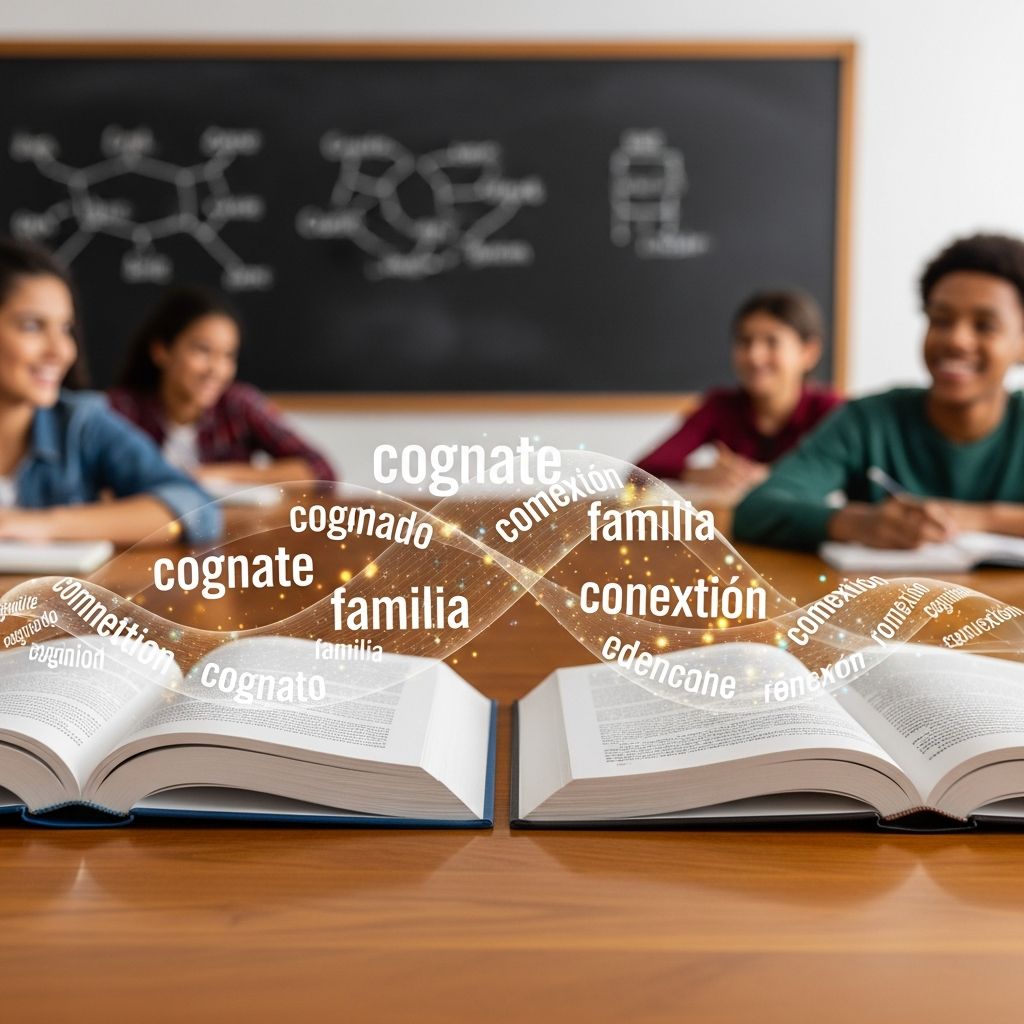
Cognates—words in different languages that share similar spelling, pronunciation, and meaning—serve as powerful bridges for students learning a new language, particularly in bilingual settings. By leveraging these linguistic connections, educators can significantly enhance vocabulary development and reading comprehension for emergent bilingual learners.
Understanding the Foundation of Cognates
Cognates arise from shared linguistic histories, such as the Latin roots common to English and Romance languages like Spanish, French, and Italian. For Spanish-English learners, over 30,000 cognates exist, making up a substantial portion of academic vocabulary. This overlap allows students to transfer knowledge from their home language to English, accelerating acquisition without starting from scratch.
Research highlights that cognate awareness—the ability to recognize and use these word similarities—directly correlates with improved second-language proficiency. Early exposure, even in preschool, builds this skill, enabling children to decode unfamiliar terms intuitively. As students advance, introducing complex cognates with nuanced meanings further refines their linguistic toolkit.
Evidence from Classroom Research
A key study in Illinois bilingual classrooms demonstrated the edge of cognate-focused instruction. Involving 25 second- and third-grade emergent bilingual students, including those with IEPs, the six-week intervention alternated English-only and bilingual cognate lessons using curriculum words from Wit & Wisdom ELA.
During cognate weeks, words were presented in both languages with images and sentences; English-only weeks used monolingual slides. Assessments via Google Forms showed cognate instruction yielding higher average scores (3.14 vs. 2.76), with 15 students outperforming their English-only results. Notably, even in English-only sessions, cognates outperformed non-cognates, proving their inherent advantage.
| Intervention Type | Average Score | Students with Higher Scores | Mean Gain |
|---|---|---|---|
| English-Only | 2.76 | – | – |
| Cognate-Based | 3.14 | 15/25 | 0.35 |
This data underscores cognates’ role in providing an academic boost, especially for students in transitional bilingual programs.
Practical Strategies for Cognate Integration
Effective cognate teaching requires explicit, structured activities. Begin with teacher modeling: highlight connections in spelling, sound, and meaning during read-alouds. Pause to discuss matches, inviting multilingual input from French or Portuguese speakers.
- Read-Aloud Engagement: Have Spanish speakers signal cognates; compare subtle differences like pronunciation.
- Sticky Note Hunts: Students mark cognates in texts, compiling a class chart for group review.
- Word Sorts: Pair English-Spanish cognate cards (e.g., family/familia, radio/radio) for sorting by patterns.
Advance to relationship-building: Use semantic mapping to link words by meaning, creating networked mental models over rote lists. Differentiated sorts explore similarities/differences, while grouping by grammar or theme fosters deeper analysis.
Addressing False Cognates
Not all look-alikes align: false cognates like English ‘pie’ (pie) vs. Spanish ‘pie’ (foot) or ‘exit’ vs. ‘éxito’ (success) demand caution. Dedicate time to ‘Circle Differences’ activities, where students mark divergent letters, and hunts for true vs. false pairs to build discernment.
| English | Spanish | Type |
|---|---|---|
| Family | Familia | True Cognate |
| Globe | Globo | False (balloon) |
| Magic | Magia | True Cognate |
| Rope | Ropa | False (clothes) |
Building Advanced Cognate Proficiency
Structured training is essential; students won’t spot cognates spontaneously under pressure, like exams. Metacognitive strategies—guessing from context, sounding similarities—require weeks of explicit practice across listening, reading, and writing.
Picture books offer an engaging entry: Integrate cognates into content-area lessons, using visuals to reinforce ties. Virtual small-group sessions, as in the Illinois study, prove scalable for diverse needs, including IEPs.
Benefits Across Learner Profiles
Cognates empower all: Monolingual teachers gain an accessible tool, while bilingual educators amplify cross-linguistic transfer. For emergent bilinguals, they create affirming spaces, boosting confidence and equity. Even non-cognate words benefit indirectly via heightened awareness.
- 15/25 students showed gains in the study.
- Cognates recalled at higher rates in monolingual settings.
- Supports IEPs and K-8 transitional programs.
Overcoming Common Pitfalls
Avoid assumptions: Don’t expect instant recognition. Overconfidence from easy wins can mask false cognates or gaps. Balance with systematic training to prevent mislearning. Research warns against shallow guessing; depth comes from repetition.
Long-Term Classroom Implementation
Embed cognates curriculum-wide: Weekly targets from ELA, sorted into charts. Partner work evolves to independent mapping. Track progress with pre/post assessments, adjusting for grade levels—simple for K-2, nuanced for 3+.
Collaborative grouping shares strategies, reinforcing community. For literacy, pair with Dr. Elsa Cárdenas-Hagan’s methods: Model examples, including false cognates, in instruction.
Frequently Asked Questions (FAQs)
What are cognates and why do they matter?
Cognates are similar words across languages sharing origins. They matter for rapid vocabulary building in bilingual education, leveraging existing knowledge.
How do cognates help emergent bilinguals?
They enable cross-language transfer, improving scores by 0.35 points on average per study, even in English-only contexts.
Can monolingual teachers use cognates?
Yes, simple lists and visuals suffice; explicit instruction benefits all educators.
What about false cognates?
Teach them explicitly via sorts and discussions to avoid confusion, like ‘soap’ vs. ‘sopa’ (soup).
How long to see results from cognate teaching?
Studies show gains in 3 weeks; sustained practice yields deeper proficiency.
Future Directions in Cognate Research
Expand to other language pairs (e.g., English-French) and digital tools. Longitudinal studies could quantify retention. Despite small samples, current evidence supports immediate adoption for equity.
In summary, cognates transform bilingual teaching from rote to relational, fostering confident, capable learners. (Word count: 1678)
References
- A Case for Teaching with Cognates — The Learning Agency Lab. 2023. https://the-learning-agency-lab.com/the-learning-curve/a-case-for-teaching-with-cognates/
- 6 Ways to Use Cognates to Support Second Language Literacy — Ignite Language. 2021-07-16. https://ignitelanguage.com/2021/07/16/6-ways-to-use-cognates-to-support-second-language-literacy/
- Using Cognates to Develop Comprehension in English — Colorín Colorado. N/A. https://www.colorincolorado.org/article/using-cognates-develop-comprehension-english
- Cognates: Their Power, Pitfalls and Untapped Potential — Gianfranco Conti. 2025-04-23. https://gianfrancoconti.com/2025/04/23/cognates-their-power-pitfalls-and-untapped-potential-and-implications-for-the-classroom/
- Teaching English Learners: Using Cognates to Teach Vocabulary — Reading Universe (YouTube). N/A. https://www.youtube.com/watch?v=PiWgSubZPq4

Medha Deb is an editor with a master's degree in Applied Linguistics from the University of Hyderabad. She believes that her qualification has helped her develop a deep understanding of language and its application in various contexts. Medha specializes in the areas of beauty, health, sports, and wellness and is committed to ensuring that the content on the website is…