
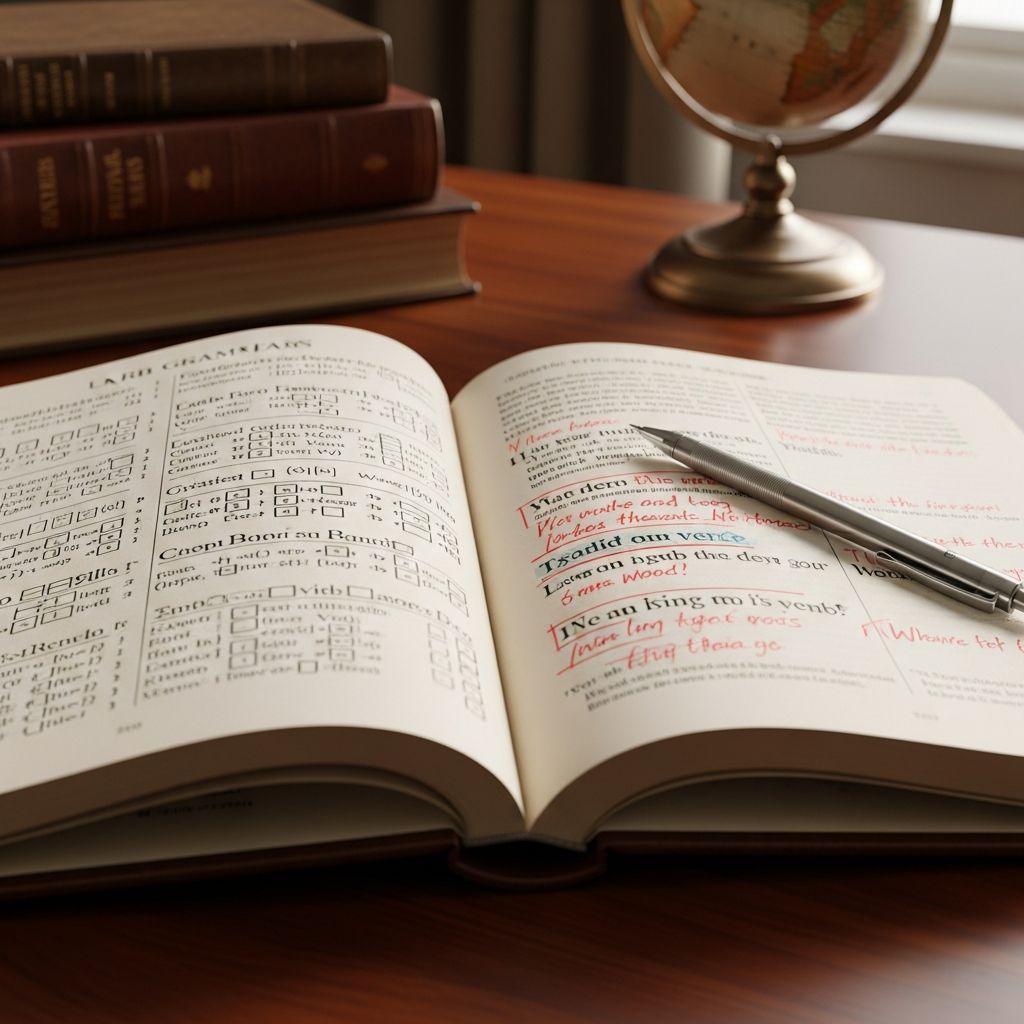
Verb conjugation represents a cornerstone of grammatical structure, enabling verbs to adapt their forms to convey precise meanings about actions, states, and occurrences. This process involves modifying the base or infinitive form of a verb to align with elements like subject identity, time frames, and contextual nuances.
Foundations of Verb Forms and Changes
At its core, conjugation alters verbs through inflection, where endings or auxiliary elements are added to the root form. This adaptation ensures sentences communicate who performs the action, when it occurs, and its completion status. Unlike nouns or adjectives, which undergo declension, verbs specifically conjugate to form finite expressions suitable for main clauses.
In English, the infinitive—often marked by ‘to’—serves as the starting point, such as ‘to run’ or ‘to speak’. Conjugation then produces variations like ‘runs’, ‘ran’, or ‘will run’, each carrying distinct implications.
- Person: Indicates the subject (I, you, he/she/it, we, they).
- Number: Singular or plural agreement.
- Tense: Past, present, future timelines.
- Mood: Indicative for facts, subjunctive for hypotheticals, imperative for commands.
- Voice: Active (subject acts) or passive (subject receives action).
- Aspect: Simple, progressive, perfect, or perfect progressive.
These categories interplay to create over a dozen forms per verb in English alone, multiplying across languages with richer systems.
Key Components Driving Conjugation
Understanding the six primary elements of conjugation clarifies why verbs shift. First, the performer of the action—person—affects endings: ‘I walk’ versus ‘she walks’. Number follows, distinguishing ‘we walk’ from ‘I walk’. Time placement via tense marks past ‘walked’ from present ‘walk’. Aspect reveals if actions continue (‘walking’) or complete (‘have walked’). Voice flips perspectives: ‘The dog chased the cat’ (active) to ‘The cat was chased by the dog’ (passive). Finally, mood conveys intent, like ‘Walk!’ (imperative).
| Element | Description | Example (Verb: Walk) |
|---|---|---|
| Person | Who acts | I walk / He walks |
| Number | Singular/Plural | She walks / They walk |
| Tense | Time frame | Walked (past) / Will walk (future) |
| Aspect | Duration/Completion | Was walking / Has walked |
| Voice | Active/Passive | Walks the path / Path is walked |
| Mood | Intent | Walk! (imperative) / If I walked (subjunctive) |
This table illustrates how ‘walk’ morphs systematically.
Regular Versus Irregular Patterns
English verbs divide into regular and irregular classes. Regular verbs follow predictable patterns, adding ‘-ed’ for past and perfect tenses, like ‘jump’ becoming ‘jumped’. Present third-person singular adds ‘-s’ or ‘-es’: ‘jumps’. These consistency aids learners.
Irregular verbs defy rules, demanding memorization. ‘Go’ conjugates as ‘goes’, ‘went’, ‘gone’; ‘be’ spans ‘am, is, are, was, were, been’. Over 200 exist, forming high-frequency words like ‘have’, ‘do’, ‘see’. Tables help mastery:
| Verb | Present | Past | Past Participle |
|---|---|---|---|
| Go | go/goes | went | gone |
| Be | am/is/are | was/were | been |
| Have | have/has | had | had |
| Do | do/does | did | done |
Conjugation classes group similar patterns, easing study.
Tense and Aspect Combinations
English boasts 12 tenses blending simple, progressive, perfect, and perfect progressive aspects across past, present, future.
- Simple Present: Habits/facts (I eat).
- Present Progressive: Ongoing now (I am eating).
- Present Perfect: Completed with present link (I have eaten).
- Present Perfect Progressive: Ongoing to now (I have been eating).
Future uses ‘will’ or ‘be going to’: ‘I will eat’ (prediction), ‘I am going to eat’ (plan). Past mirrors: ‘ate’, ‘was eating’, ‘had eaten’, ‘had been eating’. Mastering these via practice charts builds fluency.
Special Verb Categories
Modal auxiliaries like ‘can’, ‘must’, ‘should’ conjugate minimally, mainly adding ‘s’ in third person: ‘she can’, ‘he must’. They express ability, obligation, possibility without full infinitive forms.
Helping verbs pair with main verbs for complex tenses: ‘have’ for perfect, ‘be’ for progressive/passive. ‘To be’ stands out as highly irregular: present ‘am/is/are’, past ‘was/were’.
Imperatives drop subjects, using base form: ‘Run!’, plural ‘Let’s run!’. Subjunctives appear in wishes/conditions: ‘If I were rich’, ‘I suggest he go’.
Conjugation Across Languages
While English simplifies conjugation, others elaborate. Spanish verbs change per person/number/tenses, e.g., ‘hablar’ (to speak): hablo, hablas, habla… Romance languages feature extensive paradigms. Latin had four conjugations; Finnish agglutinates suffixes for nuance.
Some languages incorporate subject pronouns into verbs or use classifiers. English’s analytic nature relies more on auxiliaries than endings.
Practical Drills and Common Pitfalls
Practice via charts: conjugate ‘sing’ across tenses/persons. Pitfalls include irregular mix-ups (‘goed’ vs. ‘went’), subject-verb mismatch (‘he go’ vs. ‘he goes’), tense shifts in narratives.
- Tip 1: Memorize top 50 irregulars daily.
- Tip 2: Use apps for interactive drills.
- Tip 3: Read aloud to internalize patterns.
- Tip 4: Focus on context—tense signals time flow.
Non-native speakers benefit from comparative tables highlighting English quirks versus L1 systems.
Frequently Asked Questions
What exactly is verb conjugation?
Verb conjugation modifies a verb’s form to match person, number, tense, mood, voice, and aspect, creating contextually appropriate versions.
Why do English verbs have irregular forms?
Historical evolution preserved older roots; high-use verbs resisted regularization, like ‘be’ from Old English variants.
How many tenses does English have?
Twelve main tenses combine four aspects (simple, progressive, perfect, perfect progressive) with three time periods (past, present, future).
Do modals conjugate fully?
No, modals like ‘can’ or ‘will’ change little, mostly adding ‘-s’ for third-person singular; they lack infinitives or participles.
What’s the difference between conjugation and declension?
Conjugation applies to verbs for finite forms; declension handles nouns/adjectives for case, number, gender.
Advanced Applications in Writing
Proficient conjugation elevates prose: consistent tenses maintain narrative flow; varied moods add depth (subjunctive for unreal scenarios). In academic writing, precise voice controls focus—active for clarity, passive for objectivity. Poetry exploits irregularities for rhythm, as in Shakespeare’s ‘I am that I am’.
Programming languages mimic conjugation in function overloading, adapting based on parameters—analogous to person/number shifts.
For educators, gamified conjugation boosts retention: bingo with forms, races to conjugate sentences. Multilingual classrooms compare paradigms, revealing universals like tense-aspect marking.
References
- Grammatical conjugation – Wikipedia — Wikipedia contributors. 2023-10-15. https://en.wikipedia.org/wiki/Grammatical_conjugation
- How is ‘Verb Conjugation’ Defined? — BYJU’S. 2023-01-01. https://byjus.com/english/verb-conjugation/
- Conjugation – English Grammar Rules — Ginger Software. 2023-05-20. https://www.gingersoftware.com/content/grammar-rules/verbs/conjugations
- CONJUGATION Definition & Meaning — Merriam-Webster. 2026-04-01. https://www.merriam-webster.com/dictionary/conjugation
- Your Ultimate Guide to English Verb Conjugations — EnglishClass101. 2020-10-05. https://www.englishclass101.com/blog/2020/10/05/english-conjugations/
- Verb Conjugation–Grammar Rules — Grammarly. 2024-02-14. https://www.grammarly.com/blog/parts-of-speech/verb-conjugation/
- Verb Conjugation in English — Grammar Monster. 2023-11-10. https://www.grammar-monster.com/glossary/verb_conjugation.htm

- Integrated M.A. in Applied Linguistics, University of Hyderabad
- 5+ years in editorial, instructional, SEO, and research-based writing
Sneha is a relationships and lifestyle writer with a strong foundation in applied linguistics and certified training in relationship coaching. She brings over five years of writing experience to theskillvault, crafting thoughtful, research-driven content that empowers readers to build healthier relationships, boost emotional well-being, and embrace holistic living. Her writing and insights reflect the belief that beauty, happiness, and wellness…