
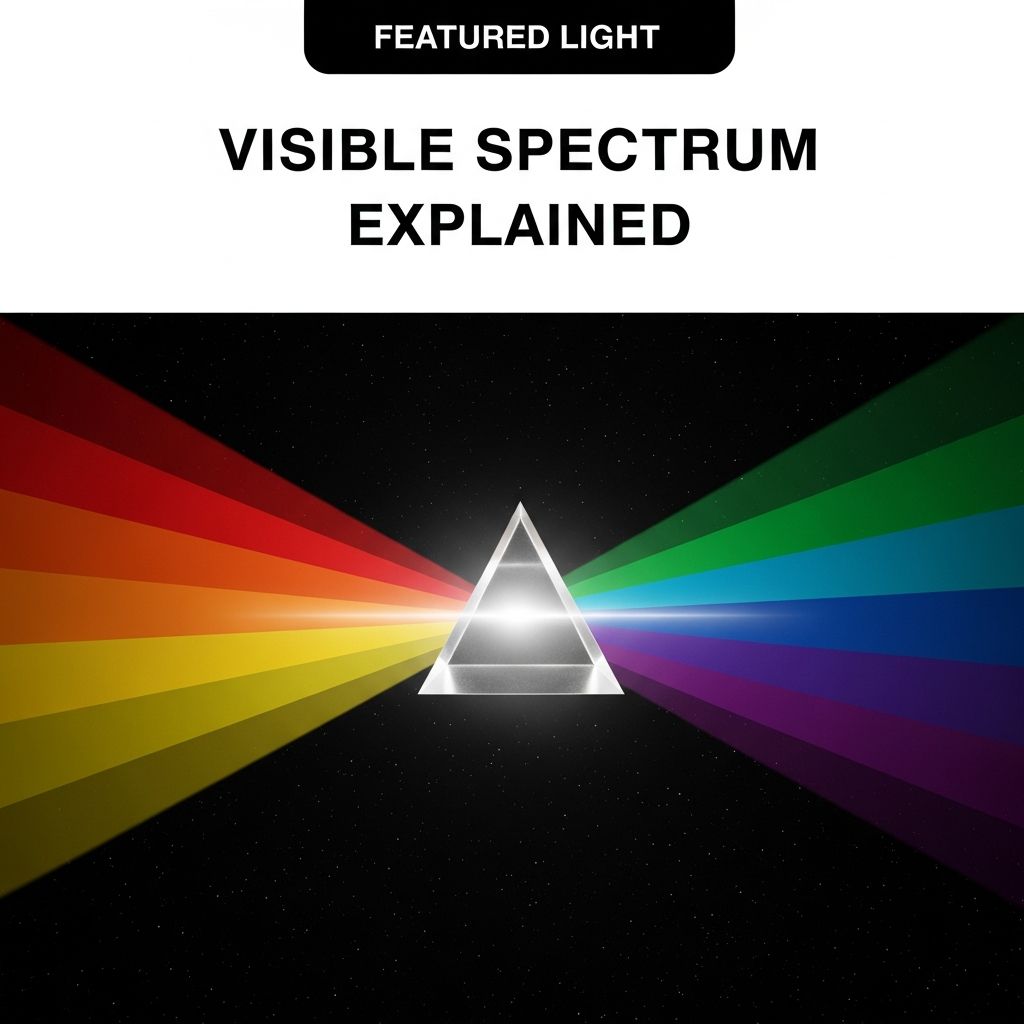
The visible spectrum represents the narrow band of electromagnetic radiation that human eyes can detect, spanning wavelengths roughly from 380 to 700 nanometers and producing the colors we see daily.
The Electromagnetic Context of Visible Light
Light exists as part of the vast electromagnetic spectrum, which includes radio waves, microwaves, infrared, ultraviolet, X-rays, and gamma rays. Visible light occupies a tiny portion, defined by wavelengths our biology can process. Electromagnetic waves are oscillations of electric and magnetic fields traveling at the speed of light, with properties like wavelength (distance between peaks) and frequency (cycles per second) inversely related by the equation c = λf, where c is the speed of light (3 × 10^8 m/s).
Shorter wavelengths correspond to higher frequencies and greater photon energy, measured in electron volts (eV). Red light photons carry about 1.8 eV, while blue ones deliver around 3.1 eV. This energy difference explains why ultraviolet (shorter than violet) can damage skin, while infrared (longer than red) feels like heat.
Defining the Boundaries of Visibility
Standard references cite the visible range as 380-700 nm (violet to red), but precise limits vary by individual, age, and light intensity. Under ideal conditions, young eyes may detect down to 310 nm (near-ultraviolet) or up to 1100 nm (near-infrared). The Commission Internationale de l’Éclairage (CIE) defines visible radiation as any optical radiation causing direct visual sensation, noting no sharp boundaries due to retinal sensitivity and source brightness.
Lens yellowing with age reduces short-wavelength sensitivity, limiting UV perception, while opsin proteins in cone cells tune peak responses: short (blue ~420 nm), medium (green ~530 nm), long (red ~560 nm). The luminous efficiency function combines these, peaking at 555 nm (green-yellow) where eyes are most sensitive.
Wavelengths and Corresponding Colors
Each color arises from specific wavelengths, though perception blends at edges. Here’s a breakdown:
| Color | Wavelength (nm) | Frequency (THz) | Photon Energy (eV) |
|---|---|---|---|
| Violet | 380–450 | 670–790 | 2.75–3.26 |
| Blue | 450–485 | 620–670 | 2.56–2.75 |
| Cyan | 485–500 | 600–620 | 2.48–2.56 |
| Green | 500–565 | 530–600 | 2.19–2.48 |
| Yellow | 565–590 | 510–530 | 2.10–2.19 |
| Orange | 590–625 | 480–510 | 1.98–2.10 |
| Red | 625–700 | 430–480 | 1.77–1.98 |
Data adapted from standard spectral divisions; values approximate as boundaries overlap. Violet’s short waves refract most in prisms, appearing first; red’s long waves least.
How Human Eyes Perceive the Spectrum
Vision relies on photoreceptors: rods for low-light grayscale (peaking ~500 nm) and cones for color. Three cone types enable trichromatic vision, comparing signals to discern millions of hues. White light, containing all wavelengths, splits via dispersion—demonstrated by Newton’s prism experiments separating sunlight into rainbows.
Atmospheric effects enhance perception: Rayleigh scattering disperses short blue/violet waves, making skies blue (violet scatters more but eyes less sensitive). Sunsets glow red as longer waves penetrate dust-laden air.
Scientific Demonstrations and Experiments
- Prism Separation: Pass white light through a glass prism; shorter violet bends more (higher refractive index), fanning into spectrum.
- Diffraction Grating: Grooved surfaces mimic prisms, producing spectra for spectroscopy.
- Blackbody Radiation: Heated objects glow red then white, illustrating Planck’s law where peak emission shifts with temperature (Wien’s displacement law).
- Laser Pointers: Monochromatic sources emit single wavelengths, e.g., 650 nm red, ideal for alignment without dispersion.
Applications Across Technology and Nature
Understanding the spectrum drives innovations:
- Photography and Displays: RGB pixels mimic cone sensitivities for lifelike images.
- Medicine: Lasers at 532 nm (green) coagulate tissue precisely; phototherapy uses blue light for jaundice.
- Astronomy: Spectrographs analyze starlight for composition, Doppler shifts revealing motion.
- Biology: Plants absorb red/blue for photosynthesis, reflecting green; insects see UV patterns on flowers.
In nature, chameleons shift skin cells to reflect wavelengths for camouflage, while birds detect UV for navigation/mating.
Common Misconceptions Clarified
Many believe the spectrum rigidly ends at 400-700 nm—false; it’s gradient, extending with intensity. Another: all see colors identically—no, tetrachromats (rare extra cone) perceive more. Rainbows aren’t new light but refracted sunlight; double rainbows invert via secondary reflection.
Frequently Asked Questions
Why is the sky blue?
Shorter blue wavelengths scatter more in atmosphere than red, per Rayleigh scattering.
Can humans see infrared or ultraviolet?
Typically no, but intense sources push limits to ~1100 nm IR or 310 nm UV in youth.
What determines a color’s wavelength range?
Cone opsin absorption peaks; blends create intermediates like magenta (no single wavelength).
How does white light form rainbows?
Dispersion separates wavelengths by refraction angle in water droplets.
Why green-yellow most visible?
Luminous efficiency peaks there, evolutionarily advantageous for survival.
Advanced Topics: Beyond Standard Visibility
Research explores hyperspectral imaging capturing 400-1000 nm for material identification. Quantum dots tune emission precisely for brighter LEDs. In quantum mechanics, light’s particle-wave duality means photons carry discrete energy E = hc/λ, explaining photoelectric effects.
Climate science uses visible spectra in remote sensing: vegetation indices ratio red/near-infrared reflectance. Future displays may exploit full optical window, enhancing VR realism.
The visible spectrum bridges physics and perception, underpinning art, engineering, and exploration. Its study reveals universe’s hidden patterns, from atomic fingerprints to cosmic redshifts.
References
- Visible Light – NASA Science — NASA. 2023. https://science.nasa.gov/ems/09_visiblelight/
- Visible spectrum – Wikipedia — Wikipedia contributors. 2023-10-01. https://en.wikipedia.org/wiki/Visible_spectrum
- Visible Light – UCAR Center for Science Education — UCAR. 2023. https://scied.ucar.edu/learning-zone/atmosphere/visible-light
- What is light? The visible spectrum and beyond – PMC — Sharpe LT et al. 2016-01-28. https://pmc.ncbi.nlm.nih.gov/articles/PMC4763133/
- Colour – Visible Spectrum, Wavelengths, Hues | Britannica — Britannica. 2023. https://www.britannica.com/science/color/The-visible-spectrum

Medha Deb is an editor with a master's degree in Applied Linguistics from the University of Hyderabad. She believes that her qualification has helped her develop a deep understanding of language and its application in various contexts. Medha specializes in the areas of beauty, health, sports, and wellness and is committed to ensuring that the content on the website is…