
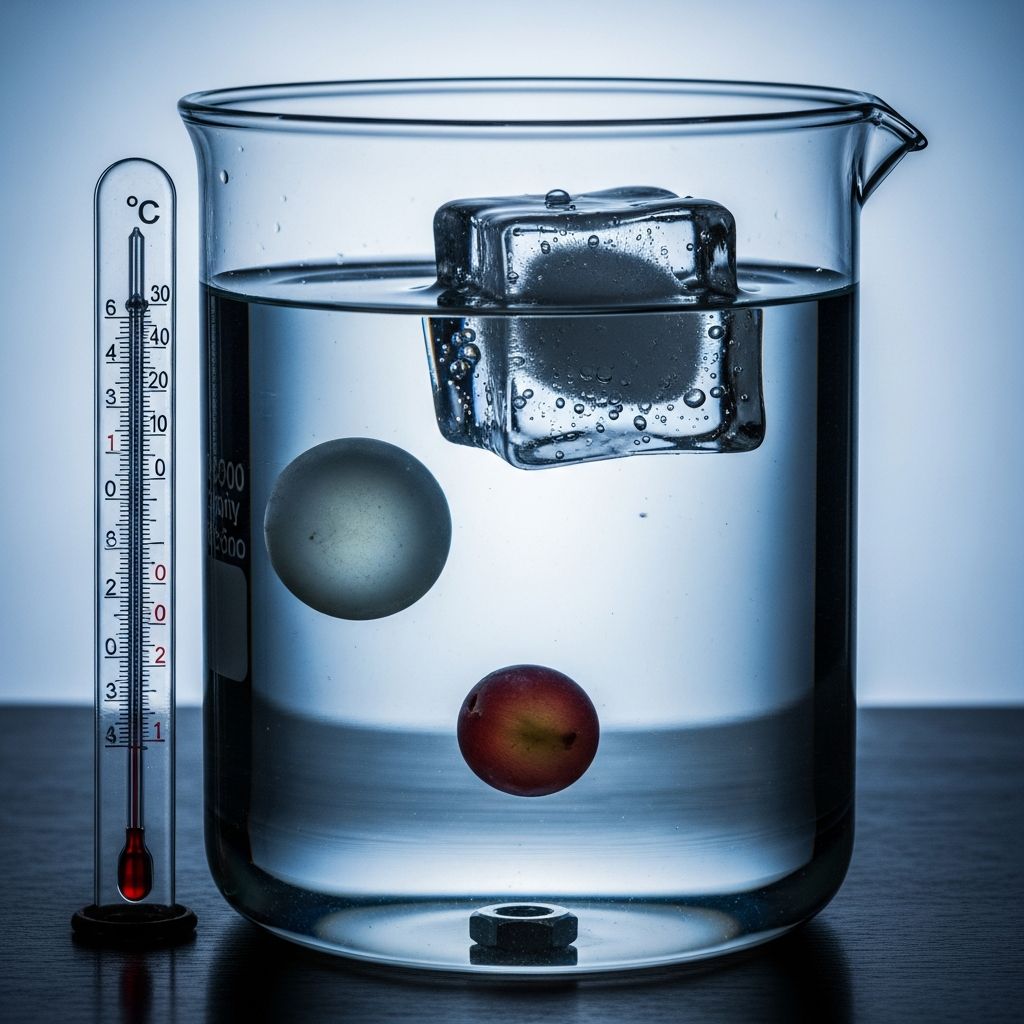
Water’s density is a cornerstone of physical chemistry, defined as mass per unit volume, typically around 1 gram per cubic centimeter under standard conditions. This value serves as a benchmark for comparing other substances and underpins numerous natural and industrial processes.
The Science of Density in Liquids
Density quantifies how much matter occupies a given space, calculated using the formula: density = mass / volume. For water, this yields about 1 g/cm³ or 1000 kg/m³ at 4°C, making it a reference standard in laboratories worldwide. Unlike most substances, water’s density does not decrease monotonically with rising temperature; instead, it exhibits an anomaly.
Temperature’s Impact on Water Density
Water reaches its highest density of approximately 0.99997 g/cm³ at 3.98°C. Below this point, cooling causes expansion due to hydrogen bonding forming an open structure, while above it, thermal expansion dominates, reducing density. At 0°C, liquid water’s density is 0.9998 g/cm³, dropping to about 0.958 g/cm³ at 100°C.
| Temperature (°C) | Density (g/cm³) |
|---|---|
| 0 | 0.9998 |
| 4 | 1.0000 |
| 20 | 0.9982 |
| 100 | 0.9584 |
This table illustrates the non-linear variation, highlighting the peak density near 4°C.
Why Ice Floats: The Density Anomaly
Unlike typical liquids, ice is less dense than liquid water, at about 0.917 g/cm³, causing it to float. This arises from hydrogen bonds locking molecules into a rigid, hexagonal lattice with more open space than in the liquid state. Upon freezing, water expands by roughly 9%, a property unique among common substances.
- Hydrogen bonds create tetrahedral arrangements in ice.
- Liquid water molecules pack more tightly due to dynamic bonding.
- This inversion prevents full freezing of water bodies from the bottom.
Hydrogen Bonding: The Root Cause
Water’s polarity—oxygen partially negative, hydrogens positive—enables hydrogen bonds. In liquid water, these bonds constantly form and break, allowing dense packing. In ice, stable bonds form an expansive network, reducing density. This explains high heat capacity, solvent properties, and the density maximum.
Ecological and Biological Significance
The floating ice insulates underlying liquid water, crucial for aquatic ecosystems. Lakes freeze from the top, preserving life below during winter. This property likely aided survival during ice ages, as surface ice protected deeper waters. In biology, it influences cell structures and organism buoyancy.
Industrial and Engineering Applications
Engineers account for density variations in pipelines, where water is often approximated at 1000 kg/m³ but adjusted for temperature. In oceanography, density gradients drive currents via thermohaline circulation. Hydropower and cooling systems rely on precise density knowledge.
Measuring Water Density Accurately
To measure, weigh a known volume of water. For any sample, density remains consistent at a fixed temperature because molecules pack uniformly. This characteristic property enables reliable calculations regardless of sample size.
- Use a graduated cylinder for volume.
- Balance for mass measurement.
- Calculate: D = m/V.
Variations Due to Impurities and Pressure
Pure water’s density is the standard, but salts increase it (seawater ~1.025 g/cm³). Pressure has minimal effect due to low compressibility (bulk modulus ~2.2 GPa), treating water as incompressible in many models.
Historical Context and Standards
The gram was originally defined as the mass of 1 cm³ of water at maximum density, linking density to metric standards. Modern definitions use more precise methods, but water remains the density archetype.
Everyday Examples and Experiments
Density explains why oil floats on water (0.92 g/cm³) and sugar sinks (1.59 g/cm³). A simple experiment: freeze water in a bottle—it cracks from expansion, demonstrating the anomaly.
Frequently Asked Questions (FAQs)
What is the density of water at room temperature?
Around 0.998 g/cm³ at 20°C, slightly less than at 4°C.
Why does ice float on water?
Ice’s open crystal structure from hydrogen bonds makes it ~9% less dense than liquid water.
Does water density change with salinity?
Yes, seawater is denser (~1.025 g/cm³) due to dissolved salts.
What temperature has the highest water density?
Approximately 3.98°C, with 1.000 g/cm³.
How does pressure affect water density?
Minimally; water is nearly incompressible under normal conditions.
Advanced Insights: Molecular Dynamics
Neutron scattering and simulations reveal tetrahedral networks in liquid water, akin to ice but dynamic. Below 4°C, cooling favors open structures; above, vibration disrupts them, leading to expansion.
Climate and Environmental Implications
Density-driven stratification affects nutrient distribution in oceans, influencing phytoplankton blooms and fisheries. Climate change alters temperature profiles, potentially disrupting these patterns.
Conclusion: Water’s Density in Perspective
Water’s density behavior, rooted in molecular interactions, shapes our world profoundly—from sustaining life to enabling technology. Its study reveals nature’s elegance.
References
- Properties of water — Wikipedia. 2023-10-01. https://en.wikipedia.org/wiki/Properties_of_water
- Properties of Water – Density — Pearson. Accessed 2026. https://www.pearson.com/channels/anp/learn/bruce/cell-chemistry-and-cell-components/properties-of-water-density-Bio-1
- Lesson 3.3: Density of Water — American Chemical Society. 2023-05-15. https://www.acs.org/middleschoolchemistry/lessonplans/chapter3/lesson3.html
- What Is the Density of Water? — Waterdrop Filter. 2024-02-20. https://www.waterdropfilter.ca/blogs/home-and-wellness/what-is-the-density-of-water
- Density of Water – Physical Properties — Flowstar Valve Shop. 2023-11-10. https://www.flowstarvalveshop.com/Catalogue/TECHNICAL-INFORMATION/Useful-Information/The-Density-of-Water-Physical-Properties-Variability-and-Practical-Implications

Medha Deb is an editor with a master's degree in Applied Linguistics from the University of Hyderabad. She believes that her qualification has helped her develop a deep understanding of language and its application in various contexts. Medha specializes in the areas of beauty, health, sports, and wellness and is committed to ensuring that the content on the website is…