
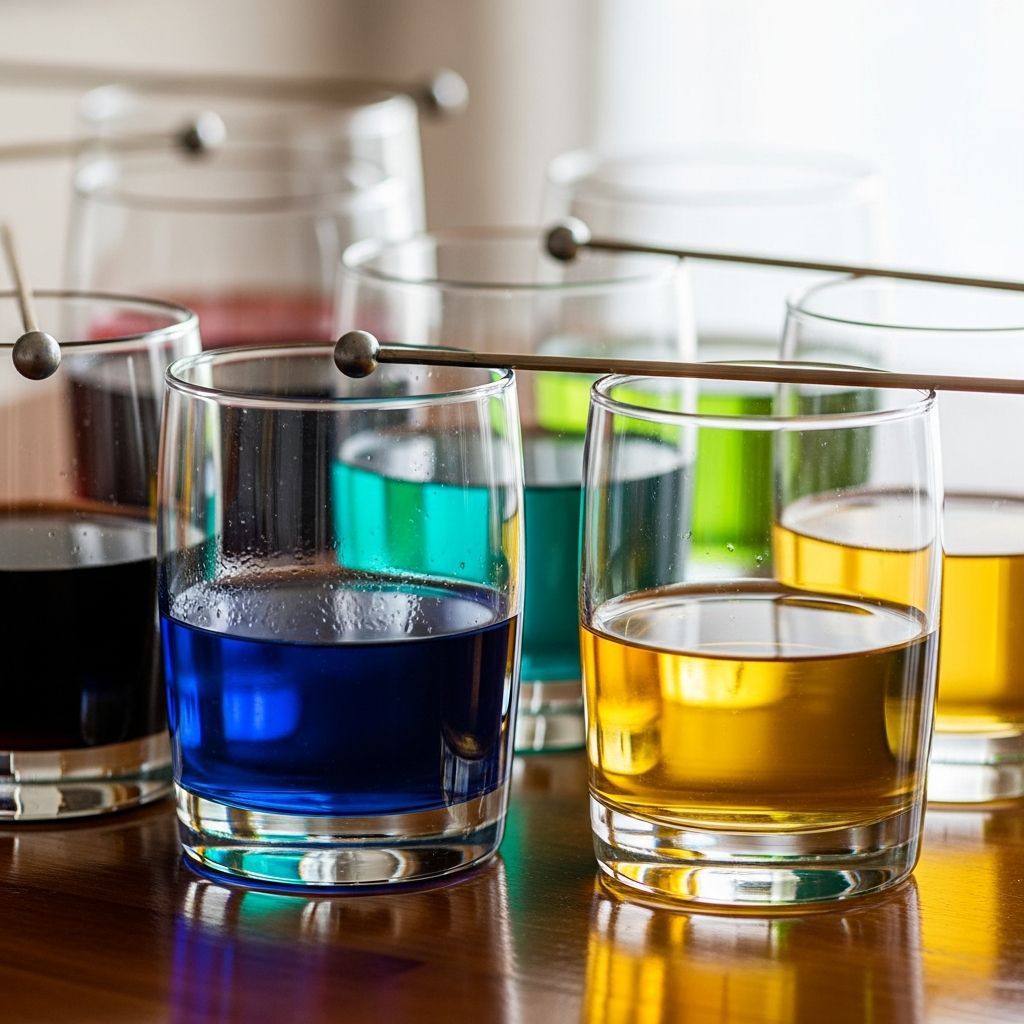
This engaging at-home experiment transforms ordinary glasses into a musical instrument, demonstrating core principles of acoustics through everyday items. By adjusting water levels, participants observe how vibrations produce varying pitches, offering an accessible entry into physics concepts like frequency and wave propagation.
Gathering Your Materials for the Experiment
To conduct this sound exploration, assemble a few basic household supplies. The simplicity ensures anyone can replicate it without special equipment.
- Five to eight identical clear glasses or jars, ensuring uniform size for consistent results.
- Room-temperature water, approximately two quarts to fill glasses variably.
- A metal spoon or wooden spoon for striking the glasses.
- Optional: Food coloring to visually distinguish water levels in each glass.
- A flat, stable surface like a table covered with a towel to dampen stray sounds.
Matching glass shapes are crucial because differences in material thickness or rim size could alter vibration patterns independently of water volume.
Step-by-Step Setup: Creating Your Water Xylophone
Follow these precise instructions to build your instrument and generate a scale of notes.
- Arrange the glasses in a row on the protected surface, spaced evenly for easy access.
- Fill the first glass nearly to the brim, leaving about half an inch of headspace.
- Progressively decrease water in subsequent glasses: second glass three-quarters full, third half full, fourth one-quarter full, and the last with just one inch at the bottom.
- Add a drop of food coloring to each if desired, stirring gently to create a rainbow effect without introducing bubbles that might interfere with vibrations.
- Test by tapping the rim of each glass lightly with the spoon, starting from the fullest.
Listen attentively: the fullest glass emits the deepest tone, while the emptiest rings highest. This gradient forms the basis of your xylophone scale.
Observing Pitch Changes: What You Hear and Why
Upon tapping, each glass resonates differently due to the interplay between glass and water. The sound originates from the glass’s vibration upon impact, which transfers through the liquid medium.
Glasses with more water produce lower pitches because the added mass dampens vibrations, slowing their frequency. Conversely, less water allows faster oscillations, yielding higher notes. This mirrors how string instruments use thicker strings for bass tones.
| Water Level | Expected Pitch | Vibration Speed | Analogy |
|---|---|---|---|
| Full (near brim) | Low (deep) | Slow | Bass guitar string |
| Half full | Medium | Moderate | Standard guitar string |
| Minimal (1 inch) | High (shrill) | Fast | Violin string |
This table summarizes the relationship, highlighting how mass influences auditory output.
Delving into the Physics: Vibrations and Sound Waves
Sound is a mechanical wave requiring a medium for propagation—here, the glass and water serve that role. Striking the glass disturbs its molecules, creating longitudinal waves that oscillate back and forth.
The pitch, or perceived highness/lowness, correlates directly with frequency: cycles per second measured in Hertz (Hz). Higher frequency means higher pitch. Water increases the effective mass, reducing frequency as per the formula for vibrating systems: \( f = \frac{1}{2\pi} \sqrt{\frac{k}{m}} \), where \( m \) is mass and \( k \) is stiffness.
Amplitude affects volume: harder taps amplify waves, making sounds louder before damping occurs. Touching a ringing glass halts vibrations instantly, proving their necessity for sustained tone.
These principles extend to real instruments; xylophones use tuned wooden bars of varying lengths to achieve similar effects.
Advanced Techniques: Tuning and Playing Melodies
Precision elevates this from demo to instrument. Measure water volumes exactly—start with 200ml in the fullest, decrementing by 25ml per glass—to match musical scales like C major.
Practice sequences: tap fullest for Do, next for Re, ascending to highest for Ti. Common tunes include “Hot Cross Buns” (three notes) or “Row Row Row Your Boat.” Fine-tune by adding/removing water dropwise until notes align harmoniously.
For richer tones, rub a wet finger around the rim. Friction generates continuous waves, producing a sustained “singing” effect. Vary water to modulate pitch similarly—less water raises the note.
Safety Guidelines and Best Practices
This experiment is family-friendly but requires care:
- Supervise children to prevent glass breakage or water spills.
- Use tempered glasses to minimize shatter risk.
- Avoid overfilling to prevent splashing during taps.
- Strike gently; excessive force dulls tones and risks cracks.
- Clean up spills immediately to avoid slips.
These measures ensure safe, repeated enjoyment.
Educational Extensions: Integrating into Learning
Broaden the lesson across disciplines. In math, graph water volume against pitch frequency using a smartphone tone app. Science curricula cover waves via NGSS standards on energy transfer.
Art fusion: paint glasses beforehand. History tie-in: Benjamin Franklin’s glass armonica used similar wet-glass rubbing for music in the 1700s.
Compare with bottles: blow across tops for inverse effect—more water raises pitch as air column shortens.
Common Questions Answered
Why does more water lower the pitch?
Increased mass slows vibrations, dropping frequency and thus pitch.
Can I use plastic cups?
Possible, but glass resonates clearer due to rigidity; plastic dampens too quickly.
How accurate are the notes for songs?
With measurement, precise enough for simple melodies; apps verify pitches.
What if glasses don’t match perfectly?
Variations cause off-notes; select closest matches or adjust water compensatorily.
Does temperature affect results?
Yes, warmer water slightly lowers pitch via density changes, but room temp suffices.
Why This Experiment Captivates Learners
Bridging sensory experience with abstract science, it fosters curiosity. Multisensory—visual water gradients, auditory scales, tactile taps—enhances retention. Scalable for ages 5-15, it builds confidence in experimentation.
Encourage iterations: test sugar water for pitch shifts or oils for wave interference. This iterative approach mirrors scientific method.
References
- Experiment: Music in a Glass — Science With Me. Accessed 2026. https://www.sciencewithme.com/experiment-music-in-a-glass/
- Simple Water Glass Xylophone — Home Science Tools Learning Center. Accessed 2026. https://learning-center.homesciencetools.com/article/simple-water-glass-xylophone/
- Musical Jars Science Experiment — Cool Science Experiments HQ. Accessed 2026. https://coolscienceexperimentshq.com/musical-jars/
- Kids’ Science Experiment to Make Music with Water — Hands On As We Grow. Accessed 2026. https://handsonaswegrow.com/make-music-water-experiment/
- Easy science experiment: Musical wine glasses — Rutgers University via NJ.com. 2015-02-14. https://www.youtube.com/watch?v=VmgZJ3F0jm8
- Musical Jars and the Science of Sound — Little Passports. Accessed 2026. https://www.littlepassports.com/blog/science/musical-jars-science-sound/

Medha Deb is an editor with a master's degree in Applied Linguistics from the University of Hyderabad. She believes that her qualification has helped her develop a deep understanding of language and its application in various contexts. Medha specializes in the areas of beauty, health, sports, and wellness and is committed to ensuring that the content on the website is…