
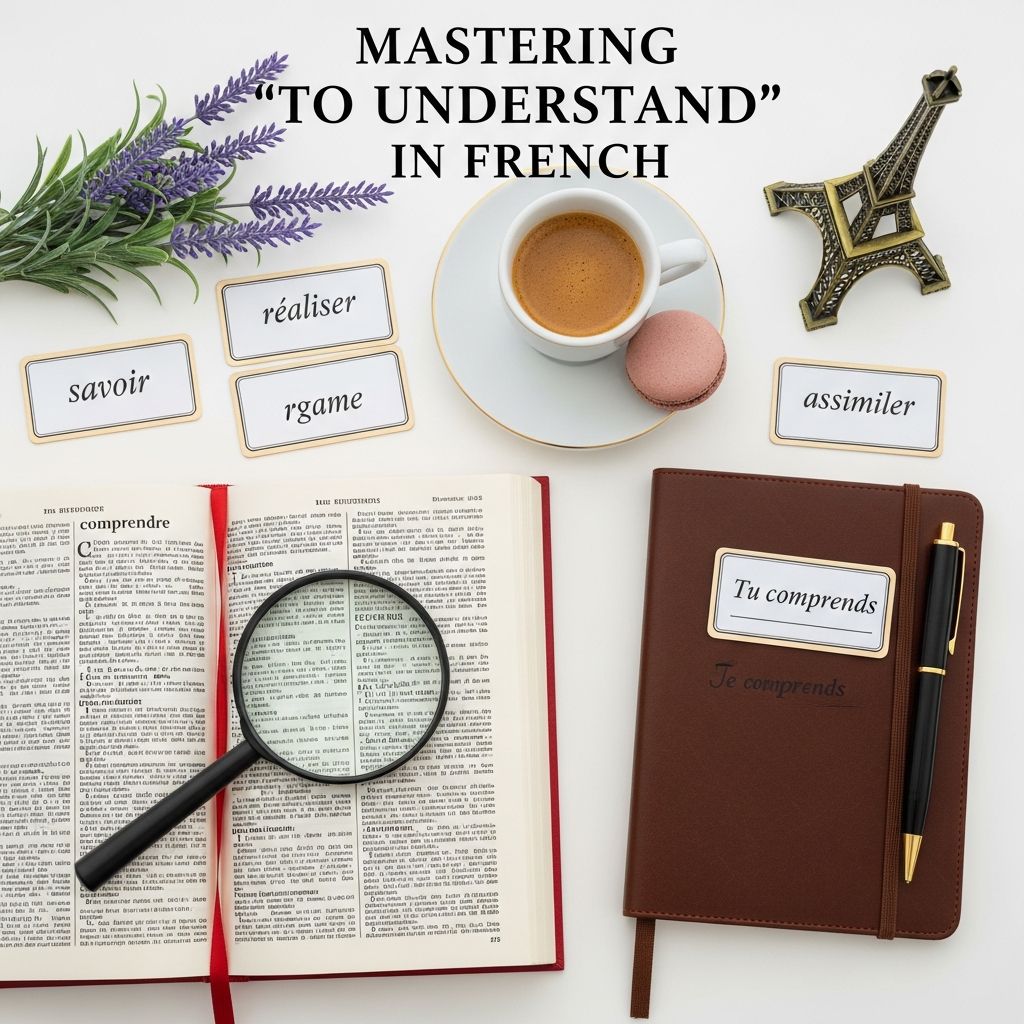
The ability to convey understanding is central to any language conversation. In French, while comprendre serves as the primary verb for ‘to understand,’ a variety of alternatives enrich expression depending on context, formality, and nuance. This guide explores these verbs comprehensively, offering conjugations, idiomatic uses, and practical advice to elevate your French proficiency.
Core Verb: Comprendre and Its Versatility
Comprendre stands as the cornerstone verb for expressing comprehension in French. It encapsulates mental grasp of ideas, empathy, or situational awareness, making it indispensable for daily interactions. This irregular verb conjugates like other -prendre verbs in the present tense: je comprends, tu comprends, il/elle/on comprend, nous comprenons, vous comprenez, ils/elles comprennent.
Typically transitive, it pairs with direct objects: Je comprends la règle (I understand the rule). It also extends to empathy: Je te comprends parfaitement (I totally get how you feel). With que, it introduces factual realizations: Il comprend que c’est important (He understands that it’s important).
Key idioms amplify its utility:
- Faire comprendre: To explain clearly, e.g., Je vais faire comprendre mon point de vue (I’ll make my viewpoint clear).
- Se faire comprendre: To ensure one’s message lands, e.g., En Chine, il a dû se faire comprendre par gestes (In China, he had to make himself understood through gestures).
Everyday Alternatives for Casual Contexts
For informal settings, French speakers often opt for simpler or regional verbs. Piger, popular in spoken French, conveys quick grasp: J’ai pigé l’idée (I got it). Similarly, capter implies tuning into something: Tu captes ce que je dis ? (Do you catch what I’m saying?).
Saisir adds a layer of immediacy, suitable for both casual and semi-formal talks: As-tu saisi le message ? (Did you grasp the message?). These options prevent repetitive use of comprendre, enhancing natural flow.
Formal Expressions of Comprehension
In professional or academic environments, precision matters. Percevoir denotes perceptive understanding, often sensory or subtle: Je perçois la différence (I perceive the difference). Beyond cognition, it means receiving payments, as in percevoir un salaire (to receive a salary), showcasing its multifaceted nature.
Déduire focuses on logical inference: De ces faits, j’en déduis la vérité (From these facts, I deduce the truth). This verb suits analytical discussions, distinguishing reasoned insight from basic comprehension.
Realization and Sudden Awareness
Capturing that ‘aha’ moment requires specific phrasing. While réaliser can imply becoming aware, its dominant sense is ‘to achieve’ or ‘to produce’: Il a réalisé son rêve (He achieved his dream). For true realization, prefer se rendre compte de: Je me rends compte de mon erreur (I realize my mistake). This pronominal phrase is idiomatic and reliable.
Another gem is cerner, meaning to grasp fully or outline mentally: Je ne cerne pas son caractère (I can’t quite figure out his personality). It excels in describing incomplete understanding.
Conjugation Tables for Key Verbs
Mastery demands memorizing patterns. Below are present tense tables for primary verbs.
| Subject | Comprendre | Saisir | Piger |
|---|---|---|---|
| Je | comprends | saisis | pige |
| Tu | comprends | saisis | pires |
| Il/Elle/On | comprend | sait | pige |
| Nous | comprenons | saisissons | pigeons |
| Vous | comprenez | saisissez | pigez |
| Ils/Elles | comprennent | saisissent | pigment |
Note: Piger is colloquial; use cautiously in formal settings. For full paradigms, consult resources like the Académie Française dictionary.
Common Pitfalls and Pro Tips
English speakers often misuse réaliser due to false cognates. Stick to se rendre compte for awareness. Context dictates choice: comprendre for empathy, saisir for quick uptake.
- Avoid over-relying on one verb; vary for fluency.
- Practice with negatives: Je ne saisis pas (I don’t get it).
- In questions: Est-ce que tu piges ? (Do you get it?).
Regional variations exist; Quebec French favors savoir or comprendre similarly.
Practical Examples in Context
Apply knowledge through scenarios:
- Classroom: L’élève comprend la théorie (The student understands the theory).
- Debate: Déduis-tu les implications ? (Do you infer the implications?).
- Friendship: Je perçois ta frustration (I sense your frustration).
- Travel: Se faire comprendre à l’étranger (Making oneself understood abroad).
Frequently Asked Questions (FAQs)
What’s the difference between comprendre and saisir?
Comprendre is general comprehension; saisir implies faster, firmer grasp, often immediate.
How do you say ‘I don’t understand’ politely?
Use Je ne comprends pas or formally Pourriez-vous reformuler ? (Could you rephrase?).
Is piger appropriate for writing?
No, it’s strictly oral and informal; opt for comprendre in emails or essays.
Can réaliser mean ‘to understand’?
Rarely; it primarily means ‘to accomplish.’ Use se rendre compte instead.
How to conjugate comprendre in past tense?
Passé composé: j’ai compris; imparfait: je comprenais.
Advanced Usage and Idioms
Delve deeper: Comprendre à demi-mot (to understand without words). Avoir compris signals full agreement: J’ai compris, chef ! (Got it, boss!). These elevate speech to native levels.
In literature, verbs like percevoir appear in Proust for subtle insights, while déduire fits detective novels.
To internalize, immerse via podcasts or apps repeating dialogues. Track progress by narrating daily events using varied verbs.
References
- 9 Ways to Say ‘To Understand’ in French — GoSimplyFrench. 2023-10-15. https://gosimplyfrench.com/blog/9-ways-to-say-to-understand-in-french/294cd2e1-d4c4-8153-9aff-ebbb28e81c9e
- Comprendre – French Word of the Day — The Perfect French. 2024-05-20. https://theperfectfrench.com/french-word-of-the-day/comprendre/
- Comprendre: Meaning, Pronunciation, and Examples — French Learner. 2023-11-10. https://www.frenchlearner.com/french-word-of-the-day/comprendre/
- Le Bon Usage — Grevisse & Goosse. Académie Française (official reference). 2022-01-01. https://www.academie-francaise.fr/le-bon-usage

Medha Deb is an editor with a master's degree in Applied Linguistics from the University of Hyderabad. She believes that her qualification has helped her develop a deep understanding of language and its application in various contexts. Medha specializes in the areas of beauty, health, sports, and wellness and is committed to ensuring that the content on the website is…