
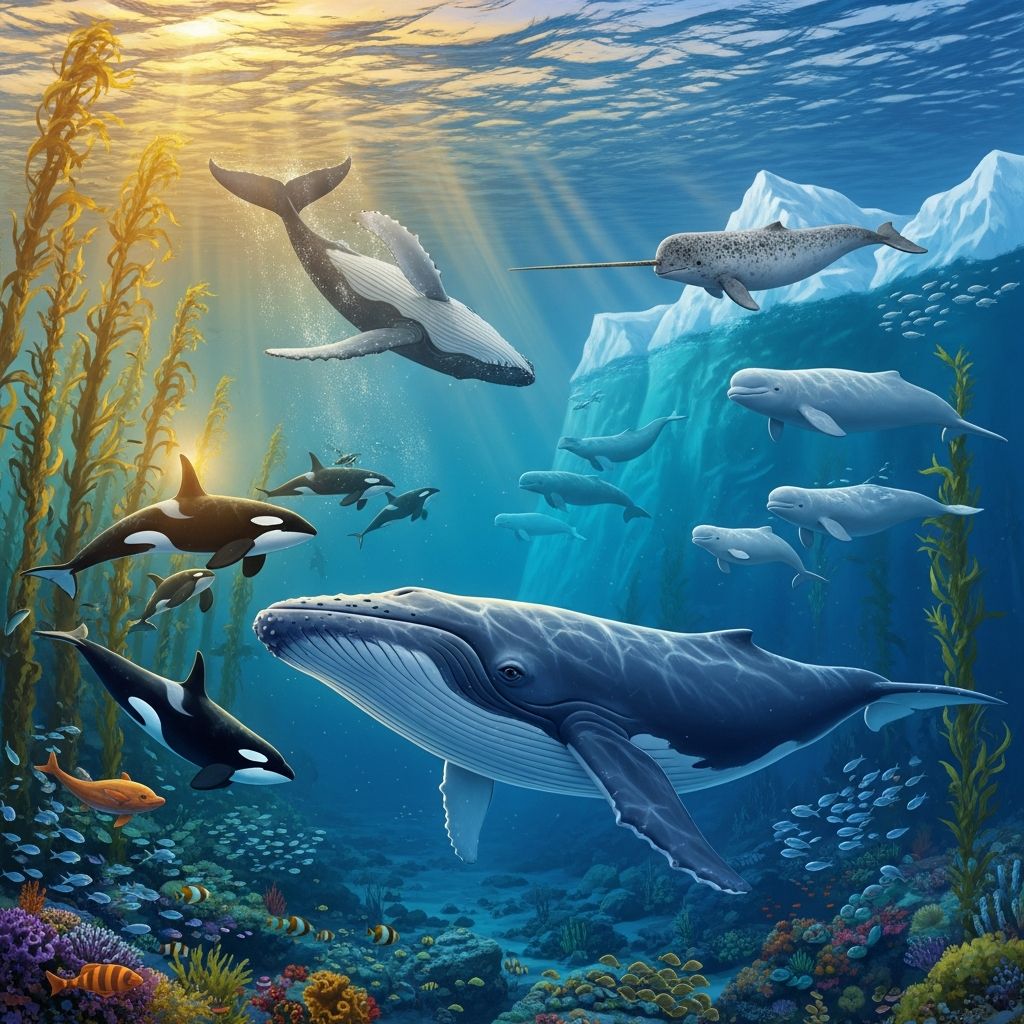
Whales, the largest creatures on Earth, captivate scientists and nature enthusiasts alike with their immense size, complex behaviors, and essential roles in marine ecosystems. Belonging to the order Cetacea, these air-breathing mammals have evolved into two primary groups: baleen whales (Mysticeti) and toothed whales (Odontocetes). Baleen whales filter-feed on tiny prey like krill, while toothed whales hunt fish, squid, and even other mammals. This article delves into their classifications, standout species, habitats, and the urgent conservation needs facing these ocean titans.
Classifying Whales: Baleen vs. Toothed
Baleen whales, numbering around 16 species, possess flexible plates of baleen in their mouths instead of teeth. These plates act like sieves, trapping small organisms from vast gulps of seawater. Ranging from the pygmy right whale to the colossal blue whale, they dominate as the largest animals ever known. Toothed whales, with over 70 species, feature conical teeth suited for grasping prey. This group includes familiar names like sperm whales and orcas, showcasing greater agility and social complexity.
The distinction traces back to evolutionary divergence millions of years ago. Baleen whales adapted to abundant plankton-rich waters, developing throat pleats for engorging massive water volumes. Toothed whales honed predatory skills, with echolocation aiding hunts in dim depths. Understanding these categories reveals how whales influence food webs, from nutrient cycling in polar seas to controlling squid populations.
Gigantic Baleen Whales: Filter-Feeding Marvels
Baleen whales represent nature’s engineering feats, with bodies streamlined for long migrations and energy-efficient feeding. Their songs and breaches add acoustic and visual spectacles to ocean life.
The Blue Whale: Earth’s Largest Inhabitant
The blue whale (Balaenoptera musculus) holds the title of the planet’s biggest animal, stretching up to 100 feet and weighing as much as 200 tons. Its mottled blue-gray skin and tiny dorsal fin distinguish it. Feeding primarily on krill, a single blue whale consumes up to 4 tons daily during summer feasts in polar regions. These gentle giants migrate thousands of miles to warmer breeding grounds, vocalizing with powerful low-frequency calls that travel vast distances.
Humpback Whales: Acrobats of the Sea
Humpback whales (Megaptera novaeangliae) thrill observers with breaches, flips, and haunting songs lasting hours. Growing to 60 feet, they sport long pectoral fins—one-third of body length—and knobby tubercles on their heads. These rorquals lunge-feed on krill and small fish, using expandable throat grooves. Famous for annual migrations from high-latitude feeding zones to tropical calving areas, humpbacks gather in groups called pods.
Fin Whales: Speed Demons of the Depths
Dubbed “grayhounds of the sea,” fin whales (Balaenoptera physalus) reach speeds of 23 mph, second only to blue whales in size at 80 feet long. Their asymmetrical jaw—one side pale, the other dark—sets them apart. These fast swimmers gulp krill near the surface, their V-shaped water spout a field ID clue. Found worldwide, they prefer deep offshore waters.
- Key Baleen Traits: Baleen plates, throat pleats, double blowholes.
- Habitat Range: Polar to tropical oceans, with seasonal migrations.
- Feeding Style: Lunge or skim feeding on plankton.
Swift Toothed Whales: Hunters and Socialites
Toothed whales excel in predation and communication, using a single blowhole and melon-shaped foreheads for echolocation. Their diversity spans from deep-sea divers to coastal pod-dwellers.
Sperm Whales: Masters of the Abyss
Sperm whales (Physeter macrocephalus), the largest toothed whales, dive over 3,000 meters for giant squid, holding breath for 90 minutes. Males reach 60 feet with massive, squared heads housing spermaceti organs for buoyancy and sonar. Females and calves form matrilineal groups, while males roam solitarily. Their iconic bushy spout angles forward.
Orcas: Apex Predators with Culture
Orcas (Orcinus orca), or killer whales, blend dolphin agility with wolf-like pack hunting. Males’ towering dorsal fins reach 6 feet, contrasting females’ curved ones. Distinct ecotypes—residents (fish-eaters in pods), transients (mammal-hunters), and offshore types—show genetic and behavioral variations. Intelligent and matriarchal, they use coordinated tactics to catch prey.
Beluga Whales: Arctic Canaries
Belugas (Delphinapterus leucas), nicknamed sea canaries for chirps and whistles, thrive in Arctic waters up to 15 feet long. Their flexible necks, small dorsal ridges, and white skin aid ice navigation. Highly social, they gather in hundreds for river estuaries, feeding on fish and invertebrates.
| Species | Max Length | Key Feature | Primary Diet |
|---|---|---|---|
| Sperm Whale | 60 ft | Squared head | Squid |
| Orca | 32 ft | Tall dorsal fin | Fish, seals |
| Beluga | 15 ft | White skin | Fish, crustaceans |
Lesser-Known Wonders: Beaked and Beyond
Beyond icons, beaked whales like Baird’s (up to 42 feet with bulbous foreheads) and Northern bottlenose types dive deepest, evading easy study. Gray whales, technically baleen but bottom-feeders, migrate 12,000 miles along coasts, scarred by barnacles. Minke whales, the smallest baleen at 30 feet, flash white flipper bands while shyly surfacing. Emerging studies spotlight Omura’s and Bryde’s whales, with tropical habits and unique ridges.
Migrations, Behaviors, and Ecosystem Roles
Whales undertake epic journeys: grays from Arctic to Baja lagoons, humpbacks across basins. Songs facilitate mating and navigation; breaches may dislodge parasites or signal. As nutrient recyclers, their feces fertilize phytoplankton blooms, sustaining fisheries. Predatory toothed whales regulate prey, preventing overpopulation.
Conservation Challenges Facing Whales
Despite protections, threats persist: ship strikes doom right whales (under 350 North Atlantics left), entanglements snare humpbacks, noise disrupts echolocation. Climate change alters prey distribution, stranding species like bowheads. International efforts by bodies like the IWC aim to curb bycatch and whaling remnants. Recovery stories, like humpbacks rebounding from near-extinction, inspire hope.
Frequently Asked Questions (FAQs)
What is the largest whale species?
The blue whale is the largest, exceeding 100 feet in length and 200 tons in weight.
Are orcas whales or dolphins?
Orcas are the largest dolphins but classified as toothed whales (Odontocetes).
How do baleen whales eat without teeth?
They use baleen plates to filter krill and plankton from seawater engulfed in huge gulps.
Why do humpback whales sing?
Males sing complex songs during breeding seasons, possibly for mating displays or territory.
What threatens whale populations today?
Primary threats include fishing gear entanglement, vessel collisions, ocean noise, and habitat loss from climate change.
References
- Whales, Dolphins and Porpoises — Oregon Department of Fish and Wildlife. 2023. https://myodfw.com/wildlife-viewing/species/whales-dolphins-and-porpoises
- 24 Types of Whales: Explore Whale Species Diversity — MyFahlo. 2023. https://www.myfahlo.com/blogs/wildlife/types-of-whales
- Types of whales: meet the largest animals in the ocean — International Fund for Animal Welfare (IFAW). 2023. https://www.ifaw.org/journal/types-of-whales
- Whales and Dolphins — Hawaii Division of Aquatic Resources (DLNR). 2023. https://dlnr.hawaii.gov/dar/whales-and-dolphins/
- Whale Species Spotlight — NOAA Office of National Marine Sanctuaries. 2023. https://sanctuaries.noaa.gov/education/teachers/whales/species-spotlight.html
- Whale Species — International Whaling Commission (IWC). 2023. https://iwc.int/about-whales/whale-species

Medha Deb is an editor with a master's degree in Applied Linguistics from the University of Hyderabad. She believes that her qualification has helped her develop a deep understanding of language and its application in various contexts. Medha specializes in the areas of beauty, health, sports, and wellness and is committed to ensuring that the content on the website is…