
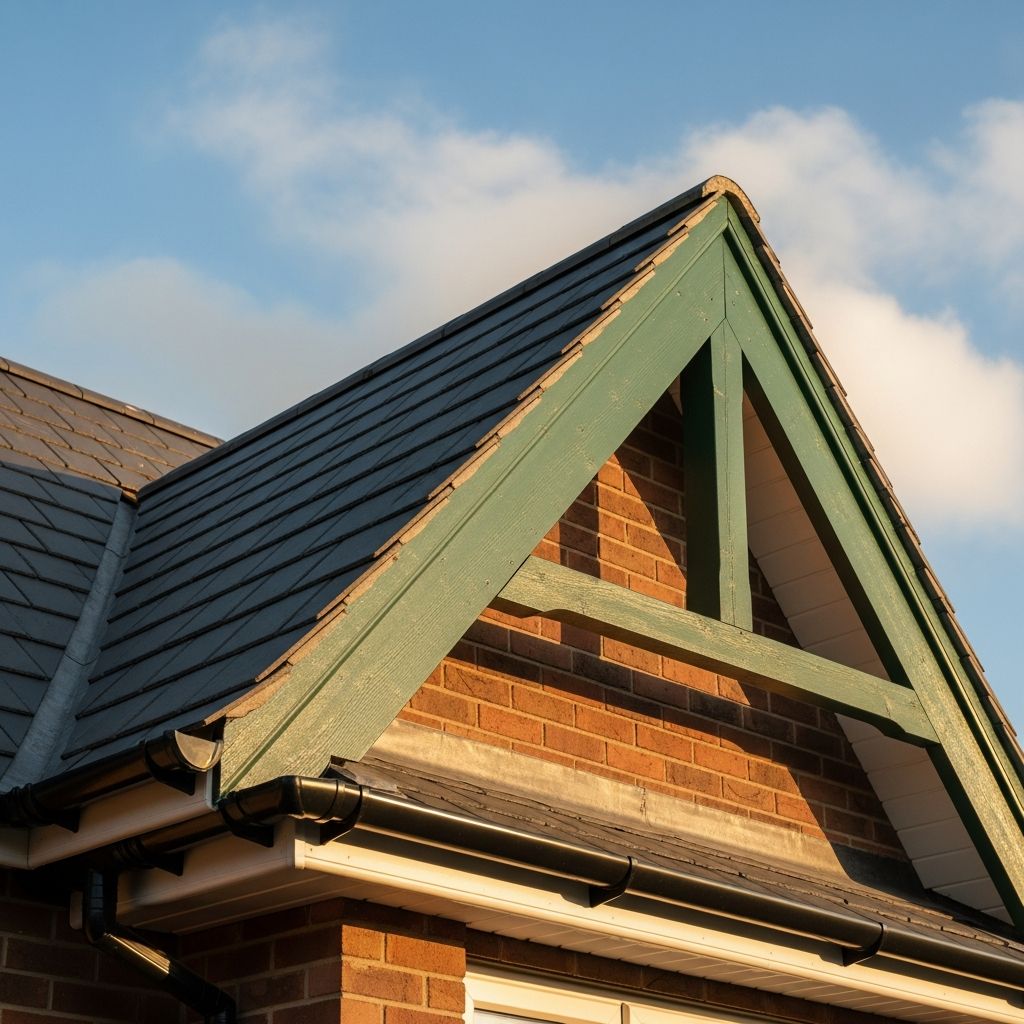
Bargeboards, known also as vergeboards or rake fascia, form a crucial component of gable roof designs by securing and concealing the sloping edges where the roof meets the gable end. These boards not only safeguard vulnerable roof structures from environmental damage but also contribute significantly to a building’s visual appeal.
Defining the Anatomy of a Bargeboard
A bargeboard is fundamentally a structural and decorative panel affixed along the inclined verge of a gable roof. Positioned at the triangular gable extremities, it extends from the roof peak down to the eaves, mirroring the roof’s slope. Typically dimensioned at 1-2 inches in thickness and 6-12 inches in width, this trim element overlays the exposed ends of roof decking, rafters, and purlins.
By hiding these raw timber ends, bargeboards prevent moisture penetration, which could otherwise cause rot and structural weakening. In essence, they act as a barrier at one of the roof’s most exposed junctions, ensuring longevity and integrity. Unlike standard fascia boards that run horizontally along the eaves, bargeboards follow the diagonal rake, demanding precise fitting to match the roof’s pitch.
Historical Evolution of Bargeboards in Architecture
The origins of bargeboards trace back to the 14th century, with surviving examples showcasing their early adoption in ecclesiastical and residential timber-framed structures. Initially functional, these boards evolved into elaborate features during the late medieval period in Europe, particularly in England.
Architects adorned them with intricate carvings, including cusped edges, trefoil and quatrefoil piercings, foliate spandrels, and feathered motifs culminating in floral accents. This ornate style peaked in Tudor England and persisted into the 19th-century Gothic Revival movement, where bargeboards often supported hip-knobs at gable apexes.
In church porches and wooden gabled homes, bargeboards became ubiquitous, projecting outward to either sheath genuine rafters or mimic them as false ones. Their scarcity on principal church roofs underscores a preference for subtler designs in grander applications. The term ‘bargeboard’ likely derives from Medieval Latin ‘bargus’ or ‘barcus,’ denoting a scaffold, rather than the obsolete ‘vergeboard,’ highlighting their protruding nature.
Core Functions: Protection and Aesthetic Enhancement
Bargeboards fulfill dual roles in contemporary and traditional roofing. Primarily, they provide weatherproofing by sealing gaps at the roof verge, deflecting rain, wind-driven moisture, and debris away from underlying timbers. This protection averts rot in rafter tails and decking, preserving the roof’s structural stability.
Additionally, they reinforce the roof framework, tying together stringers or purlins across the gable edge, which adds rigidity against wind uplift and sagging. Aesthetically, bargeboards unify the roofline, concealing utilitarian elements and allowing for stylistic expression—from Victorian gingerbread scrollwork to sleek modern profiles.
Well-maintained bargeboards can dramatically elevate a property’s curb appeal, framing the gable like an inverted ‘V’ and harmonizing with fascia and soffits.
Material Options for Modern Bargeboard Applications
Selecting the right material balances durability, maintenance needs, and design goals. Here’s a comparison:
| Material | Pros | Cons | Best For |
|---|---|---|---|
| Timber | Classic aesthetic, customizable carving; cost-effective initially | Prone to rot, insect damage, requires painting/sealing | Historical restorations, decorative features |
| uPVC/Plastic | Weather-resistant, low-maintenance, rot-proof | Less authentic look, can discolor over time | Modern homes, high-exposure areas |
| Metal (Aluminum/Steel) | Extremely durable, lightweight, fire-resistant | Higher cost, potential corrosion if not coated | Commercial builds, coastal regions |
| Fiberglass Composites | Strong, versatile shapes, UV-stable | Premium pricing | Custom designs, harsh climates |
Traditional timber dominated early uses but has largely yielded to synthetics like uPVC for their superior resistance to moisture and pests. Profiles vary—bullnose, ogee, square—to complement fascia styles and roof colors.
Installation Techniques for Optimal Performance
Installing bargeboards demands precision post-roof decking but pre-final roofing layers. Key steps include:
- Measure and Cut: Match the gable slope exactly, allowing for overhangs.
- Secure Framing: Attach to rafter ends or dedicated ledger boards using galvanized nails or screws.
- Seal Joints: Apply high-quality caulk at eaves and peak connections to block water ingress.
- Integrate Gutters: Notch for gutter brackets if extending fascia integration.
- Finish: Prime and paint, or cap with aluminum for hybrid protection.
Professional installation ensures alignment, preventing leaks that compromise the entire roof system. In renovations, removing old bargeboards reveals often-neglected rafter damage requiring prior repair.
Common Challenges and Proactive Maintenance Strategies
Despite their robustness, bargeboards face threats like UV degradation, freeze-thaw cycles, and vegetative growth. Timber variants suffer rot from prolonged wetting, while uPVC may warp under extreme heat.
Regular inspections—biannually, focusing on joints and undersides—catch issues early. Clean debris, reapply sealants, and trim encroaching plants. Damaged sections warrant full replacement to avoid cascading failures.
For historic properties, matching original profiles preserves authenticity, often necessitating custom milling. Modern replacements prioritize low-maintenance materials to minimize long-term costs.
Design Inspirations: From Victorian Opulence to Contemporary Minimalism
Bargeboards offer endless customization. Victorian-era homes boast ‘gingerbread’ with lacy cutouts and brackets, evoking romantic grandeur. Gothic Revival examples feature pointed arches and tracery, echoing ecclesiastical motifs.
Today’s architects favor streamlined uPVC or metal in matte finishes for minimalist appeal, blending seamlessly with standing-seam roofs. In sustainable designs, recycled composites enable eco-friendly profiles without sacrificing strength. Pairing bargeboards with contrasting soffit colors accentuates gable geometry, enhancing architectural drama.
Frequently Asked Questions About Bargeboards
Can bargeboards be painted to match my home’s exterior?
Yes, most materials accept paint well; use exterior-grade acrylics on primed surfaces for longevity. uPVC may require specialized adhesion promoters.
How do bargeboards differ from fascia boards?
Fascia runs horizontally at the eaves, supporting gutters; bargeboards follow the diagonal gable rake, focusing on verge protection.
Are bargeboards necessary on all gable roofs?
While not always structurally mandated, they are recommended for weatherproofing and aesthetics, especially in wet climates.
What lifespan can I expect from a uPVC bargeboard?
With proper installation, 30-50 years, far outlasting untreated timber.
Can I install bargeboards myself as a DIY project?
Possible for straight runs with basic tools, but sloped gables demand roofing experience to ensure watertight seals.
Conclusion: Elevating Your Roofline with Bargeboards
Integrating bargeboards transcends mere utility, transforming exposed roof edges into statement features. Whether restoring heritage charm or modernizing a new build, these versatile elements safeguard investments while captivating the eye. Prioritize quality materials and expert installation for enduring performance.
References
- Barge Board Guide: Roof Edge Protection & Maintenance — Interlock Roofing. 2023-05-15. https://www.interlockroofing.com/glossary/barge-board/
- Barge-board (or Verge-board) — Biblical Cyclopedia. 2022-11-08. https://www.biblicalcyclopedia.com/B/barge-board-(or-verge-board).html
- Bargeboards | What Are They And What Do They Do? — Professional Building Supplies. 2024-02-20. https://www.professionalbuildingsupplies.co.uk/bargeboards-what-are-they-what-do-they-do
- Bargeboard — Encyclopædia Britannica. 2025-01-10. https://www.britannica.com/technology/bargeboard
- Bargeboard — Wikipedia (referencing historical architecture standards). 2026-03-15. https://en.wikipedia.org/wiki/Bargeboard

Medha Deb is an editor with a master's degree in Applied Linguistics from the University of Hyderabad. She believes that her qualification has helped her develop a deep understanding of language and its application in various contexts. Medha specializes in the areas of beauty, health, sports, and wellness and is committed to ensuring that the content on the website is…