
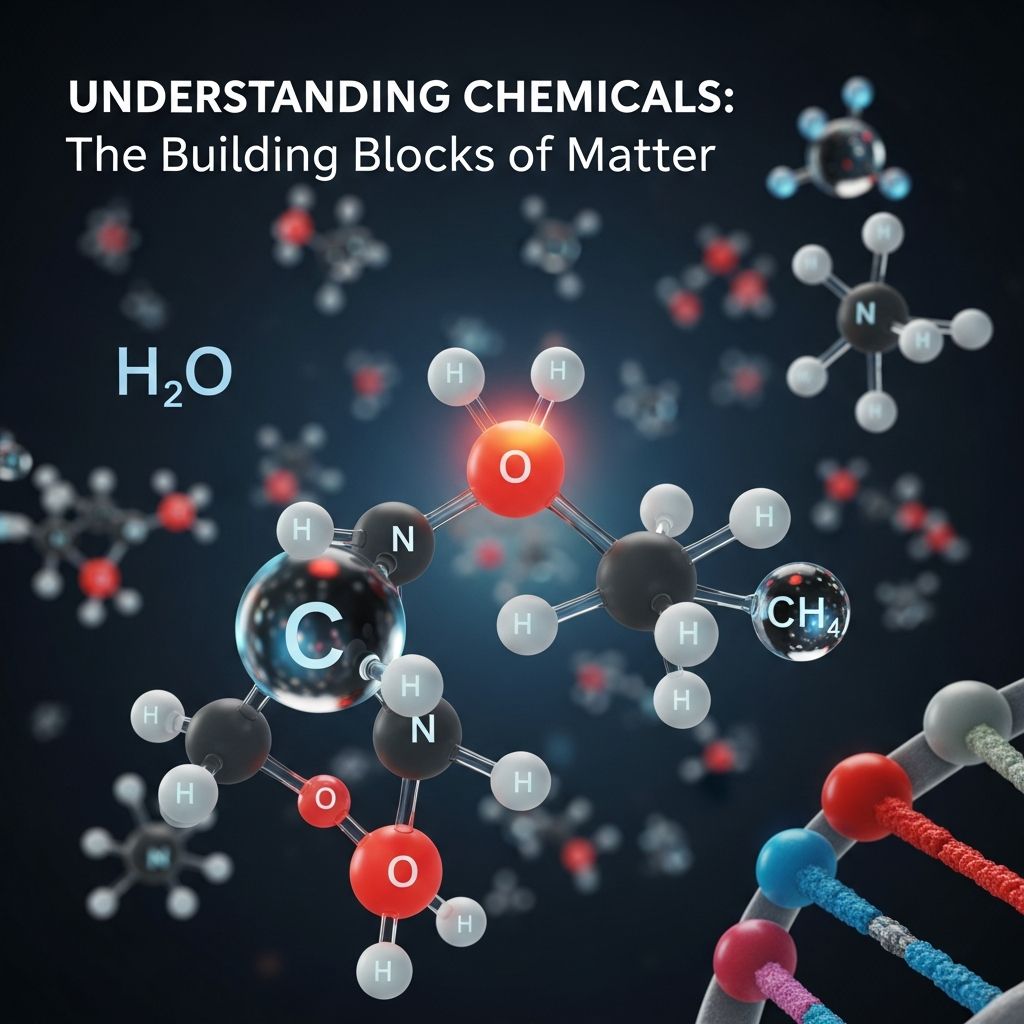
Chemicals form the foundation of everything around us, constituting all matter in the universe. In scientific terms, a chemical is any substance with a defined composition, made up of atoms, the fundamental units of matter. This includes everything from the air we breathe to the food we eat and the materials we use daily.
The Essence of Matter and Chemicals
At its core, matter is anything that has mass and occupies space. All matter is composed of chemicals, which are either pure substances or mixtures thereof. Pure chemicals maintain a consistent makeup, like water (H₂O), where every molecule consists of two hydrogen atoms bonded to one oxygen atom.
Chemistry, the discipline studying these substances, examines their composition, structure, properties, and transformations. It bridges the natural sciences by exploring how atoms combine into molecules and ions, influencing everything from biological processes to industrial applications.
Fundamental Types of Chemicals
Chemicals are broadly categorized into elements, compounds, and mixtures. Each type plays a unique role in the composition of our world.
Elements: The Simplest Form
Elements are pure substances consisting of only one type of atom. There are 118 known elements, 98 of which occur naturally on Earth. Each is represented by a unique symbol in the periodic table, such as H for hydrogen or Fe for iron. Elements cannot be broken down into simpler substances by chemical means.
- Hydrogen (H): The lightest element, essential for water and fuels.
- Oxygen (O): Vital for respiration and combustion.
- Carbon (C): Backbone of organic life.
The periodic table organizes elements by atomic number, electron configuration, and properties, aiding predictions of chemical behavior.
Compounds: Combinations of Elements
Compounds arise when two or more elements chemically bond, forming a new substance with distinct properties. Unlike mixtures, compounds have fixed ratios of elements. Water, for instance, is always H₂O, not variable.
Organic compounds primarily feature carbon-hydrogen bonds, including sugars, proteins, and hydrocarbons. Inorganic compounds, like sodium chloride (NaCl), lack these dominant bonds.
| Compound | Elements | Common Use |
|---|---|---|
| Water (H₂O) | Hydrogen, Oxygen | Solvent, life essential |
| Sodium Chloride (NaCl) | Sodium, Chlorine | Table salt, seasoning |
| Carbon Dioxide (CO₂) | Carbon, Oxygen | Photosynthesis, beverages |
Mixtures: Blends Without Chemical Change
Mixtures combine chemicals without altering their identities, separable by physical means. Air, a mix of nitrogen, oxygen, and others, exemplifies this. Homogeneous mixtures (solutions) appear uniform, like saltwater; heterogeneous ones, like sand in water, do not.
Properties That Define Chemicals
Chemicals exhibit physical and chemical properties. Physical properties, observable without reaction, include state (solid, liquid, gas), density, melting point, and color. Chemical properties reveal behavior during reactions, such as flammability or reactivity with acids.
- Physical Change: Alters form but not composition, e.g., ice melting to water.
- Chemical Change: Produces new substances, e.g., rusting iron forming iron oxide.
Understanding these helps distinguish transformations. In rusting, iron (Fe) reacts with oxygen (O₂) to form Fe₂O₃, a permanent change.
Chemical Reactions: Transforming Substances
A chemical reaction rearranges atoms to form new substances. Reactants on the left of an equation become products on the right, conserving mass. For example: 4Fe + 3O₂ → 2Fe₂O₃.
Reactions power life (photosynthesis: 6CO₂ + 6H₂O → C₆H₁₂O₆ + 6O₂) and industry (ammonia synthesis for fertilizers).
Chemicals in Daily Life and Nature
Our bodies are chemical marvels: DNA carries genetic info, proteins catalyze reactions, ATP fuels cells. Food contains carbohydrates, fats, proteins—all chemicals.
In nature, chemicals drive cycles: nitrogen fixation for soil fertility, carbon cycle regulating climate. Industry produces millions of chemicals, from pharmaceuticals to plastics, totaling around 10 million known substances.
Organic vs. Inorganic Chemicals
Organic chemicals feature carbon-hydrogen bonds, vital for life (e.g., methane CH₄). Inorganic ones, like metals or salts, support structures and reactions. Organometallic compounds bridge both, with carbon-metal bonds.
This distinction aids classification: organics in biology, inorganics in geology.
The Role of Molecules and Bonds
Molecules are neutral groups of atoms bound covalently, retaining unique properties. Covalent bonds share electrons; ionic bonds transfer them, as in NaCl.
Bonds dictate properties: water’s polarity enables hydrogen bonding, crucial for life.
Importance in Science and Society
Chemicals underpin medicine (drugs targeting receptors), energy (batteries), environment (pollutants). Regulations like EU REACH classify substances for safety.
Advancements continue: nanomaterials, green chemistry reduce hazards.
Frequently Asked Questions (FAQs)
What is the difference between a chemical and a substance?
A chemical substance has constant composition and properties. All chemicals are substances, but substances include mixtures.
Are all chemicals dangerous?
No, many are essential and safe in context, like water or salt. Toxicity depends on dose and exposure.
How many chemical elements exist?
118 elements are known, with 98 natural.
What is a chemical reaction?
A process where substances transform into new ones via bond breaking/forming.
Is air a chemical?
Air is a mixture of chemicals like nitrogen (78%) and oxygen (21%).
References
- Chemistry — Wikipedia. 2026. https://en.wikipedia.org/wiki/Chemistry
- What Exactly Is A Chemical? — Reagent.co.uk. N/A. https://www.reagent.co.uk/blog/what-exactly-is-a-chemical/
- What is a Chemical? — U.S. Nuclear Regulatory Commission. N/A. https://www.nrc.gov/reading-rm/basic-ref/students/science-101/what-is-a-chemical
- Substance (chemistry) — Wikipedia. 2026. https://en.wikipedia.org/wiki/Substance_(chemistry)
- Chemical in Science | Definition, Advantages & Disadvantages — Study.com. N/A. https://study.com/learn/lesson/chemicals-science-overview-examples.html
- What is a Chemical Substance? [Fast and Easy] | CHEMISTRY — YouTube (ACC). N/A. https://www.youtube.com/watch?v=Xha4uIvrHHA

- Integrated M.A. in Applied Linguistics, University of Hyderabad
- 5+ years in editorial, instructional, SEO, and research-based writing
Sneha is a relationships and lifestyle writer with a strong foundation in applied linguistics and certified training in relationship coaching. She brings over five years of writing experience to theskillvault, crafting thoughtful, research-driven content that empowers readers to build healthier relationships, boost emotional well-being, and embrace holistic living. Her writing and insights reflect the belief that beauty, happiness, and wellness…