
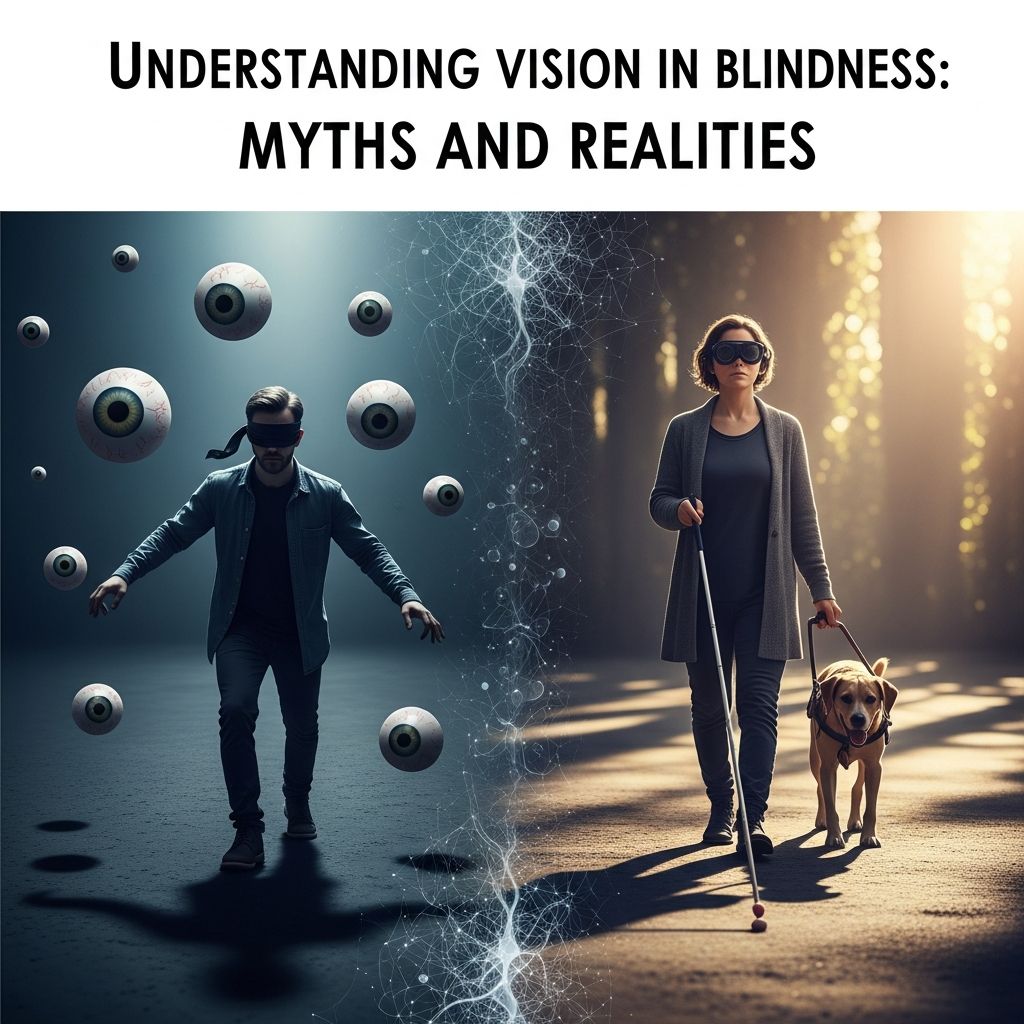
Blindness encompasses a wide spectrum of visual experiences, far from the common assumption of perpetual darkness. While some individuals perceive nothing at all, many detect light, shapes, or colors, depending on the cause and extent of their vision loss.
The Spectrum of Visual Impairment
Visual impairment ranges from mild difficulties to complete loss of sight. Legally blind individuals often retain some vision, such as the ability to discern light or broad outlines. Only about 15% experience total blindness, defined as no light perception whatsoever. This diversity arises from conditions like retinal damage, glaucoma, or optic nerve disorders, each altering perception uniquely.
For those with low vision, everyday sights might appear blurry or distorted. They could struggle with fine details, colors, or contrast, yet navigate familiar environments effectively. Understanding this spectrum challenges stereotypes and promotes accurate empathy.
Light Perception: A Common Residual Ability
Most people classified as blind can perceive light to varying degrees. This might manifest as distinguishing day from night, noticing a room’s brightness, or detecting flashes from sources like sunlight or screens. For instance, someone with light perception might sense a holiday light display blinking without identifying colors or patterns.
This ability aids orientation. Brighter areas feel more navigable, helping individuals position themselves relative to light sources. Even in total blindness cases, rare reports mention sensing overall illumination without visual input, possibly linked to non-visual neural pathways.
How Light Perception Varies
- Basic detection: Awareness of light versus dark environments.
- Directional sense: Identifying light sources’ locations.
- Intensity response: Improved function in well-lit spaces.
- Flashes: Brief bursts from sudden lights like cameras.
Color Vision in Blindness
Color perception among blind individuals is inconsistent. Those with partial sight might see faded hues or struggle to differentiate similar shades, favoring bold, high-contrast colors that reflect more light. Total blindness precludes color sight, though memory allows recall for those who once saw.
Distinguish this from color blindness, a separate condition where sight persists but color processing falters, such as confusing reds and greens. Rare monochromacy mimics total color absence alongside clarity issues.
| Condition | Vision Level | Color Experience |
|---|---|---|
| Low Vision Blindness | Partial sight | Faded or hard-to-distinguish colors |
| Total Blindness | No light perception | No colors; possible memory recall |
| Color Blindness | Normal acuity | Altered color differentiation |
Shapes, Blurs, and Visual Distortions
Beyond light, some detect vague shapes or figures. Vision might resemble heavy fog, with large objects appearing as indistinct blobs. Visual acuity below 20/200 means details blur at close range, akin to viewing the world through frosted glass.
Common distortions include central scotomas (blind spots), wavy lines, or peripheral limitations. Night vision often suffers most, while bright light exacerbates glare. These experiences personalize blindness—no two are identical.
The Myth of Eternal Blackness
Media portrays blindness as total black, like closed eyes. This misleads, especially for congenital blindness, where “black” holds no visual meaning—there’s simply no image. Acquired blindness might retain darkness familiarity, but innate cases lack this reference.
Analogies fail: unused senses, like a knee “seeing” nothing, better illustrate absence over color. This misconception hinders support, assuming uniform nothingness.
Neurological Phenomena and Hallucinations
Brain adaptations can produce phosphenes—spontaneous light bursts or patterns without external stimuli. Common in long-term blindness, these resemble stars or glows. Charles Bonnet syndrome triggers vivid hallucinations in those with vision loss, blending real and imagined visuals.
Congenital cases report fewer such events, as visual cortex never activates. These phenomena highlight the brain’s active role in “sight,” even sans input.
Dreams and Visual Memory
Dream content varies by blindness onset. Late-onset individuals dream visually, drawing from memory, though details fade. Congenital blind dream via sounds, touches, smells—non-visual senses dominate.
Some report no dreams, others spatial awareness in familiar settings. Visual memory aids navigation mentally, preserving layouts despite impairment.
Navigating Without Full Sight
Blind individuals excel via other senses. Touch identifies textures, sound maps spaces (echolocation via clicks), and smell detects environments. Tools amplify remnants: magnifiers, high-contrast aids, or audio tech.
Mobility training teaches cane use, guide dogs, or GPS apps. Heightened hearing processes subtle cues sighted people overlook. Senses compensate, not supercharge—adaptation, not enhancement.
- Hearing: Primary navigation tool, detecting echoes.
- Touch: Braille reading, object recognition.
- Echolocation: Sound-based spatial imaging.
- Olfaction: Environmental cues in dreams or waking.
Types of Blindness and Their Visual Effects
| Cause | Typical Perception | Example |
|---|---|---|
| Retinal Detachment | Shadows, flashes | Curtain-like loss |
| Glaucoma | Tunnel vision | Peripheral blackout |
| Cataracts | Blurry, cloudy | Foggy overlay |
| Optic Nerve Damage | Total darkness | No light |
Daily Impacts and Adaptations
Partial vision influences routines profoundly. Bright lighting aids tasks; color contrasts simplify identification. Tech like screen readers or voice assistants bridges gaps.
Socially, misconceptions isolate—educating others fosters inclusion. Support focuses on strengths: acute listening, spatial intuition.
Frequently Asked Questions
Do all blind people see complete darkness?
No, most perceive light or shapes; total blackness affects only a minority.
Can blind people dream in pictures?
Those losing sight later often do via memory; congenital cases use other senses.
Is blindness always from birth?
No, it can result from injury, disease, or aging, altering experiences.
Do blind people have better hearing?
They rely more on hearing, honing it through use, not innate superiority.
What does light perception feel like?
Like sensing brightness changes or flashes without form or color.
References
- What do blind people see? Light and color perception — Medical News Today. 2023-10-12. https://www.medicalnewstoday.com/articles/what-do-blind-people-see
- What Do People Who Are Blind See? — Chicago Lighthouse. 2022-05-15. https://chicagolighthouse.org/sandys-view/what-blind-people-see/
- What Do Blind People See? — YouTube (Vision Vibes). 2023-08-20. https://www.youtube.com/watch?v=Ji-RZzoFbp8
- What do blind people see? What to know about sight for those with visual impairment — NewView Oklahoma. 2024-01-10. https://nvoklahoma.org/blog/what-do-blind-people-see-what-to-know-about-sight-for-those-with-visual-impairment/
- 5 facts about blindness and the blind — Envision. 2023-11-05. https://www.letsenvision.com/blog/5-facts-about-blind-people-and-blindness
- What blindness really looks like — Perkins School for the Blind. 2023-09-18. https://www.perkins.org/what-blindness-really-looks-like/

- Integrated M.A. in Applied Linguistics, University of Hyderabad
- 5+ years in editorial, instructional, SEO, and research-based writing
Sneha is a relationships and lifestyle writer with a strong foundation in applied linguistics and certified training in relationship coaching. She brings over five years of writing experience to theskillvault, crafting thoughtful, research-driven content that empowers readers to build healthier relationships, boost emotional well-being, and embrace holistic living. Her writing and insights reflect the belief that beauty, happiness, and wellness…