
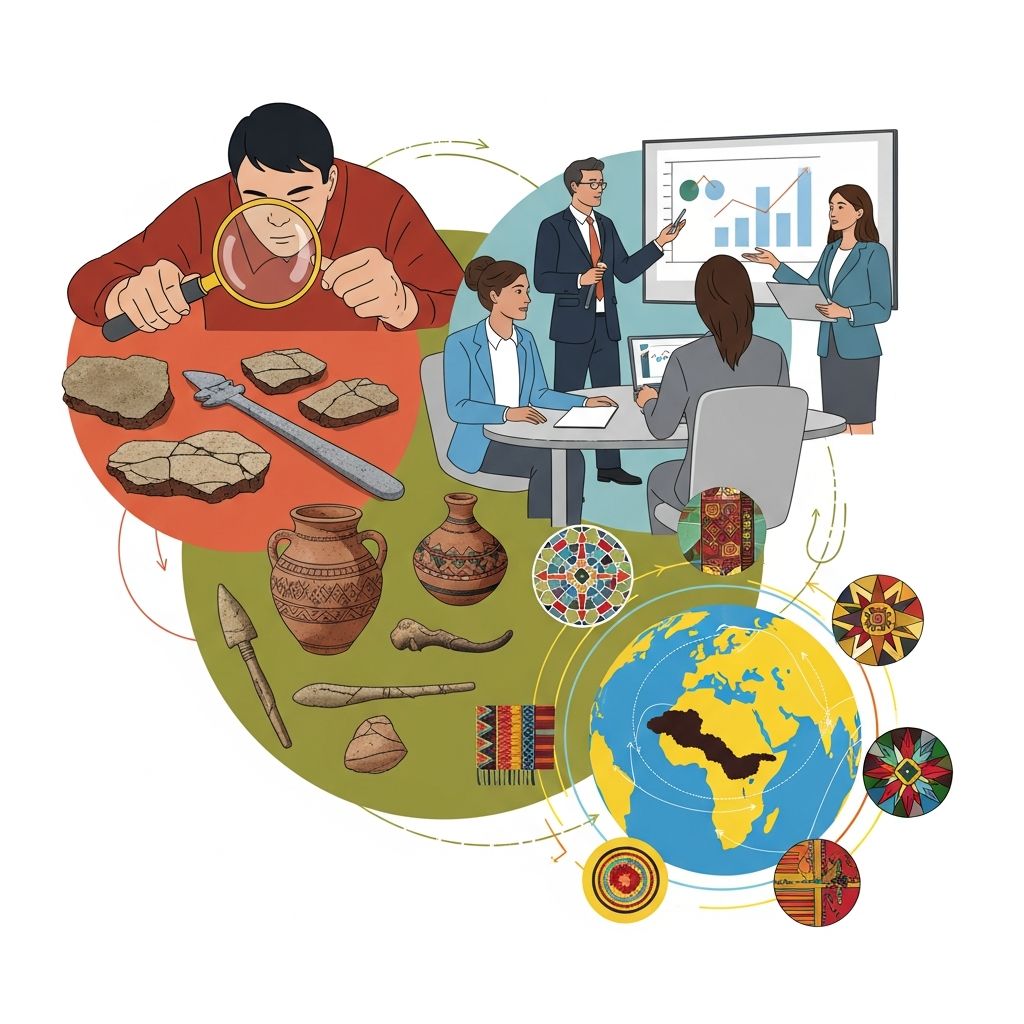
Anthropology is often described as the study of humans in all their complexity: cultures, languages, histories, and biological variation. That broad focus turns out to be a strength in the job market. With the right strategy, an anthropology degree can open doors in business, government, technology, health, education, and nonprofit work.
This guide explains how to translate an undergraduate anthropology major into concrete career paths, which skills employers value most, and what steps to take while you are still in school or just after graduation.
Why Anthropology Is More Career-Flexible Than You Think
Universities and professional associations consistently emphasize that anthropology majors enjoy wide career flexibility and move into many different fields after graduation. That flexibility comes from a combination of skills employers increasingly seek:
- Global and cultural awareness for working with diverse communities and international teams
- Qualitative and quantitative research skills for gathering and interpreting complex data
- Critical thinking and the ability to question assumptions
- Clear writing and communication, including explaining complex findings to non-experts
- Adaptability across sectors in a rapidly changing job market
Because these abilities cut across industries, anthropology graduates can be found in roles ranging from UX researcher to public health analyst to policy advisor.
Core Skills You Gain With an Anthropology Degree
To position yourself well, start by understanding what your degree actually gives you. Anthropology programs typically cultivate several key skill sets.
1. Research and Evidence-Based Decision Making
Anthropology majors learn to design and carry out research using methods such as interviews, participant observation, surveys, mapping, and archival study.
- Formulating research questions based on real-world problems
- Collecting both qualitative and quantitative data
- Identifying patterns and drawing grounded conclusions
- Presenting findings in reports, presentations, or visual formats
These abilities are directly relevant to careers in market research, user-experience research, public policy, and program evaluation.
2. Cultural Competence and Global Perspective
Anthropology emphasizes how culture shapes behavior, institutions, and perspectives. Programs frequently highlight that this cultural knowledge is valuable in fields like international development, public health, and business.
- Working sensitively with communities that differ from your own
- Spotting cultural blind spots in products, policies, and services
- Helping organizations avoid miscommunication and inequitable outcomes
3. Communication and Storytelling
Anthropologists are trained to turn complex findings into clear, compelling narratives. In practice, this means you can:
- Write concise, evidence-based reports and policy briefs
- Translate data into stories that decision-makers understand
- Design presentations tailored to different audiences
4. Analytical and Critical Thinking
Anthropology encourages you to question what appears normal or taken for granted and to understand systems of power, inequality, and change.
- Identifying root causes rather than just surface problems
- Evaluating policies or programs from multiple perspectives
- Spotting unintended consequences before they cause harm
Major Career Directions for Anthropology Graduates
According to university career overviews and the American Anthropological Association, anthropology majors move into four broad areas: public sector and government, private sector and business, nonprofit and community work, and academic or research careers.
| Career Area | Typical Roles | Key Anthropology Strengths |
|---|---|---|
| Government & Public Service | Policy analyst, cultural resource specialist, legislative staff, public health worker | Understanding communities, research, equity-focused analysis |
| Business & Private Sector | UX researcher, market researcher, organizational consultant, HR or DEI specialist | User insight, consumer behavior, workplace culture analysis |
| Nonprofits & International Development | Program manager, community organizer, NGO project officer, advocacy specialist | Community engagement, cross-cultural communication, impact assessment |
| Academia, Museums & Research | Professor, archaeologist, museum curator, research associate | Fieldwork, theory, long-term research, public education |
Job Ideas for Anthropology Majors by Interest Area
The list below is not exhaustive but illustrates how you might align your anthropology training with different sectors. Some roles require graduate study or additional certifications; others are accessible with a bachelor’s degree plus experience.
Interested in People and Products? Business, UX, and Market Research
- User Experience (UX) Researcher – Conduct interviews and usability studies to understand how people interact with digital products, then translate insights into design recommendations.
- Market Research Analyst – Study consumer behavior, preferences, and trends to help companies design, price, and promote products effectively.
- Customer Insights Specialist – Combine analytics with field research to advise on customer strategy in retail, tech, or services.
- Human Resources or Diversity, Equity & Inclusion (DEI) Coordinator – Use cultural knowledge to shape hiring practices, training, and inclusive workplace policies.
Drawn to Health, Medicine, and Well-Being?
- Public Health Program Coordinator – Help design and evaluate health outreach programs, particularly in communities where culture, language, or history affect health behaviors.
- Medical or Health Research Assistant – Support research projects on health disparities, health communication, or patient experiences.
- Global Health Project Officer – Work with NGOs or government agencies on vaccination campaigns, maternal health, or community health education.
Some students eventually pursue advanced training in medical anthropology, public health, or clinical fields to shape health policy or practice from a culturally informed perspective.
Passionate About Social Justice and Community Change?
- Community Organizer or Advocate – Partner with residents to address housing, labor, environmental, or human rights issues.
- Nonprofit Program Manager – Run programs in areas like refugee resettlement, women’s services, youth development, or food security.
- Policy or Legislative Aide – Conduct background research and community outreach to support legislation or local initiatives.
- Restorative Justice or Conflict Resolution Specialist – Apply cultural understanding to mediation, alternative justice, or reconciliation efforts.
Fascinated by History, Archaeology, or the Environment?
- Cultural Resource Management (CRM) Technician – Assist with surveys and excavations to identify and protect archaeological sites prior to construction or development projects.
- Museum Educator or Collections Assistant – Help curate exhibits, care for artifacts, and develop educational programming.
- Historic Preservation or Heritage Consultant – Work with governments or organizations to protect historic landscapes and cultural sites.
- Environmental or Heritage Interpreter – Develop educational materials and tours in parks or protected areas that connect ecology with local cultures.
Considering Law, Technology, or Graduate Study?
Because anthropology majors perform well on standardized exams such as the LSAT and MCAT, some pursue professional degrees in law, medicine, or business.
- Law and Policy – Use your background to specialize in immigration, Indigenous rights, environmental law, or international human rights.
- Technology and Data – Pair anthropology with data science, GIS, or computer science to work in areas like UX, natural language processing, or smart-city planning.
- Academic Anthropology – Pursue a master’s or PhD to become a professor, principal investigator, or research anthropologist in universities, think tanks, or research institutes.
What the Job Market Looks Like for Anthropologists
U.S. Bureau of Labor Statistics (BLS) data indicate that employment of anthropologists and archaeologists is projected to grow about 8% between 2023 and 2033, roughly as fast or faster than the average for all occupations. In 2023, anthropologists and archaeologists earned a median annual wage of around $63,800 in the United States.
Many anthropology majors, however, work in roles where the job title is not “anthropologist.” They enter fields like health care, law, business, education, media, community development, and government service.
How to Make Your Anthropology Degree Marketable
Because anthropology is broad, you need to be deliberate about shaping a career story that employers understand. These strategies can help.
1. Choose Complementary Minors or Certificates
Pair your major with training that signals a clear direction:
- Business, marketing, or economics if you’re drawn to corporate or market research roles
- Public health, biology, or environmental studies if you want to work in health or environmental fields
- Statistics, data science, or GIS to show you can handle quantitative and spatial data
- Languages, international relations, or area studies for international development or diplomacy
2. Build Experience Through Internships and Fieldwork
Universities and professional organizations emphasize that applied experience is key to a successful anthropology career.
- Seek internships with museums, NGOs, community organizations, design firms, or research labs.
- Join or initiate campus-based research projects that use ethnography, surveys, or evaluation methods.
- Volunteer in roles that let you work directly with communities or user groups.
3. Learn to Translate Your Skills for Non-Specialists
Most employers are not anthropologists. Instead of listing only course titles, spell out what you can do:
- Replace “Ethnographic Methods” with “Conducted 25+ in-depth interviews and coded 150 pages of field notes to identify user needs.”
- Replace “Anthropological Theory” with “Applied cross-cultural frameworks to evaluate organizational policies for potential equity issues.”
4. Network With Practicing Anthropologists
Connecting with professionals who studied anthropology helps you see the range of possibilities and gain practical advice.
- Join student chapters of professional organizations or attend local/virtual events.
- Ask alumni in fields you admire for short informational interviews.
- Follow anthropology practitioners in UX, policy, or global development to see how they talk about their work.
Is Graduate School Necessary?
Whether you pursue further study depends on your goals:
- Usually required if you want to be a professional anthropologist (e.g., academic researcher, principal investigator in archaeology, many museum curator roles).
- Helpful but not mandatory for applied roles in public health, public policy, international development, or organizational consulting.
- Often optional for UX research, market research, HR, and many nonprofit or community roles, provided you have strong experience.
Many universities note that anthropology majors perform well on exams for law, medicine, business, and graduate school, due in part to the critical reading and analytical writing built into the discipline.
Practical Steps to Take During Your Degree
If you are currently an anthropology student or considering the major, you can set yourself up for a strong transition into the workforce by being intentional in these areas:
- Map your interests early – Identify whether you are drawn toward business, health, environment, policy, or culture-focused roles.
- Choose applied courses – Look for classes on methods, evaluation, design, or community-based research.
- Create a portfolio – Save project reports, posters, and presentations that show your research and communication skills.
- Use your campus career center – Get help translating your skills into resume language that resonates with recruiters.
- Stay open to interdisciplinary work – Consider joint projects with departments like public health, engineering, or business.
Frequently Asked Questions About Anthropology Careers
Q: Can I get a well-paying job with just a bachelor’s in anthropology?
A: Yes. Many anthropology graduates build well-paying careers in UX research, market research, consulting, public health, and related fields, even if their job title is not “anthropologist.” Earnings often depend more on industry, role, geographic location, and experience than on the major alone.
Q: Do I have to become a professor or archaeologist if I major in anthropology?
A: No. While academia and archaeology are important parts of the discipline, graduates also enter health care, law, technology, business, media, education, government, environmental services, and nonprofit work.
Q: Is anthropology a good major if I want to work internationally?
A: Anthropology is strong preparation for international development, diplomacy, humanitarian work, and global health because it trains you to navigate cultural differences, understand local contexts, and collaborate respectfully with diverse communities.
Q: Will an anthropology major help if I plan to go to law or medical school?
A: Many schools report that anthropology majors do well on exams like the LSAT and MCAT, and the major can be especially useful if you want to focus on health disparities, human rights, immigration, or environmental justice. You will still need to complete required science or pre-law coursework alongside your anthropology studies.
Q: How can I explain anthropology to employers who are unfamiliar with it?
A: Focus on outcomes, not jargon. Emphasize that you are trained to understand people and systems, gather and analyze data, communicate clearly, and design solutions that work in real communities. Use specific examples from projects, internships, or fieldwork that demonstrate those skills in action.
References
- Career Paths for Anthropology Majors — University of California, Davis Department of Anthropology. 2024-01-10. https://anthropology.ucdavis.edu/undergraduate/career-paths
- Career Paths: Department of Anthropology — Northwestern University. 2023-08-15. https://anthropology.northwestern.edu/undergraduate/career-paths/
- Seeking a Career in Anthropology — Wake Forest University, Department of Anthropology. 2022-09-01. https://anthropology.wfu.edu/seeking-a-career-in-anthropology/
- Careers in Anthropology — James Madison University, Department of Sociology & Anthropology. 2023-02-20. https://www.jmu.edu/socanth/anthropology/careers.shtml
- Careers in Anthropology — Colorado State University, Department of Anthropology and Geography. 2022-05-30. https://anthgr.colostate.edu/careers-in-anthropology/
- What Can You Do With an Anthropology Degree? — Southern New Hampshire University. 2024-06-12. https://www.snhu.edu/about-us/newsroom/social-sciences/what-can-you-do-with-an-anthropology-degree
- Careers in Anthropology — American Anthropological Association. 2023-11-05. https://americananthro.org/careers/careers-in-anthropology/

Medha Deb is an editor with a master's degree in Applied Linguistics from the University of Hyderabad. She believes that her qualification has helped her develop a deep understanding of language and its application in various contexts. Medha specializes in the areas of beauty, health, sports, and wellness and is committed to ensuring that the content on the website is…