
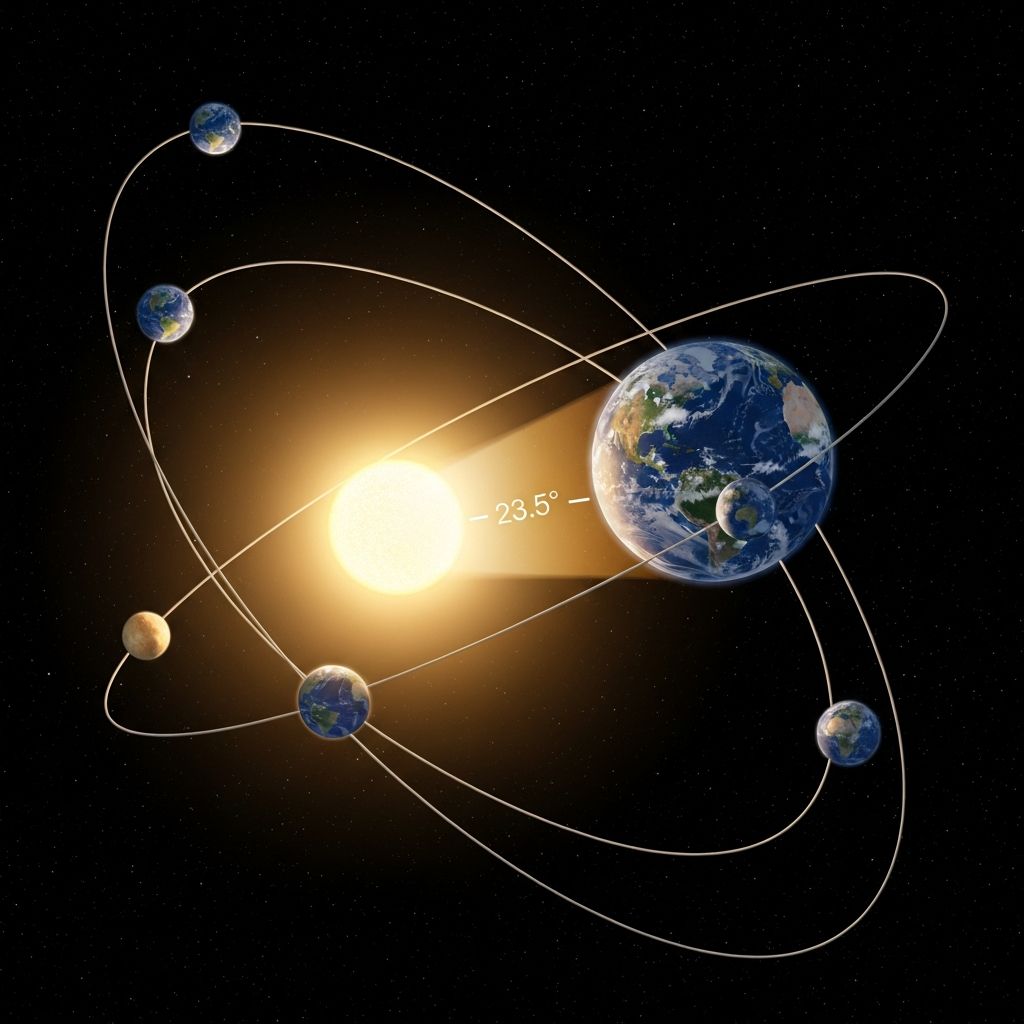
Earth’s predictable cycle of spring, summer, autumn, and winter shapes life, agriculture, and ecosystems worldwide. Far from random, these seasonal shifts stem from the planet’s unique orientation in space. At the heart of this phenomenon lies Earth’s axial tilt, which interacts with its yearly journey around the Sun to distribute sunlight unevenly across the globe.
The Role of Earth’s Tilted Axis
Earth’s axis, an imaginary line running from the North Pole to the South Pole, is tilted at approximately 23.5 degrees relative to its orbital plane around the Sun. This tilt remains constant as the planet orbits, always pointing in the same direction toward Polaris, the North Star.
Without this tilt, every location on Earth would receive consistent sunlight year-round, eliminating seasons. Instead, the tilt ensures that different hemispheres face varying angles of solar radiation throughout the year. When the Northern Hemisphere leans toward the Sun, it bathes in direct rays, fostering warmth and growth; conversely, the Southern Hemisphere receives slanted light, leading to cooler conditions.
- Axial tilt angle: 23.5 degrees on average, varying slightly between 22 and 24.5 degrees over millennia.
- Constant direction: The axis maintains its northward point, unaffected by orbital motion.
- Impact on hemispheres: Opposite seasons occur simultaneously in each hemisphere.
Earth’s Orbit: The Yearly Path Around the Sun
Earth completes one orbit around the Sun every 365.25 days, a journey that slightly elliptical rather than perfectly circular. This path, combined with the fixed tilt, dictates how sunlight strikes the planet’s surface. Perihelion, the closest approach to the Sun in early January, and aphelion, the farthest in early July, cause only minor temperature variations of about 3-4% in solar energy received—insufficient to drive seasons.
The real driver is the tilt’s interaction with this orbit. As Earth travels, the angle of incoming sunlight shifts: direct overhead rays concentrate heat in smaller areas, while oblique rays spread energy over larger surfaces, reducing intensity.
Solstices: Peaks of Summer and Winter
Solstices mark the extremes of seasonal tilt. Around June 20-21, the summer solstice in the Northern Hemisphere occurs when the North Pole tilts maximally toward the Sun. The Sun reaches its highest point over the Tropic of Cancer (23.5°N), delivering long days—up to 24 hours of twilight-free sunlight at the Arctic Circle.
Conversely, the December 21-22 winter solstice tilts the North Pole away, positioning the Sun over the Tropic of Capricorn (23.5°S). Northern days shorten dramatically, with polar nights plunging regions into darkness.
| Event | Date (Northern Hemisphere) | Tilt Position | Day Length Effect |
|---|---|---|---|
| Summer Solstice | June 20-21 | North Pole toward Sun | Longest day |
| Winter Solstice | December 21-22 | North Pole away from Sun | Shortest day |
Equinoxes: Balance of Day and Night
Equinoxes bridge solstices, occurring when the Sun aligns directly over the equator. The March 19-21 vernal (spring) equinox heralds longer days in the north, while the September 22-23 autumnal equinox evens daylight globally at about 12 hours everywhere.
At these points, the tilt neither favors one hemisphere, resulting in balanced insolation. This balance triggers migrations, budding plants, and falling leaves as ecosystems respond.
Debunking the Distance Myth
A widespread misconception attributes seasons to Earth’s varying distance from the Sun. Reality contradicts this: Northern Hemisphere summer aligns with aphelion (farthest point), yet it’s hottest; winter coincides with perihelion (closest), yet coldest. The 3% solar variation pales against tilt-induced changes in sunlight angle and duration, which alter effective heating by up to 50%.
- Perihelion: January 3-4, Earth closest (~147 million km).
- Aphelion: July 4-5, Earth farthest (~152 million km).
- Conclusion: Orbital distance influences climate minimally compared to tilt.
Daylight Variations and Atmospheric Effects
Seasons manifest through changing day lengths and sunlight paths. Summer’s high solar angles mean rays traverse less atmosphere, minimizing scattering and maximizing ground heat. Winter’s low angles increase atmospheric path length, filtering out energy.
Latitude amplifies this: equatorial regions experience subtle seasons, while poles endure extremes—six months of day or night. Earth’s rotation on its axis creates daily cycles, but orbital revolution with tilt governs annual ones.
Long-Term Changes in Earth’s Tilt
Earth’s obliquity isn’t static; it wobbles over 41,000-year cycles between 22.1 and 24.5 degrees, influenced by gravitational pulls from the Sun, Moon, and planets. These shifts, alongside orbital eccentricity variations (100,000-year cycle) and precession (26,000 years), drive ice ages by altering sunlight distribution.
Current stability at 23.44 degrees supports our temperate climate, but past extremes correlate with glacial epochs.
Seasons on Other Planets
Earth’s moderate tilt yields balanced seasons, unlike extremes elsewhere. Uranus tilts 98 degrees, causing 42-year summers and winters. Mars, at 25 degrees, mirrors Earth but with thinner atmosphere for muted effects. Venus’s near-zero tilt means uniform conditions; Jupiter’s 3 degrees yields negligible seasons.
| Planet | Axial Tilt | Seasonal Characteristics |
|---|---|---|
| Earth | 23.5° | Four distinct, moderate seasons |
| Mars | 25° | Similar to Earth, longer year |
| Uranus | 98° | Extreme, decades-long seasons |
| Venus | 3° | Minimal seasonal change |
Human and Ecological Impacts
Seasons dictate agriculture, with planting in spring and harvest in fall optimized for sunlight peaks. Wildlife migrates, hibernates, or breeds seasonally. Modern climate change disrupts patterns, shortening winters and intensifying extremes, challenging ecosystems adapted over millennia.
Frequently Asked Questions (FAQs)
Why is summer in the Southern Hemisphere when it’s winter in the North?
The hemispheres tilt oppositely toward the Sun due to Earth’s 23.5-degree axis, causing reversed seasons.
Does Earth’s elliptical orbit cause hotter summers?
No, the minor distance change has negligible effect; tilt dominates seasonal temperature swings.
What if Earth had no axial tilt?
Every day would be identical year-round, with consistent 12-hour days and minimal temperature variation by latitude.
How do solstices differ from equinoxes?
Solstices are tilt extremes (longest/shortest days); equinoxes balance sunlight equally across hemispheres.
Are seasons the same everywhere on Earth?
No, equatorial zones have minor shifts; polar regions experience prolonged light or darkness.
References
- Why Earth has seasons and why they’re wildly different on other worlds — Astronomy.com. 2023-06-20. https://www.astronomy.com/science/why-earth-has-seasons-and-why-theyre-wildly-different-on-other-worlds/
- Why does Earth have Seasons? — NESDIS, NOAA.gov. 2024-01-15. https://www.nesdis.noaa.gov/about/k-12-education/understanding-our-planet/why-does-earth-have-seasons
- What Causes the Seasons? — University of Alaska System (.edu). 2022-09-01. https://www.alaska.edu/k12reach/pdf-lessons/py1-pdfs/2-3/7_reach_23_whatcausestheseasons.pdf
- The Seasons of the Year | Causes & Explanation — Britannica.com. 2023-11-10. https://www.britannica.com/video/what-causes-seasons/-285875
- What Causes the Seasons? — NASA Space Place (.gov). 2024-03-05. https://spaceplace.nasa.gov/seasons/
- What Causes the Seasons? — National Weather Service (.gov). 2023-12-18. https://www.weather.gov/fsd/season

- Integrated M.A. in Applied Linguistics, University of Hyderabad
- 5+ years in editorial, instructional, SEO, and research-based writing
Sneha is a relationships and lifestyle writer with a strong foundation in applied linguistics and certified training in relationship coaching. She brings over five years of writing experience to theskillvault, crafting thoughtful, research-driven content that empowers readers to build healthier relationships, boost emotional well-being, and embrace holistic living. Her writing and insights reflect the belief that beauty, happiness, and wellness…