
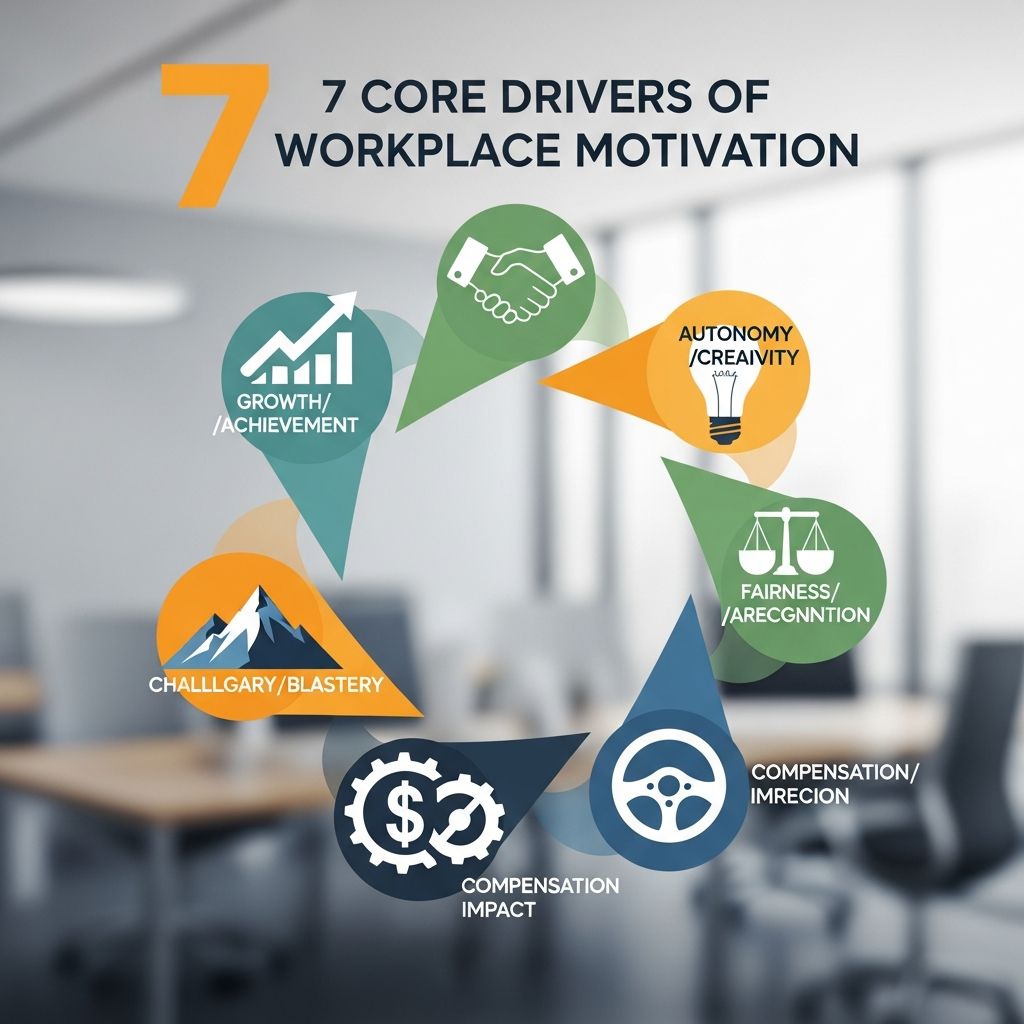
Understanding What Fuels Employee Motivation
Motivation is the invisible engine behind productivity, innovation, and retention in any organization. While pay and benefits are important, they are rarely the sole or even primary reason people stay engaged at work. Modern research and workplace experience show that motivation is a complex interplay of psychological needs, social dynamics, and structural conditions. By identifying and nurturing the core drivers of motivation, leaders can create environments where employees are not just present, but genuinely invested in their work.
1. A Sense of Purpose and Meaning
One of the most powerful motivators is the feeling that one’s work matters. Employees are more likely to be energized when they understand how their role contributes to a larger mission, whether that’s serving customers, advancing a cause, or building a product that improves lives.
When work feels arbitrary or disconnected from any broader impact, motivation tends to erode. Conversely, when people see a clear line between their daily tasks and a meaningful outcome, they are more likely to persist through challenges, take initiative, and feel pride in their contributions.
Leaders can strengthen this driver by:
- Regularly connecting team goals to the organization’s mission and values.
- Sharing stories of how the team’s work has positively affected customers or communities.
- Encouraging employees to reflect on the impact of their own roles.
2. Autonomy and Decision-Making Freedom
People are more motivated when they feel in control of how they do their work. Autonomy does not mean working in isolation or without accountability; rather, it means having the freedom to choose how to approach tasks, manage time, and solve problems.
Research grounded in self-determination theory consistently shows that autonomy is a fundamental psychological need. When employees are trusted to make decisions about their work, they experience greater ownership, creativity, and resilience.
Organizations that micromanage or impose rigid processes often see motivation decline, even when pay and conditions are good. On the other hand, environments that support autonomy tend to see higher levels of initiative, problem-solving, and job satisfaction.
Ways to foster autonomy include:
- Setting clear goals but allowing flexibility in how they are achieved.
- Encouraging employees to propose solutions and experiment with new approaches.
- Reducing unnecessary approvals and bureaucratic hurdles for routine decisions.
3. Opportunities for Growth and Mastery
Human beings are naturally inclined to grow, learn, and improve. Work that allows employees to develop new skills, deepen expertise, and take on increasingly complex challenges is inherently more motivating than work that feels stagnant or repetitive.
When employees feel they are not learning or progressing, motivation often wanes, regardless of compensation. Conversely, when they see a path for professional development—through training, mentoring, stretch assignments, or career advancement—they are more likely to stay committed and engaged.
Organizations that invest in learning and development signal that they value their people as long-term assets, not just as resources to complete tasks.
Effective strategies to support growth include:
- Creating individual development plans aligned with both personal and organizational goals.
- Providing access to training, certifications, and learning platforms.
- Offering challenging projects that stretch employees’ capabilities.
- Recognizing and rewarding skill development, not just performance outcomes.
4. Recognition and Appreciation
Feeling seen and valued is a basic human need, and it plays a critical role in motivation. Recognition does not have to be grand or formal; even small, timely acknowledgments of effort and achievement can significantly boost morale and engagement.
Recognition is most effective when it is specific, sincere, and tied to actual contributions. Generic praise like “good job” is less motivating than detailed feedback that highlights what someone did well and why it mattered.
Moreover, recognition should come from multiple sources: peers, managers, and sometimes even customers. A culture where appreciation is normalized—through shout-outs in meetings, peer-to-peer recognition programs, or simple thank-you messages—tends to be more energized and collaborative.
Key principles for meaningful recognition:
- Be timely: acknowledge contributions soon after they happen.
- Be specific: describe the behavior or outcome being recognized.
- Be inclusive: ensure recognition is distributed fairly across roles and levels.
- Be authentic: avoid formulaic or insincere praise.
5. Supportive Relationships and Belonging
Work is a profoundly social experience. The quality of relationships with colleagues, managers, and teams has a direct impact on motivation. Employees who feel they belong, are respected, and can be themselves at work are more likely to be engaged and committed.
Belonging is not just about fitting in; it’s about feeling that one’s perspective is valued and that one is part of a community. Inclusive environments where diverse voices are heard and psychological safety is high tend to see higher levels of motivation, collaboration, and innovation.
Conversely, workplaces marked by conflict, exclusion, or a lack of trust often struggle with low motivation, even when other conditions are favorable.
Ways to strengthen belonging and relationships:
- Foster open communication and active listening across teams.
- Encourage team-building activities that build trust and camaraderie.
- Address conflicts constructively and promptly.
- Promote inclusive leadership behaviors that value diverse perspectives.
6. Fairness and Equity in the Workplace
Perceived fairness in how people are treated, rewarded, and given opportunities is a foundational element of motivation. When employees believe that decisions about pay, promotions, assignments, and recognition are made fairly and transparently, they are more likely to trust the organization and remain engaged.
Unfairness—whether real or perceived—can quickly erode motivation, even among high performers. This includes not only pay equity but also access to development opportunities, workload distribution, and how feedback and discipline are handled.
Equity theory suggests that people compare their inputs and outcomes to those of others. When they perceive an imbalance, motivation can drop, and disengagement or turnover may follow.
Organizations can promote fairness by:
- Establishing clear, objective criteria for performance evaluations and promotions.
- Regularly reviewing compensation and benefits for equity across roles and demographics.
- Ensuring that workloads are distributed reasonably and that overwork is not normalized.
- Providing transparent communication about decisions that affect employees.
7. Work-Life Balance and Sustainable Workloads
Motivation cannot be sustained in environments where burnout is common. When employees are consistently overworked, under-rested, or unable to meet personal and family needs, their energy and engagement inevitably decline.
Work-life balance is not about working less; it’s about working in a way that is sustainable over the long term. Organizations that respect boundaries, support flexible arrangements, and discourage chronic overwork tend to see higher levels of motivation, creativity, and retention.
Flexible work models, reasonable expectations, and a culture that values rest and recovery all contribute to a more motivated workforce. Leaders play a crucial role by modeling healthy boundaries and not glorifying constant availability.
Practical steps to support balance and sustainable workloads:
- Offer flexible scheduling and remote or hybrid work options where feasible.
- Set realistic deadlines and avoid last-minute, high-pressure demands.
- Encourage employees to take vacation and disconnect outside of work hours.
- Monitor workloads and redistribute tasks when teams are consistently overloaded.
How These Drivers Interact in Practice
These seven motivational drivers do not operate in isolation. They interact in complex ways, and their relative importance can vary by individual, role, and organizational context.
For example:
- An employee who values growth may be highly motivated by development opportunities, even if autonomy is somewhat limited.
- Another employee might prioritize belonging and fairness, becoming demotivated quickly if they feel excluded or treated unfairly, regardless of pay.
- A high-performing individual may thrive with autonomy and meaningful work but burn out if work-life balance is ignored.
Effective leadership involves understanding these nuances and tailoring approaches to support different motivational profiles within the team.
Practical Table: Mapping Motivational Drivers to Leadership Actions
| Motivational Driver | Key Leadership Actions |
|---|---|
| Purpose & Meaning | Connect work to mission; share impact stories; clarify role significance. |
| Autonomy | Set goals, not methods; reduce micromanagement; encourage experimentation. |
| Growth & Mastery | Support learning; assign stretch tasks; create development plans. |
| Recognition | Give specific, timely praise; celebrate effort and results; enable peer recognition. |
| Belonging & Relationships | Promote inclusion; build psychological safety; address conflict early. |
| Fairness & Equity | Ensure transparent processes; review pay and opportunities; distribute workloads fairly. |
| Work-Life Balance | Respect boundaries; offer flexibility; model sustainable work habits. |
FAQs: Common Questions About Workplace Motivation
Can money alone motivate employees?
While fair compensation is essential, it is rarely sufficient on its own. Money can prevent dissatisfaction, but it does not typically create sustained motivation. Factors like purpose, autonomy, growth, and recognition are usually more powerful in driving long-term engagement and performance.
How can managers identify what motivates each employee?
Regular one-on-one conversations are the most effective way. Ask open-ended questions about what energizes them, what kind of work they enjoy, and what would make their role more fulfilling. Over time, patterns emerge that reveal individual motivational drivers.
What if an employee seems unmotivated despite good conditions?
It’s important to explore the underlying reasons. Sometimes, motivation issues stem from misalignment between the person and the role, unresolved personal challenges, or a mismatch between expectations and reality. Coaching or mentoring can help uncover and address these root causes.
Is motivation the same across all industries and roles?
The core psychological drivers are universal, but their expression and relative importance can vary. For example, frontline workers may place higher value on fairness and support, while knowledge workers might prioritize autonomy and growth. Context matters, so leaders should adapt their approach accordingly.
How can organizations measure motivation?
Motivation can be assessed through engagement surveys, pulse checks, turnover rates, absenteeism, and performance trends. Qualitative feedback from interviews and focus groups also provides valuable insights into what is (or isn’t) motivating employees.
Building a Motivation-Focused Culture
Sustained motivation is not the result of a single program or initiative; it is the outcome of a culture that consistently supports these seven drivers. Leaders who prioritize purpose, autonomy, growth, recognition, belonging, fairness, and balance create environments where people are more likely to bring their best selves to work.
Building such a culture requires intentionality, consistency, and ongoing dialogue with employees. It also requires leaders to model the behaviors they wish to see—showing appreciation, respecting boundaries, and making decisions fairly.
When organizations treat motivation as a strategic priority rather than a side effect of good pay, they unlock higher performance, stronger retention, and a more resilient, adaptable workforce.
References
- Work Motivation: The Roles of Individual Needs and Social Conditions — PMC, National Institutes of Health. 2022. https://www.ncbi.nlm.nih.gov/pmc/articles/PMC8869198/
- Work motivation: an evidence review — Chartered Institute of Personnel and Development (CIPD). 2021. https://www.cipd.org/globalassets/media/knowledge/knowledge-hub/evidence-reviews/work-motivation-scientific-summary_tcm18-89562.pdf
- Rousing our motivation — American Psychological Association (APA). 2021. https://www.apa.org/monitor/2021/10/feature-workers-motivation

- Integrated M.A. in Applied Linguistics, University of Hyderabad
- 5+ years in editorial, instructional, SEO, and research-based writing
Sneha is a relationships and lifestyle writer with a strong foundation in applied linguistics and certified training in relationship coaching. She brings over five years of writing experience to theskillvault, crafting thoughtful, research-driven content that empowers readers to build healthier relationships, boost emotional well-being, and embrace holistic living. Her writing and insights reflect the belief that beauty, happiness, and wellness…