
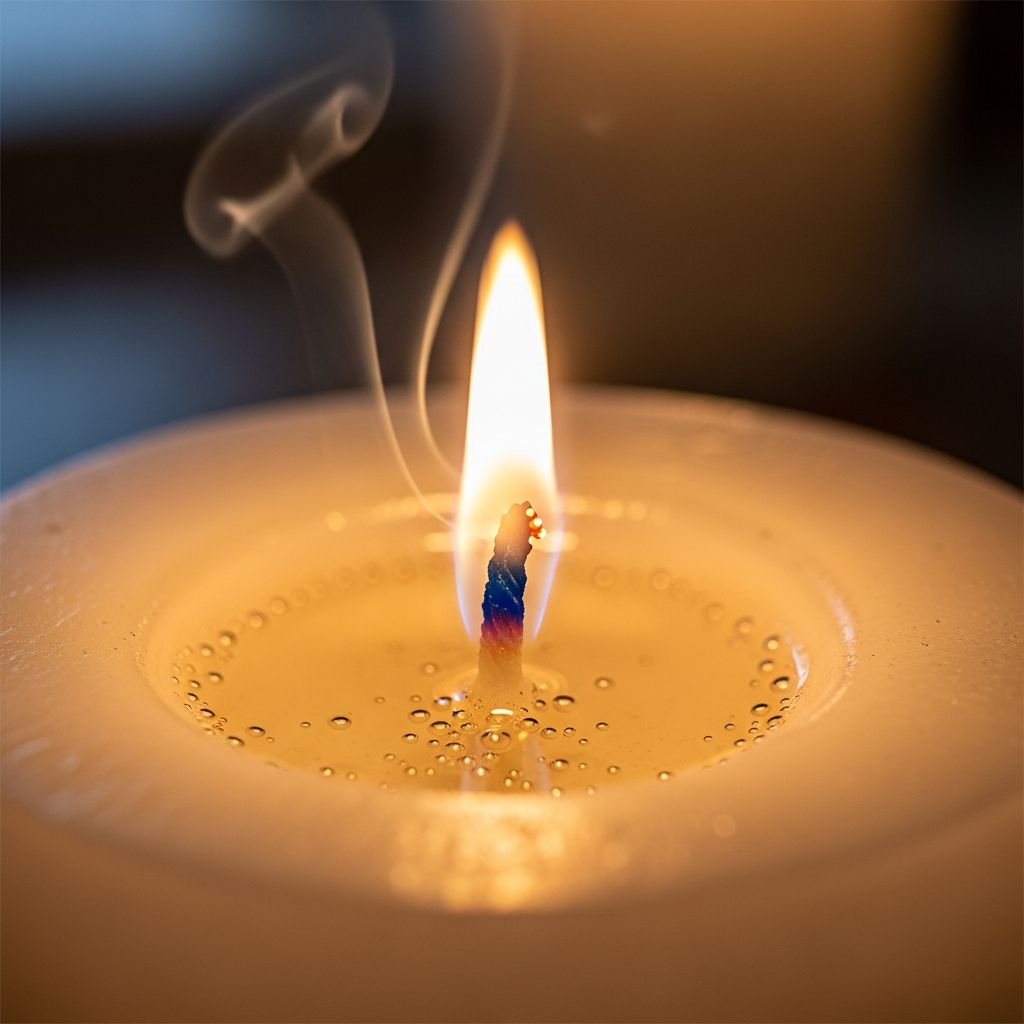
Candle wax undergoes a remarkable transformation when a flame is applied, shifting from a solid state to liquid, vapor, and ultimately gaseous combustion products. This process, rooted in basic thermodynamics and organic chemistry, explains why candles don’t simply disappear but disperse into the atmosphere and leave minimal solid residue.
The Initial Phase: Solid to Liquid Transition
When you light a candle, the heat from the flame first melts the wax near the wick. Wax, primarily composed of long hydrocarbon chains derived from paraffin, soy, or beeswax, has a relatively low melting point—typically between 46°C and 68°C for common varieties. This liquefaction allows the molten wax to be drawn up the wick via capillary action, a process where liquid rises through narrow spaces against gravity due to surface tension.
Understanding this step is crucial: the wax doesn’t burn as a solid. Instead, it must become liquid to fuel the flame continuously. Factors like wick thickness and wax type influence how efficiently this happens; a properly sized wick ensures even melting without excessive dripping or tunneling.
Vaporization: The Key to Sustained Burning
Once liquid wax reaches the flame’s base, intense heat—around 1,000°C at the wick tip—vaporizes it. Molecules break free from liquid bonds, turning into gas that mixes with oxygen from the air. This gaseous wax serves as the true fuel, igniting in a controlled combustion reaction.
Without vaporization, no flame would persist; it’s why extinguishing a candle leaves a pool of unmelted solid wax. Experiments demonstrate this: blowing out the flame halts vapor supply, causing the wick to cool and solidify remaining liquid.
Chemical Combustion: Breaking Down Hydrocarbons
The core reaction is hydrocarbon oxidation: CnH2n+2 + (n + ½)O2 → nCO2 + (n+1)H2O. Paraffin wax, a mix of alkanes like C20H42 to C40H82, reacts with oxygen to produce carbon dioxide (CO2) and water vapor (H2O). These gases rise as invisible exhaust, carrying away over 90% of the wax’s mass.
| Wax Type | Primary Composition | Main Byproducts | Clean Burn? |
|---|---|---|---|
| Paraffin | Petroleum hydrocarbons | CO2, H2O, soot | Moderate |
| Soy | Vegetable esters | CO2, H2O | High |
| Beeswax | Ester hydrocarbons | CO2, H2O | Very High |
Natural waxes like soy or beeswax burn cleaner, producing less soot (particulate carbon) due to shorter chains and fewer impurities.
Visible and Invisible Flame Layers
A candle flame reveals distinct zones:
- Dark inner core: Unburned wax vapor.
- Bright blue base: Complete combustion to CO2 and H2O.
- Yellow mantle: Partial combustion forming incandescent carbon soot, glowing at 1,200–1,400°C.
- Outer translucent zone: Heated air drawing oxygen inward.
This structure optimizes energy transfer: heat radiates back to melt more wax while gases escape upward.
What Remains: Minimal Solid Residue
After full burning, little wax solidifies—typically just wick remnants or trace unvaporized bits. The bulk (99+%) exits as gas. Any leftover pool results from uneven burning, extinguished flames, or oversized wicks causing excess melt.
Practical observation: a standard 200g candle burns 30-40 hours, leaving under 5g residue if trimmed properly.
Practical Implications for Candle Users
Knowing wax disperses as gas informs safe usage:
- Trim wicks to ¼ inch for efficient vaporization and reduced soot.
- Burn on heat-safe surfaces; molten wax can exceed 70°C.
- Avoid drafts, which disrupt oxygen flow and cause tunneling.
For aromatherapy candles, volatile oils vaporize alongside wax, enhancing scent diffusion.
Eco-Friendly Disposal of Candle Remnants
Unused wax or partially burned candles require thoughtful handling. Never pour liquid wax down drains—it solidifies, causing clogs.
Effective Removal Techniques
- Freezer Method: Chill jar 2-3 hours; contracted wax pops out easily. Ideal for soy or paraffin remnants.
- Hot Water Pour: Fill with boiling water (on a plate to catch overflow); wax floats, solidifies, and lifts off. Dry with paper towel.
- Absorption Hack: Add cotton balls to warm wax; they soak it up for trash disposal. Wipe residue clean.
- Warming Plate: Use low-heat warmer to liquify, pour onto napkin-lined plate, then trash.
Reuse glass jars as planters or storage after thorough cleaning. Metal tabs from wicks are recyclable curbside.
Sustainable Wax Options
Opt for soy or beeswax: soy hardens for easy pop-out, while some natural pearls compost fully. Paraffin goes to trash, as it’s non-biodegradable.
Advanced Science: Energy and Efficiency
Candle combustion releases about 40-50 kJ/g, mostly as light (minimal) and heat (dominant). Efficiency hovers at 0.1-1% luminous, explaining why they’re ambiance tools, not lightsources. Modern LEDs vastly outperform them energetically.
Thermodynamically, it’s an exothermic oxidation: ΔH ≈ -800 kJ/mol for alkanes, driving the self-sustaining cycle until wax depletes.
Common Myths Debunked
- Myth: Wax drips fuel the flame. False—drips are waste; capillary action suffices.
- Myth: All wax evaporates invisibly. Partially true; soot and water vapor are detectable.
- Myth: Colored wax burns differently. Dyes vaporize unchanged, minimally affecting combustion.
Frequently Asked Questions
Does candle wax disappear completely when burned?
Mostly yes—over 99% becomes CO2 and water vapor, with traces as soot or residue.
Why does wax pool at the bottom?
Excess melt from wide flames or drafts; trim wick and center flame to prevent.
Can I recycle candle wax?
Paraffin: trash only. Soy/beeswax: compost or reuse. Check local rules.
Is burning candles bad for indoor air?
Minimal if ventilated; natural waxes emit fewer VOCs than paraffin.
How do I safely remove wax from fabric?
Freeze, scrape, then launder with hot water and degreaser.
References
- How to Dispose of Candles Safely | Eco-Friendly Tips — Candle Pearls. 2023-05-15. https://candlepearls.com/blogs/blog/how-to-dispose-of-candles
- How to Dispose of Soy Wax Melts Without the Mess — Illuminate Apothecary. 2024-02-10. https://www.illuminateapothecary.com/post/how-to-dispose-of-soy-wax-melts
- Disposal and Recycling – Candles — The Wick and Wax Co. 2023-11-20. https://thewickandwax.co/pages/disposal-and-recycling
- How to Remove Wax from a Candle Jar – 3 Ways — YouTube (DIYinYaco). 2022-08-05. https://www.youtube.com/watch?v=5nfmvWvC4xo
- Candle Flame Chemistry — Royal Society of Chemistry. 2023-01-12. https://edu.rsc.org/resources/candle-flame/142.article
- Thermodynamics of Combustion — NIST Chemistry WebBook. 2024-06-01. https://webbook.nist.gov/chemistry/

Medha Deb is an editor with a master's degree in Applied Linguistics from the University of Hyderabad. She believes that her qualification has helped her develop a deep understanding of language and its application in various contexts. Medha specializes in the areas of beauty, health, sports, and wellness and is committed to ensuring that the content on the website is…