
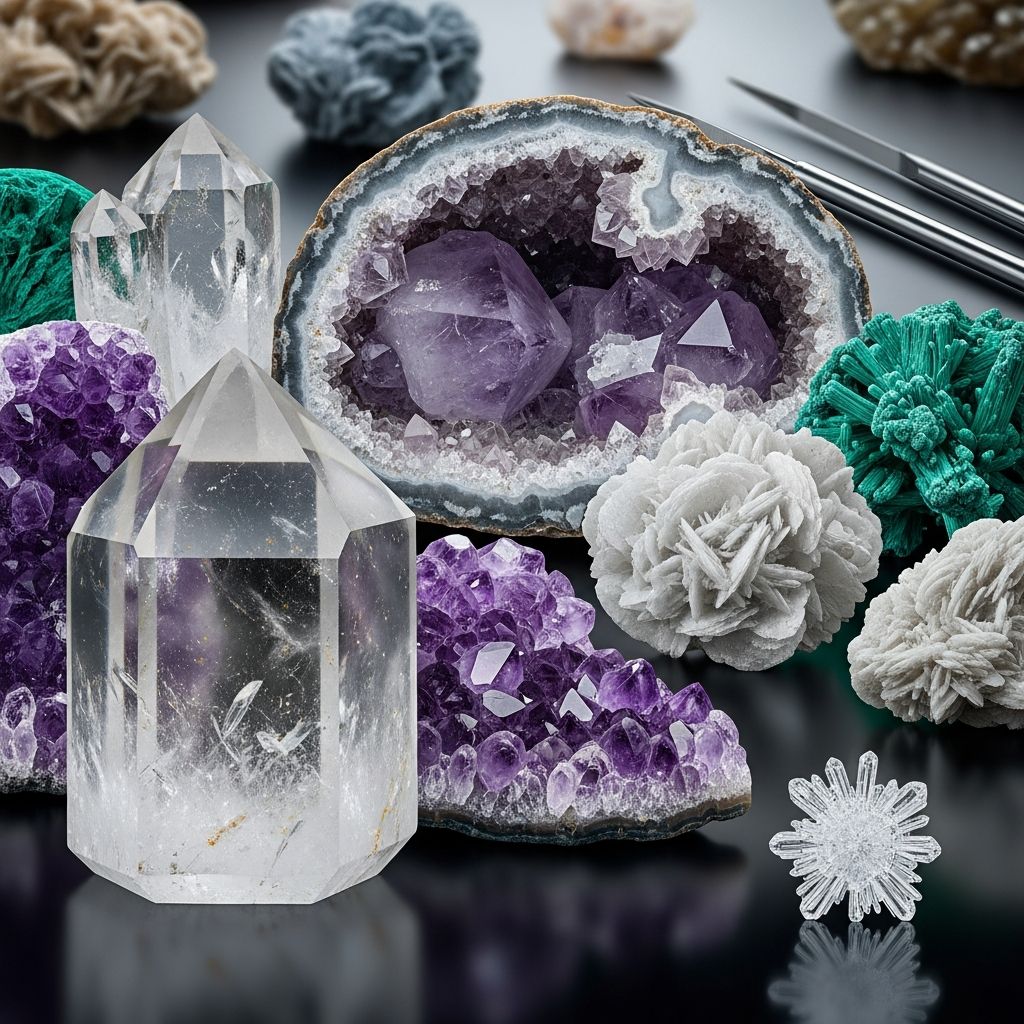
Crystals represent some of the most ordered structures in nature, where atoms, ions, or molecules align in precise, repeating patterns to create solids with remarkable symmetry and beauty. These materials captivate scientists, jewelers, and hobbyists alike due to their geometric perfection and diverse applications, from electronics to jewelry.
The Fundamental Nature of Crystalline Solids
At its core, a crystal is a solid composed of particles—typically atoms, molecules, or ions—arranged in a highly organized, repeating three-dimensional framework known as a crystal lattice. This lattice extends uniformly throughout the material, distinguishing crystals from amorphous solids like glass, which lack such order.
The repeating unit within this lattice, called the unit cell, serves as the building block. Imagine a tiny box that encapsulates the precise positioning of particles; when these boxes tile space without gaps or overlaps in all directions, they form the complete crystal structure. This periodicity is what gives crystals their characteristic properties, including cleavage along specific planes and optical behaviors.
Not all solids qualify as crystals. For instance, mineraloids such as obsidian exhibit no long-range order, despite appearing solid and sometimes glassy. True crystals demand this microscopic regularity, often manifesting in macroscopic flat faces and edges.
How Crystals Emerge: The Process of Crystallization
Crystallization occurs when a substance transitions from a liquid, gas, or dissolved state into a solid under conditions that favor ordered assembly. This process, central to crystallography—the scientific study of crystal formation—involves nucleation, where initial clusters form, followed by growth as more particles attach in alignment.
Factors like temperature, pressure, and solution concentration dictate the outcome. In nature, minerals crystallize from cooling magma, evaporating seawater, or hydrothermal vents. Synthetically, labs grow crystals via methods like the Czochralski process for silicon wafers used in semiconductors.
During growth, atoms bond selectively, propagating the lattice. Imperfections, such as dislocations or inclusions, can arise but rarely disrupt the overall order. The result is a structure where internal symmetry often mirrors external geometry, a hallmark of crystals.
The Seven Crystal Systems: Geometry in Action
Crystals organize into seven distinct systems based on unit cell dimensions and angles, each dictating possible shapes and symmetries. These systems provide a classification framework essential for mineralogists and gemologists.
| System | Key Features | Examples |
|---|---|---|
| Isometric (Cubic) | All sides equal, all angles 90° | Diamond, garnet, spinel |
| Tetragonal | Two equal axes, one different, all angles 90° | Zircon, rutile |
| Orthorhombic | All sides different, all angles 90° | Topaz, sulfur |
| Hexagonal | Three equal axes at 120°, one different perpendicular axis | Quartz, emerald, calcite |
| Trigonal | Similar to hexagonal but with different symmetry | Tourmaline, ruby |
| Monoclinic | All sides different, one angle not 90° | Gypsum, orthoclase |
| Triclinic | All sides and angles different | Labradorite, turquoise |
Each system reflects the constraints of atomic bonding and space-filling efficiency. For example, isometric crystals like diamonds exhibit high symmetry, appearing as perfect cubes or octahedrons, while triclinic forms allow for more irregular, intricate habits.
Crystal habit—the external shape—influences appearance but stems from internal lattice dictates. Growth conditions can modify habits, yielding prismatic, tabular, or fibrous forms within the same system.
Properties Arising from Crystalline Order
The lattice imparts unique physical, optical, and electrical traits. Anisotropy, where properties vary by direction, is common; cleavage occurs along weak lattice planes, as in mica’s sheets.
- Optical Effects: Many crystals refract light differently, producing birefringence in calcite or piezoelectric sparks in quartz under pressure.
- Thermal Conductivity: Diamonds excel due to rigid carbon lattices, while metals vary by electron mobility.
- Hardness: Mohs scale ranks crystals; diamond’s tetrahedral bonds yield top durability.
- Electrical Behavior: Semiconductors like silicon rely on precise lattices for doping and conductivity.
Categories include insulators (transparent, like quartz), metals (opaque, conductive), semiconductors (tunable), and molecular solids (held by van der Waals forces).
Crystals in Nature: Minerals vs. Beyond
Naturally, crystals form most minerals—inorganic solids with defined compositions—but not all. Organic crystals, like sugar or proteins, share lattice order but exclude mineral status.
Rocks aggregate minerals; a granite slab contains quartz crystals amid others. Gems, prized for clarity and color, are durable crystals like sapphire (corundum).
Quasicrystals, aperiodic yet ordered, challenge traditions, discovered in 1980s alloys.
Industrial and Technological Applications
Crystals power modern life. Silicon crystals underpin chips; liquid crystals enable LCD screens.
- Electronics: Piezoelectric quartz in watches, oscillators.
- Optics: Lasers use ruby or neodymium-doped crystals.
- Energy: Photovoltaic silicon converts sunlight.
- Medicine: Salt crystals flavor; advanced uses include drug delivery lattices.
- Gemstones: Cut crystals for jewelry, valued for scintillation.
Synthetic growth techniques produce flawless crystals unattainable in nature, revolutionizing tech.
Growing Crystals: Experiments for Enthusiasts
Simple home experiments reveal principles. Dissolve salt or sugar in hot water, cool slowly for large crystals. Alum yields purple gems; borax forms snowflakes.
Key tips:
- Use saturated solutions.
- Control cooling for size.
- Seed with string or stick.
These demonstrate supersaturation and nucleation vividly.
Frequently Asked Questions (FAQs)
Are healing crystals true crystals geologically?
Some are, like quartz varieties, but many ‘healing’ items like obsidian are mineraloids without lattice order.
What’s the difference between a crystal, mineral, and rock?
Crystal: ordered lattice solid. Mineral: inorganic crystal with fixed composition. Rock: mineral aggregate.
Can crystals form organically?
Yes, sugars and proteins crystallize, but they’re not minerals.
Why do crystals have flat faces?
Lattice planes dictate growth; faces align with stable atomic layers.
How large can natural crystals grow?
Some exceed tons, like giant gypsum in caves, under slow, stable conditions.
References
- Crystal – Wikipedia — Wikipedia Contributors. 2023-10-01. https://en.wikipedia.org/wiki/Crystal
- What are Crystals and How do They Form? — StoneMania. 2022-05-15. https://www.stonemania.co.uk/blog/what-is-a-crystal
- Crystal Definition, Types & Uses — Study.com. 2023-08-20. https://study.com/academy/lesson/video/crystal-definition-types-structure-properties.html
- Crystal | Definition, Types, Structure, & Facts — Britannica. 2024-01-12. https://www.britannica.com/science/crystal
- What is a Crystal? — International Gem Society. 2023-11-05. https://www.gemsociety.org/article/crystal/
- About Minerals & Crystals — FossilEra. 2022-09-10. https://www.fossilera.com/pages/about-minerals-crystals
- What is a crystal? – Crystals — QM Oxford (YouTube). 2015-10-20. https://www.youtube.com/watch?v=o8f1RAEHL-M

- Integrated M.A. in Applied Linguistics, University of Hyderabad
- 5+ years in editorial, instructional, SEO, and research-based writing
Sneha is a relationships and lifestyle writer with a strong foundation in applied linguistics and certified training in relationship coaching. She brings over five years of writing experience to theskillvault, crafting thoughtful, research-driven content that empowers readers to build healthier relationships, boost emotional well-being, and embrace holistic living. Her writing and insights reflect the belief that beauty, happiness, and wellness…