
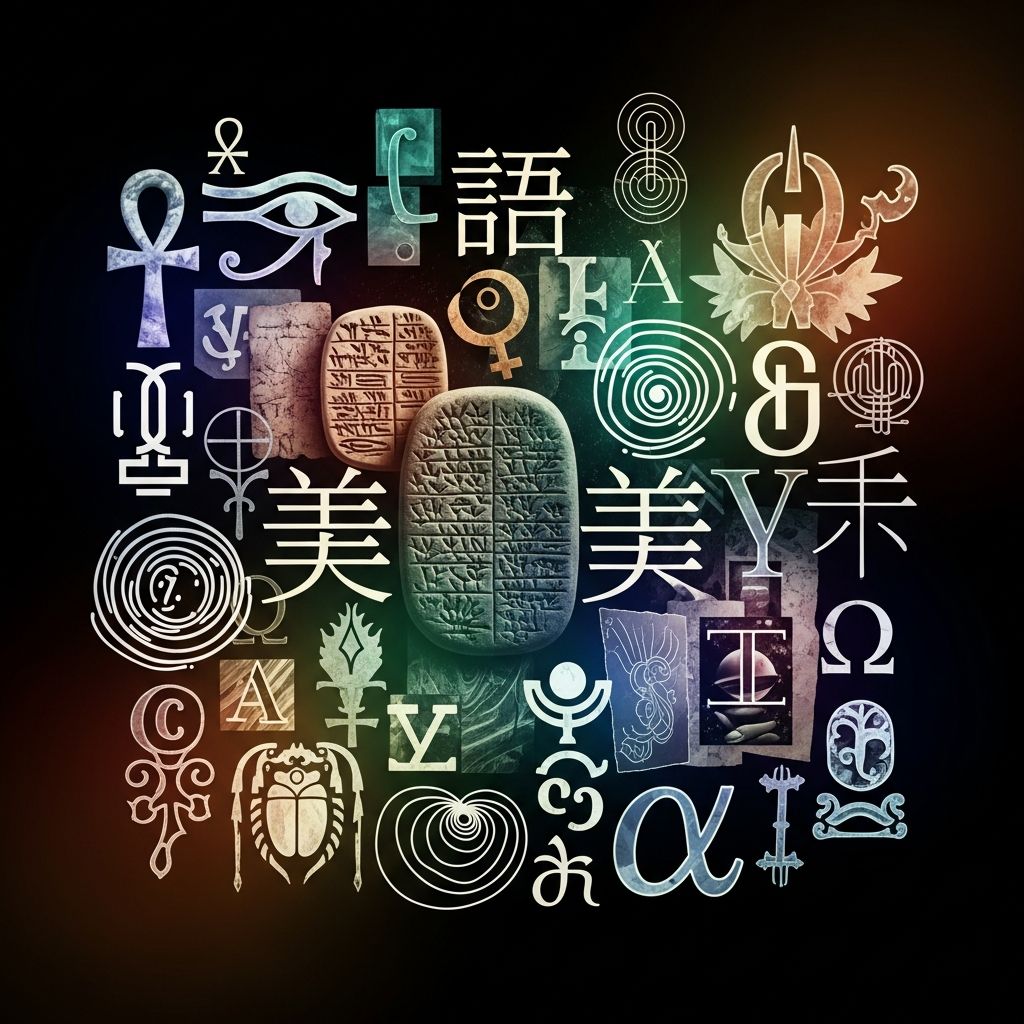
Glyphs represent the foundational building blocks of written communication, serving as visual embodiments of characters, ideas, and sounds across diverse cultures and technologies. These purposeful marks bridge the gap between abstract concepts and tangible forms, influencing everything from ancient inscriptions to contemporary digital interfaces.
Defining the Essence of a Glyph
At its core, a glyph is a deliberate graphic symbol that imparts shape and form to a character, whether alphabetic, numeric, or symbolic. Derived from the Greek term meaning ‘to carve,’ it encapsulates any intentional mark designed to convey meaning visually. Unlike abstract ideas, glyphs provide the concrete appearance that allows readers to interpret text.
In typography, a glyph denotes the specific design of a character within a particular font, distinguishing it from the broader concept of a grapheme—the abstract unit of language like the letter ‘A’. For instance, the lowercase ‘a’ might appear differently in serif versus sans-serif fonts, each variant being a unique glyph.
Examples abound in everyday use: the English letter ‘g’, the Japanese hiragana ‘あ’, or the at symbol ‘@’ all qualify as glyphs, each carrying distinct visual traits tailored to their linguistic context. This versatility underscores their role in transliteration and cross-language representation.
Historical Origins and Evolution
Glyphs trace their roots to prehistoric times, emerging as humanity’s first attempts to record thoughts through carving and inscription. Ancient civilizations like the Sumerians and Egyptians pioneered these symbols, using them to depict words, objects, and concepts on stone, clay, and papyrus.
Egyptian hieroglyphs exemplify early glyphs, where pictorial forms represented phonetic sounds, entire words, or ideas. Carved in relief on monuments, these symbols combined artistry with functionality, often incised for durability. Similarly, Mayan scripts featured glyphs as carved symbolic figures, blending narrative and decorative elements in codices and stelae.
In architecture, glyphs appeared as ornamental grooves in classical structures, such as the vertical channels in Doric friezes, merging aesthetic appeal with symbolic depth. Over millennia, these marks evolved from rigid carvings to fluid scripts, adapting to societal needs while retaining their communicative essence.
- Sumerian cuneiform: Wedge-shaped impressions on tablets representing syllables.
- Egyptian hieroglyphs: Pictorial icons for phonetics and logograms.
- Chinese oracle bone script: Incised characters on bones for divination.
This progression highlights glyphs’ adaptability, transitioning from monumental art to portable writing systems that fueled literacy and record-keeping.
Glyphs in Typography and Font Design
Modern typography elevates glyphs to the forefront of visual communication. Here, they are the precise, stylized renditions of characters within a typeface, where subtle variations in curve, weight, and proportion define a font’s personality.
Designers craft glyph sets meticulously, ensuring legibility across sizes and mediums. For example, the ampersand (&) boasts hundreds of glyph variations across fonts, from elegant swashes to compact forms. Ligatures—fused glyph pairs like ‘fi’—enhance readability by avoiding awkward overlaps.
Typography relies on glyph distinctions for hierarchy and expression. Bold glyphs convey emphasis, while italics introduce slant for nuance. In multilingual fonts, glyphs accommodate diacritics, such as the tilde over Spanish ‘ñ’, which functions as a pronunciation guide.
| Glyph Type | Description | Example |
|---|---|---|
| Alphabetic | Letter forms in a font | ‘A’ in Helvetica |
| Numeric | Digits with stylistic variations | ‘7’ with crossbar |
| Symbolic | Punctuation or icons | ‘©’ copyright mark |
| Diacritic | Modifiers for sound | Acute accent ‘é’ |
These elements ensure glyphs not only inform but also aesthetically engage, powering books, websites, and branding.
Glyphs in Computing and Digital Realms
In computing, glyphs manifest as rendered forms of Unicode characters, enabling global text display. A single Unicode codepoint, like U+0041 for ‘A’, maps to potentially thousands of glyphs across fonts, allowing contextual adaptation.
Font files store glyph outlines as vector paths, scalable without quality loss. Technologies like OpenType features permit glyph substitution—swapping standard forms for stylistic alternates based on script or user preference.
Digital interfaces leverage glyphs for icons and emojis, extending their role beyond text. Road signs employ curved arrows as nonverbal glyphs, conveying directions instantaneously. This computational precision democratizes design, letting developers embed complex glyph systems in apps and operating systems.
Cultural and Artistic Dimensions
Beyond utility, glyphs permeate art and culture as evocative symbols. In indigenous traditions, petroglyphs—rock carvings—serve as glyphs encoding myths, hunts, and celestial maps, enduring as communal narratives.
Contemporary artists repurpose glyphs in visual poetry and installations, layering historical motifs with modern media. Street art often features glyph-like tags, stylized signatures asserting identity in urban landscapes.
In painting and drawing, glyphs function as compositional anchors, their forms inspiring abstraction. Artists dissect letter shapes to explore rhythm and balance, transforming linguistic tools into pure visual language.
Distinguishing Glyphs from Related Concepts
Glyphs intersect with graphemes and characters but remain distinct. A grapheme is the minimal abstract unit (e.g., the sound /k/), while a character is its encoded form in computing. Glyphs provide the visual skin—the bespoke rendering.
Hieroglyphs, a subset, emphasize pictorial glyphs in logographic systems like Egyptian or Mayan writing. Icons and pictograms share glyph traits but prioritize universality over linguistic specificity.
- Grapheme: Abstract linguistic unit.
- Character: Digital or script encoding.
- Glyph: Visual instantiation in a medium.
Practical Applications Across Fields
Glyphs drive innovation in user experience design, where custom iconography enhances intuitiveness. In accessibility, variable glyph weights aid dyslexic readers by reducing visual clutter.
Educators use glyph analysis to teach etymology, tracing letter evolutions from pictographs. Archaeologists decode ancient glyphs to reconstruct lost languages, unveiling societal insights.
In branding, proprietary glyphs forge instant recognition—think the swoosh or bitten apple, simplified symbols wielding cultural power.
Frequently Asked Questions (FAQs)
What distinguishes a glyph from a regular symbol?
A glyph is specifically the shaped form of a character in a font or script, whereas a symbol can be any arbitrary mark without linguistic ties.
Are emojis considered glyphs?
Yes, emojis are glyphs: stylized pictorial representations mapped to Unicode, rendered variably by platform fonts.
How do glyphs impact font design?
They define a typeface’s unique aesthetic through variations in stroke, spacing, and alternates, ensuring both beauty and functionality.
What role did glyphs play in ancient civilizations?
They formed writing systems like hieroglyphs, enabling record-keeping, religion, and governance via carved symbols.
Can glyphs convey non-verbal information?
Absolutely, as in traffic signs or architectural motifs, where shapes communicate directions or decoration silently.
Future Horizons for Glyphs
Emerging technologies like variable fonts allow infinite glyph interpolations, optimizing for devices from watches to billboards. AI-driven design tools now generate glyph variants, accelerating typeface creation while preserving human oversight.
In virtual reality, glyphs evolve into immersive holograms, blending text with 3D space. As languages digitize, glyphs will adapt to preserve cultural scripts, ensuring no tradition fades into obscurity.
This enduring legacy positions glyphs as timeless conduits of human expression, evolving yet rooted in their carved origins.
References
- What is glyph? | Definition from TechTarget — TechTarget. 2023-10-15. https://www.techtarget.com/whatis/definition/glyph
- Glyph – Wikipedia — Wikipedia Contributors. 2024-01-20. https://en.wikipedia.org/wiki/Glyph
- What is a glyph? – QuillBot — QuillBot. 2023-05-12. https://quillbot.com/blog/frequently-asked-questions/what-is-a-glyph/
- Glyph – Definition, Meaning & Synonyms – Vocabulary.com — Vocabulary.com. 2024-02-28. https://www.vocabulary.com/dictionary/glyph
- GLYPH Definition & Meaning – Merriam-Webster — Merriam-Webster. 2024-03-10. https://www.merriam-webster.com/dictionary/glyph
- What Is A Glyph? – Drawing and Painting Academy – YouTube — Drawing and Painting Academy. 2022-11-05. https://www.youtube.com/watch?v=gjaqGqnyL1Q
- What is a Glyph in Typography? – Fontfabric — Fontfabric. 2023-08-22. https://www.fontfabric.com/blog/typography-knowledge-what-is-a-glyph/

Medha Deb is an editor with a master's degree in Applied Linguistics from the University of Hyderabad. She believes that her qualification has helped her develop a deep understanding of language and its application in various contexts. Medha specializes in the areas of beauty, health, sports, and wellness and is committed to ensuring that the content on the website is…