
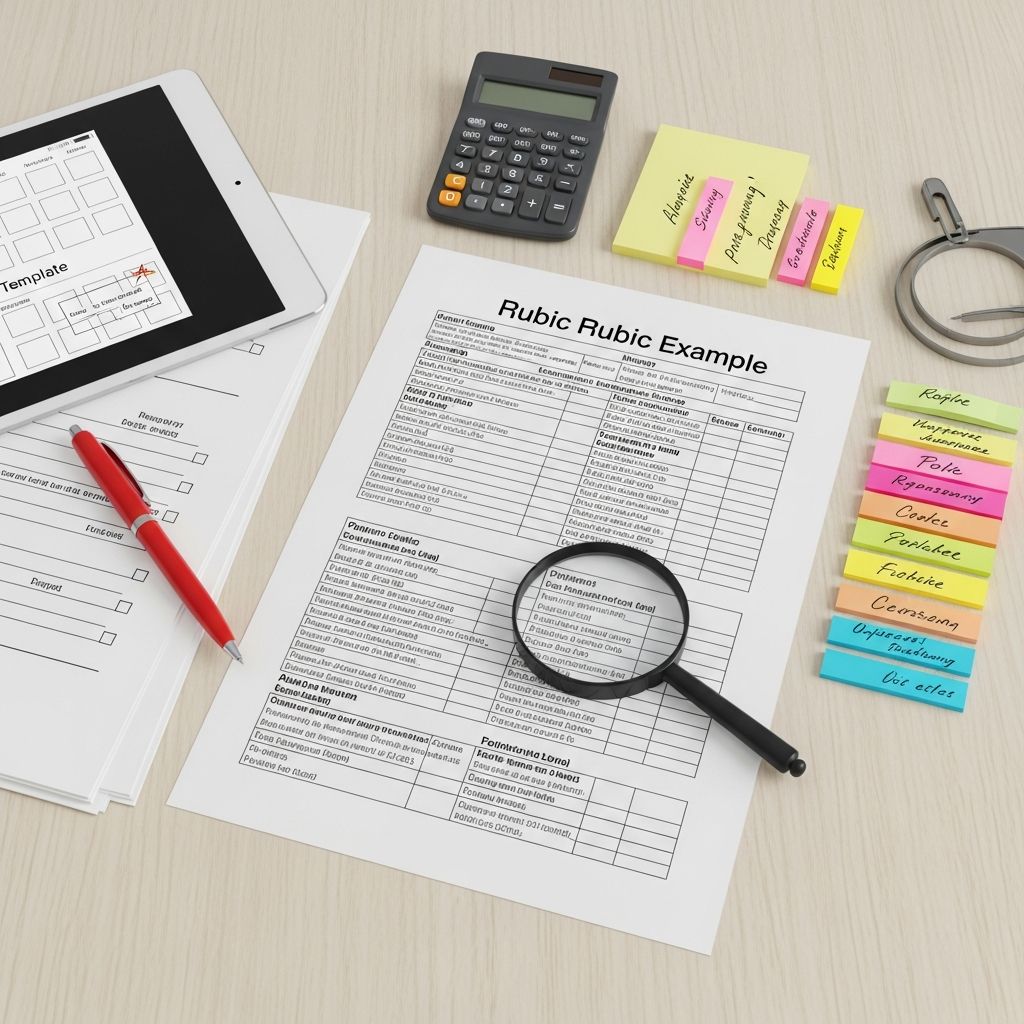
Rubrics serve as structured frameworks that outline clear expectations for student performance, enabling consistent and objective evaluation across various assignments and activities. These tools transform subjective grading into a transparent process, benefiting both instructors and learners by providing explicit standards for success.
Defining Rubrics in Contemporary Education
In educational settings, a rubric functions as a detailed scoring guide that breaks down complex tasks into measurable components. Unlike vague feedback, rubrics specify criteria such as content accuracy, organization, and creativity, paired with performance levels ranging from novice to expert. This approach ensures that evaluations are criterion-referenced, focusing on how well work aligns with predefined standards rather than comparing students against each other.
Originating from traditional uses like liturgical instructions, the term has evolved significantly in academia. Today, it emphasizes fairness and clarity, helping to minimize grader bias and promote inter-rater reliability—where multiple evaluators assign similar scores to the same work.
Core Elements That Make Rubrics Effective
Every well-designed rubric incorporates key building blocks to guide assessment effectively. These include:
- Performance Criteria: Specific traits or dimensions, like ‘depth of analysis’ or ‘use of evidence,’ that define what is being evaluated.
- Performance Levels: A scale, often 3-5 points, with descriptors for each level, such as ‘exemplary,’ ‘proficient,’ or ‘developing.’
- Descriptors: Detailed explanations or examples illustrating what work looks like at each level, making expectations concrete.
- Scoring Strategy: Guidelines for assigning points, sometimes including totals or weights for different criteria.
These components work together to create a roadmap for achievement, allowing students to self-assess and instructors to grade efficiently.
Exploring the Main Types of Rubrics
Rubrics vary in structure to suit different assessment needs. Understanding their distinctions helps educators select the right tool for the task.
Holistic Rubrics: Capturing the Big Picture
Holistic rubrics offer a single, overall score based on a comprehensive impression of the work. They integrate all criteria into broad level descriptions, ideal for quick evaluations of writing or presentations where the whole is greater than the sum of parts.
For instance, a holistic rubric for an essay might describe an ‘excellent’ paper as one with a compelling thesis, logical flow, and flawless mechanics, without breaking it down further. This type suits formative assessments but may overlook specific weaknesses.
Analytic Rubrics: Precision Through Breakdown
Analytic rubrics dissect assignments into separate criteria, scoring each independently. Presented in a grid format, they list traits down one axis and levels across the other, providing granular feedback.
This format excels for complex tasks like research papers, where categories like ‘thesis clarity,’ ‘evidence quality,’ and ‘grammar’ each receive individual ratings. It promotes targeted improvement and detailed reporting.
| Criteria | Exemplary (4) | Proficient (3) | Developing (2) | Beginning (1) |
|---|---|---|---|---|
| Thesis Strength | Clear, insightful, and fully supported | Clear and supported adequately | Vague or partially supported | Missing or unclear |
| Evidence Use | Abundant, relevant, cited perfectly | Sufficient and mostly relevant | Limited or somewhat relevant | Inadequate or irrelevant |
| Organization | Seamless flow with strong transitions | Logical with good transitions | Somewhat logical, weak transitions | Disorganized |
The above table exemplifies an analytic rubric snippet for a term paper, highlighting how scores aggregate for a total grade.
Developmental and General Rubrics
Developmental rubrics track progress over time, emphasizing growth stages rather than end-point mastery, perfect for skill-building in early education. General rubrics apply broadly across assignments, offering flexibility.
Step-by-Step Guide to Crafting Your Own Rubric
Creating a rubric starts with aligning it to learning objectives. Here’s a practical process:
- Identify Objectives: Pinpoint key skills or knowledge from the assignment, like critical thinking or technical proficiency.
- List Criteria: Select 4-7 focused, observable traits. Avoid overlap.
- Define Levels: Choose a scale (e.g., 4-point) and write distinct descriptors, starting from top performance and working down.
- Add Examples: Include anonymized student work samples for each cell to clarify standards.
- Test and Revise: Pilot with sample work, gather feedback, and refine for clarity and fairness.
This method ensures rubrics are user-friendly and legally defensible in high-stakes contexts.
Key Benefits for Teachers, Students, and Institutions
Rubrics revolutionize assessment by fostering equity and efficiency. For teachers, they standardize grading, saving time and reducing disputes—studies show improved accuracy and consistency.
Students gain from upfront clarity, enabling better planning, self-regulation, and goal-setting. They learn to evaluate their own work, building metacognitive skills essential for lifelong learning.
Institutions benefit from reliable data for program evaluation, accreditation, and instructional alignment. Rubrics also support diverse learners by making expectations explicit, aiding those with disabilities or language barriers.
- Enhances feedback quality with specific, actionable insights.
- Promotes validity by directly measuring intended outcomes.
- Encourages curriculum alignment across courses.
Real-World Applications Across Disciplines
Rubrics adapt seamlessly to any subject or format. In science labs, they assess experimental design and data analysis; in arts, creativity and technique.
For group projects, include collaboration criteria. In online learning, they guide peer reviews and multimedia submissions. Even non-traditional assessments like portfolios use rubrics for holistic growth tracking.
High-stakes exams employ them for scorer training, ensuring uniformity.
Overcoming Common Challenges in Rubric Use
Despite advantages, pitfalls exist. Overly complex rubrics confuse users; keep them concise. Vague descriptors lead to inconsistency—use precise language.
Time-intensive creation pays off long-term. Balance detail with usability, and involve students in development for buy-in. Regularly update to reflect evolving standards.
Frequently Asked Questions (FAQs)
What is the primary purpose of a rubric?
A rubric provides clear, structured criteria for evaluating student work, ensuring fairness and transparency in grading.
Holistic vs. Analytic: Which to choose?
Use holistic for overall impressions and quick scoring; analytic for detailed feedback on specific components.
Can rubrics be used for self-assessment?
Yes, they empower students to gauge their own progress against standards, fostering independence.
How many levels should a rubric have?
Typically 3-5 for reliable differentiation without overwhelming complexity.
Are digital tools helpful for rubrics?
Platforms like QuickRubric streamline creation, sharing, and digital grading.
Future Directions for Rubric Innovation
As education embraces AI and adaptive learning, rubrics evolve with automated scoring and personalized feedback. Integration with learning management systems enhances real-time assessment.
Research continues on rubric efficacy, with evidence supporting their role in equity-focused teaching. Forward-thinking educators customize them for inclusive practices, ensuring all students thrive.
References
- Rubric (academic) — Wikipedia. 2023-10-15. https://en.wikipedia.org/wiki/Rubric_(academic)
- What is a Rubric? – A Guide to Creating and Using Analytic Rubrics — QuickRubric. 2023-01-01. https://www.quickrubric.com/about/what-is-a-rubric
- What Is a Rubric and How Can I Use It to Improve My Grades? — Thomas Edison State University. 2023-05-10. https://www.tesu.edu/about/blog/2023/what-is-a-rubric.php
- Assessment Rubrics — University of California, Berkeley Center for Teaching & Learning. 2024-02-20. https://teaching.berkeley.edu/teaching-strategies/assessing-learning/assessment-rubrics
- Your students don’t know what a RUBRIC is – and maybe you don’t either — University of Sussex. 2024-01-25. https://blogs.sussex.ac.uk/tel/2024/01/25/your-students-dont-know-what-a-rubric-is-and-maybe-you-dont-either/
- Using rubrics — Cornell University Center for Teaching Innovation. 2023-11-05. https://teaching.cornell.edu/teaching-resources/assessing-student-learning/using-rubrics
- Types of Rubrics — DePaul University. 2023-09-12. https://resources.depaul.edu/teaching-commons/teaching-guides/feedback-grading/rubrics/Pages/types-of-rubrics.aspx

Medha Deb is an editor with a master's degree in Applied Linguistics from the University of Hyderabad. She believes that her qualification has helped her develop a deep understanding of language and its application in various contexts. Medha specializes in the areas of beauty, health, sports, and wellness and is committed to ensuring that the content on the website is…