
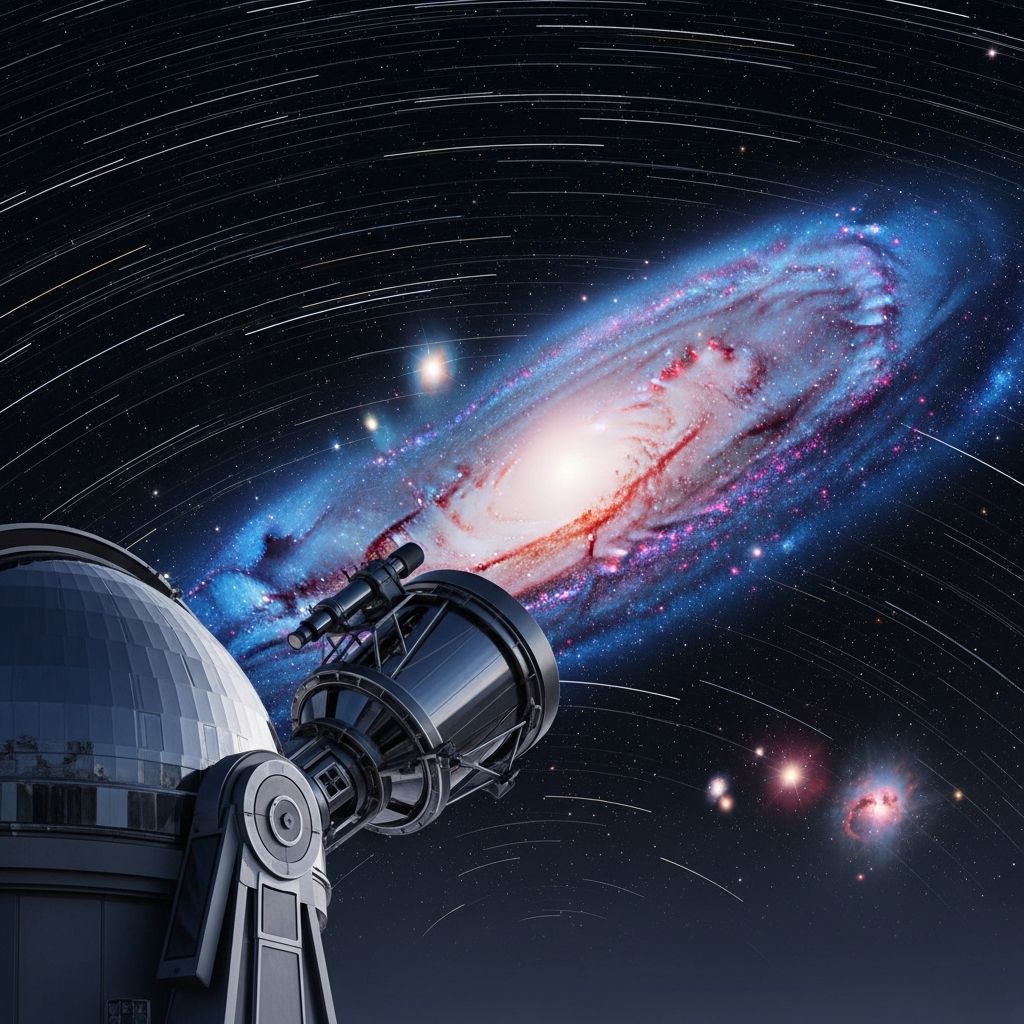
Astronomy stands as humanity’s timeless quest to comprehend the vast expanse beyond Earth, probing the mysteries of stars, planets, and galaxies through rigorous scientific methods. This discipline merges observation with physics, chemistry, and mathematics to decode the universe’s origins and fate.
The Essence of Astronomical Inquiry
At its core, astronomy examines all matter and energy originating outside Earth’s atmosphere, encompassing everything from nearby moons to remote quasars. Unlike astrology, which lacks empirical basis, astronomy relies on testable evidence gathered via telescopes and detectors across the electromagnetic spectrum.
Celestial bodies like planets, stars, nebulae, and galaxies form the primary focus, alongside dynamic events such as supernovae and cosmic microwave background radiation. This field reveals how these entities form, evolve, and interact within the grand cosmic tapestry.
Historical Foundations of Sky-Watching
Astronomy traces back to ancient civilizations, where Egyptians, Babylonians, Greeks, Indians, Chinese, and Maya peoples meticulously tracked celestial movements for calendars, navigation, and agriculture. These early observers cataloged star patterns, predicting eclipses and seasonal shifts without modern instruments.
The Greek term astronomia—meaning ‘star law’—captures this foundational pursuit. By the 17th century, Galileo’s telescope and Newton’s gravity laws transformed it into a quantitative science, shifting from mere prediction to explanatory power.
Core Branches of Modern Astronomy
Astronomy spans diverse subfields, each tackling specific cosmic scales:
- Planetary Astronomy: Investigates solar system bodies, including moons, asteroids, and exoplanets.
- Stellar Astronomy: Analyzes star lifecycles, from birth in nebulae to explosive deaths.
- Galactic Astronomy: Maps the Milky Way’s structure, interstellar dust, and central black hole.
- Extragalactic Astronomy: Studies distant galaxies, clusters, and large-scale structures.
- Cosmology: Explores the universe’s origin, expansion, and ultimate destiny, including Big Bang theory.
Astrophysics, a key branch, applies physical laws to celestial behaviors, distinguishing it from broader astronomical observations.
Observational Techniques and Technologies
Astronomers depend on light across all wavelengths—gamma rays to radio waves—since direct sampling is impossible except for rare meteorites. Ground-based observatories like those on Mauna Kea capture visible and infrared light, while space telescopes such as Hubble and James Webb pierce atmospheric interference.
| Wavelength | Examples | Purpose | Key Instruments |
|---|---|---|---|
| Visible | Stars, planets | Imaging, spectroscopy | Ground telescopes |
| Infrared | Star-forming regions | Dust penetration | James Webb Space Telescope |
| X-ray/Gamma | Black holes, supernovae | High-energy processes | Chandra X-ray Observatory |
| Radio | Pulsars, cosmic background | Maps of gas clouds | ALMA, VLA |
These tools enable spectroscopy to determine compositions, distances via parallax or redshift, and ages through stellar evolution models.
Revealing the Universe’s Building Blocks
Stars forge elements via nuclear fusion, dispersing them through supernovae to seed new generations of planets and life. Galaxies, vast star cities, cluster under gravity, with our Milky Way hosting 100-400 billion stars. The cosmic microwave background, relic radiation from the Big Bang, confirms universe age at 13.8 billion years.
Dark matter, inferred from gravitational effects, comprises 27% of the cosmos, while dark energy drives accelerating expansion. These enigmas propel ongoing research.
Career Paths and Educational Journeys in Astronomy
Aspiring astronomers typically pursue degrees in physics or astronomy, mastering calculus, programming, and data analysis. Roles span academia, observatories, space agencies like NASA, and tech firms developing instruments.
Entry-level positions include observatory technicians or data analysts, evolving to professorships or principal investigators on missions. Public outreach, via planetariums or science communication, also thrives.
Landmark Discoveries Shaping Our Worldview
- Galileo’s 1610 moons of Jupiter, proving heliocentrism.
- Hubble’s 1929 expanding universe, birthing Big Bang theory.
- 1990s exoplanet detections, revealing thousands of worlds.
- 2015 gravitational waves, validating Einstein’s predictions.
- James Webb’s 2022 deepest images, unveiling early galaxies.
These milestones underscore astronomy’s role in fundamental physics breakthroughs.
Challenges Facing Contemporary Astronomy
Light pollution hampers ground observations, while space debris threatens satellites. Massive data volumes from telescopes demand AI-driven analysis. Ethical concerns arise in planetary protection to avoid contaminating other worlds.
Funding competes with earthly priorities, yet international collaborations like the Event Horizon Telescope yield supermassive black hole images.
Frequently Asked Questions (FAQs)
What distinguishes astronomy from astrophysics?
Astronomy broadly studies celestial objects observationally, while astrophysics focuses on their physical properties and processes using physics.
Can amateur astronomers contribute meaningfully?
Yes, through citizen science projects like Zooniverse, classifying galaxies or hunting exoplanets with backyard telescopes.
How do astronomers measure cosmic distances?
Methods include parallax for nearby stars, standard candles like Cepheids for galaxies, and redshift for the farthest objects.
Is there life beyond Earth, per astronomical evidence?
No direct proof exists, but exoplanets in habitable zones and organic molecules on Mars/Enceladus suggest possibilities.
What future missions excite astronomers most?
Nancy Grace Roman Telescope for dark energy, Europa Clipper for icy moon habitability, and Habitable Worlds Observatory for exoplanet atmospheres.
Why Astronomy Matters Today
Beyond pure knowledge, astronomy drives technologies like GPS, medical imaging, and materials science. It fosters global perspective, reminding us of shared cosmic origins: ‘We are star stuff,’ as Carl Sagan noted.
Engaging with astronomy cultivates critical thinking, inspiring future generations to tackle universal questions.
References
- Astronomy — Wikipedia. 2026-04-01. https://en.wikipedia.org/wiki/Astronomy
- What is Astronomy? — Tucson Astronomy. N/A. https://tucsonastronomy.org/astronomy/what-is-astronomy/
- What is Astronomy? — Ohio State University Department of Astronomy. N/A. https://astronomy.osu.edu/undergraduates/prospective/what-astronomy
- Astronomy | Definition, History, Discoveries, & Facts — Encyclopædia Britannica. 2026-03-15. https://www.britannica.com/science/astronomy
- What is Astronomy? — American Museum of Natural History. N/A. https://www.amnh.org/explore/ology/astronomy/what-is-astronomy
- Basics of Astronomy: Exploring the Universe and Night Sky — American Public University. 2026-02-03. https://www.apu.apus.edu/area-of-study/math-and-science/resources/basics-of-astronomy/
- What exactly is astronomy? — American Astronomical Society. N/A. https://aas.org/faq/what-exactly-astronomy

- Integrated M.A. in Applied Linguistics, University of Hyderabad
- 5+ years in editorial, instructional, SEO, and research-based writing
Sneha is a relationships and lifestyle writer with a strong foundation in applied linguistics and certified training in relationship coaching. She brings over five years of writing experience to theskillvault, crafting thoughtful, research-driven content that empowers readers to build healthier relationships, boost emotional well-being, and embrace holistic living. Her writing and insights reflect the belief that beauty, happiness, and wellness…