
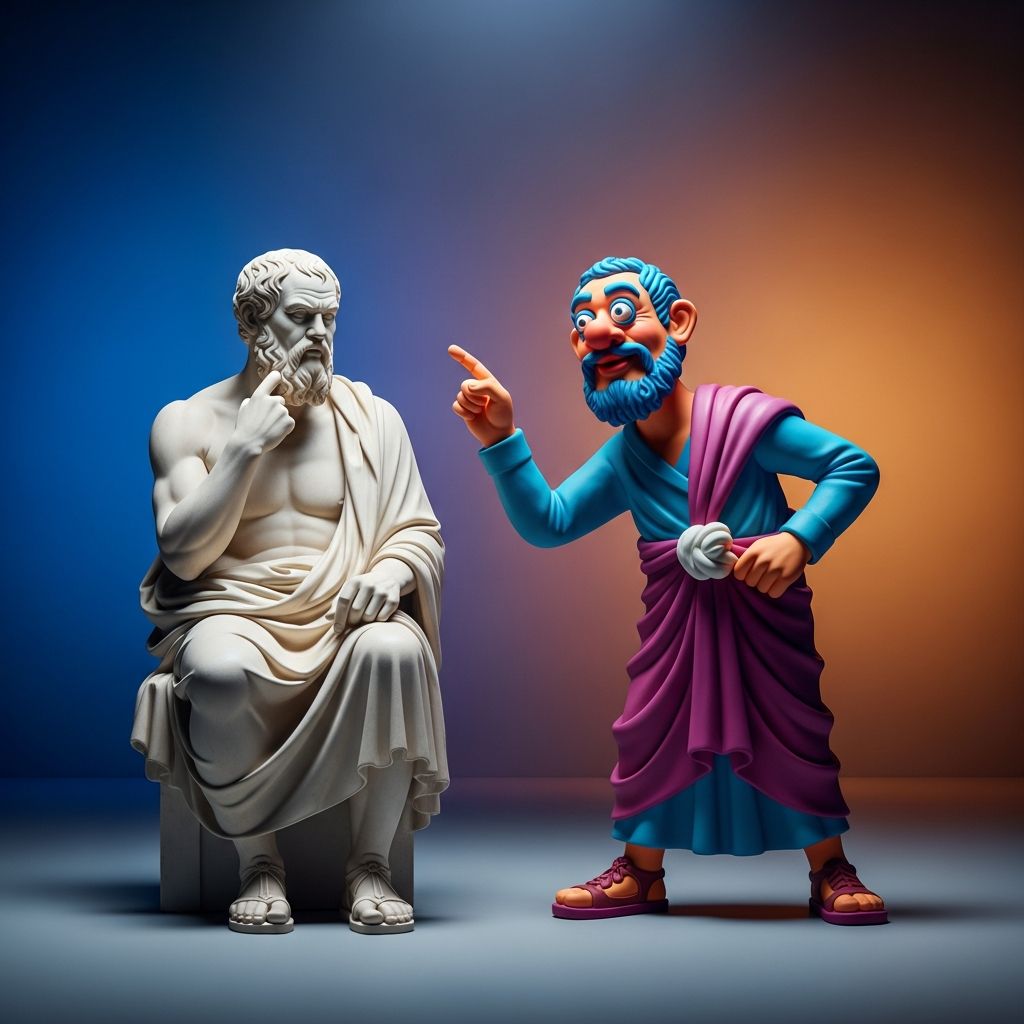
Parody stands as a cornerstone of creative expression, blending imitation with humor to critique or celebrate its subjects. At its core, a parody is a work that closely mimics the style, structure, or content of another creation, often exaggerating elements for comic effect or pointed commentary. This form appears across literature, music, film, and visual arts, serving as both entertainment and cultural mirror.
Defining Parody in Creative Contexts
A parody involves deliberate imitation of a specific source material, such as a book, song, or film, to highlight its quirks through exaggeration or irony. Unlike mere copying, it transforms the original into something new, typically aiming to amuse while subtly critiquing. Literary scholars describe it as a ‘polemical allusive imitation,’ where the parody references its target to provoke thought or laughter.
Key characteristics include:
- Imitation: Faithful recreation of tone, language, or form from the source.
- Exaggeration: Amplifying traits to absurdity, revealing underlying flaws or strengths.
- Humor: Derived from irony, sarcasm, or unexpected twists.
- Commentary: Often critiques societal issues, artistic conventions, or the original work itself.
Parodies can target high art, like epic poems, or pop culture phenomena, making them versatile tools for creators.
Historical Roots and Evolution of Parody
Parody traces back to ancient Greece, where poets like Aristophanes mimicked tragic playwrights in comedies to poke fun at dramatic conventions. This early use established parody as a means to humanize lofty art forms. During the Roman era, writers continued this tradition, imitating epic styles for satirical purposes.
In the Middle Ages and Renaissance, parody flourished in literary circles. Authors parodied chivalric romances and religious texts, blending reverence with ridicule. The 18th and 19th centuries saw parody peak in England with works mocking sentimental novels and political speeches, reflecting Enlightenment values of reason and critique.
The 20th century expanded parody into mass media. Film pioneers like Charlie Chaplin parodied dramatic actors, while modern iterations dominate television and online content. Today, digital platforms enable rapid parody creation, from viral videos to meme culture, democratizing this art form.
Parody Versus Related Literary Devices
While often confused, parody differs distinctly from satire, spoof, and pastiche. The table below clarifies these distinctions:
| Form | Target | Purpose | Example |
|---|---|---|---|
| Parody | Specific work or style | Imitate and mock via exaggeration | Song rewriting a hit with silly lyrics |
| Satire | Real-world vices or society | Criticize through irony or humor | Political cartoons targeting leaders |
| Spoof | Entire genre | Exaggerate conventions for laughs | Films mocking horror tropes |
| Pastiche | Multiple styles | Homage without mockery | Quilt-like blend of influences |
Satire broadly lampoons reality, whereas parody hones in on particular creations. Spoofs generalize, avoiding single targets. This precision makes parody a sharper tool for intertextual dialogue.
Techniques Employed in Crafting Parodies
Successful parodies master several techniques to engage audiences familiar with the original. Writers begin with close stylistic mimicry—adopting vocabulary, rhythm, or visual motifs—before subverting expectations.
Common methods include:
- Hyperbole: Blowing features out of proportion, like turning a hero’s bravery into clownish recklessness.
- Irony: Saying the opposite of what’s meant, often through unreliable narrators.
- Anachronism: Inserting modern elements into historical settings for comedic dissonance.
- Juxtaposition: Pairing lofty subjects with mundane ones, e.g., epic battles over trivial disputes.
- Deflation: Undermining grandeur by revealing banal realities.
These elements ensure the parody resonates only with those knowing the source, fostering a shared cultural wink.
Iconic Parodies Across Literature and Media
Literature offers timeless examples. Jonathan Swift’s A Modest Proposal parodies economic treatises by suggesting eating infants, brutally satirizing poverty policies—though more satire, its imitative style qualifies it. Alexander Pope’s The Rape of the Lock mocks epic poetry by centering a hair-snatching scandal.
In music, ‘Weird Al’ Yankovic exemplifies parody mastery. His ‘Eat It’ mimics Michael Jackson’s ‘Beat It,’ swapping dance rebellion for gluttony, amassing billions of views while respecting fair use.
Film parodies thrive via directors like Mel Brooks. Young Frankenstein imitates Universal monster movies, exaggerating accents and lab mishaps to hilarious effect. Scary Movie spoofs horror franchises by piling clichés into absurdity.
Television sketches, such as Saturday Night Live bits parodying politicians, blend visual mimicry with timely critique, influencing public discourse.
Legal Dimensions: Parody as Protected Speech
In the United States, parody enjoys First Amendment safeguards as transformative expression. Courts distinguish it from infringement by assessing if it critiques the original or adds new meaning. The Supreme Court’s Campbell v. Acuff-Rose Music ruling affirmed 2 Live Crew’s parody of ‘Oh, Pretty Woman’ as fair use, emphasizing market harm absence.
Key legal tests include:
- Transformative Nature: Does it alter the original with commentary?
- Amount Used: Limited to necessary portions.
- Market Impact: Doesn’t supplant the source.
Internationally, protections vary; the EU emphasizes parody exceptions in copyright law. Creators must navigate these to avoid lawsuits, balancing creativity with rights.
Parody’s Role in Modern Culture and Society
Beyond laughs, parody shapes culture by challenging norms. It democratizes critique, allowing amateurs to mock power via memes or TikToks. In politics, parodies humanize leaders, fostering accountability.
Yet, risks exist: misaimed parodies can offend or reinforce stereotypes. Ethical creators ensure targets warrant scrutiny, prioritizing insight over cruelty.
Digital evolution amplifies parody’s reach. AI tools now generate parodies instantly, raising questions on originality. Still, human wit remains irreplaceable.
Frequently Asked Questions About Parody
Is parody always meant to be funny?
No, while humor dominates, some parodies critique seriously without laughs, focusing on flaws.
Can parody be flattering rather than mocking?
Yes, affectionate parodies homage admired works through playful imitation.
How does parody differ from plagiarism?
Parody transforms via commentary; plagiarism copies without adding value.
Are all spoofs parodies?
No, spoofs target genres broadly; parodies focus on specifics.
Is parody legal everywhere?
Protections vary by jurisdiction, but many nations recognize it under fair use or exceptions.
References
- Parody – Wikipedia — Wikipedia contributors. 2023-10-15. https://en.wikipedia.org/wiki/Parody
- What is a Parody — Definition and Examples in Film — StudioBinder. 2023-05-20. https://www.studiobinder.com/blog/what-is-parody-definition/
- What Is Parody | Definition & Examples — Eminent Editing. 2022-11-10. https://www.eminentediting.com/post/what-is-parody
- What is a Parody?: A Literary Guide — OSU School of Writing, Literature and Film (YouTube). 2018-06-12. https://www.youtube.com/watch?v=izMt9fcAzno
- Parody in Literature || Defining Parody — English with Qaiser Sajjad (YouTube). 2021-03-05. https://www.youtube.com/watch?v=QAsugQNEyc4
- PARODY Definition & Meaning — Merriam-Webster. 2023-09-01. https://www.merriam-webster.com/dictionary/parody
- Parody | Wex | US Law — Legal Information Institute, Cornell Law School. 2024-01-22. https://www.law.cornell.edu/wex/parody
- PARODY | definition in the Cambridge English Dictionary — Cambridge University Press. 2024-02-14. https://dictionary.cambridge.org/us/dictionary/english/parody

Medha Deb is an editor with a master's degree in Applied Linguistics from the University of Hyderabad. She believes that her qualification has helped her develop a deep understanding of language and its application in various contexts. Medha specializes in the areas of beauty, health, sports, and wellness and is committed to ensuring that the content on the website is…