
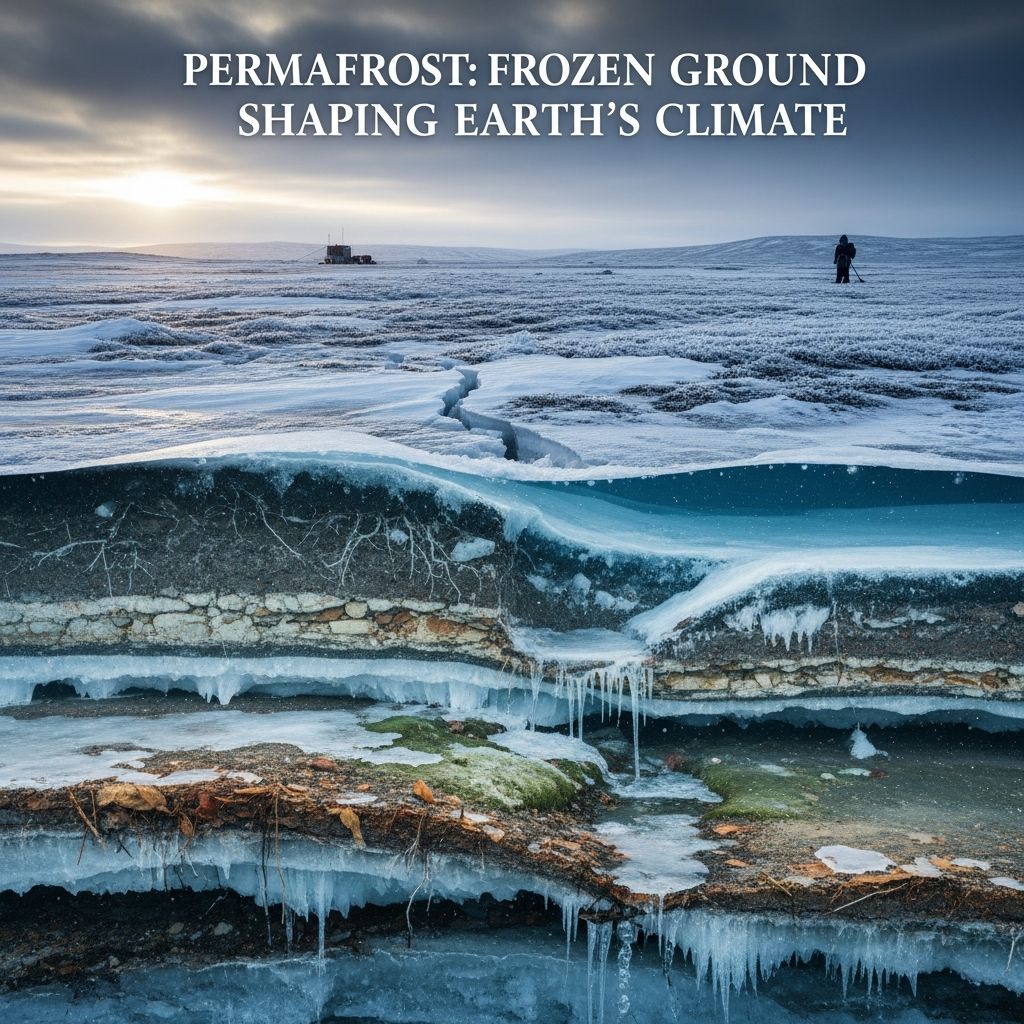
Permafrost represents a critical yet often overlooked component of Earth’s cryosphere, consisting of soil, rock, and ice that remains frozen for at least two consecutive years. This frozen layer underlies approximately 24% of the Northern Hemisphere’s land surface, primarily in Arctic and sub-Arctic regions, playing a pivotal role in global carbon cycles and ecosystem stability.
Defining the Essence of Frozen Ground
At its core, permafrost is ground—comprising soil, gravel, sand, organic matter, and ice—that stays at or below 0°C (32°F) continuously for two years or longer. The term itself, a blend of ‘permanent’ and ‘frost,’ was introduced by geologist Siemon William Muller to describe this enduring icy state. Unlike seasonal frost, permafrost endures through summers and winters, forming during glacial periods like the Pleistocene and persisting into modern times.
This frozen matrix acts like natural cement, binding disparate materials together and creating stable foundations in otherwise harsh environments. Organic carbon from ancient plants, preserved by the cold, accumulates in upper layers, while deeper strata are dominated by mineral-rich soils.
Global Reach and Zonation Patterns
Permafrost blankets vast expanses, covering about 15-24% of the Northern Hemisphere’s exposed land, with the largest extents in Russia, Canada, Alaska, and Scandinavia. It thrives in high-latitude polar zones and high-altitude mountains, even extending beneath the Arctic Ocean.
Scientists classify permafrost into zones based on continuity:
- Continuous permafrost: Covers 90-100% of the landscape, typically where mean annual air temperatures hover around -8°C or lower.
- Discontinuous permafrost: Spans 50-90%, found in transitional areas with temperatures near -5°C.
- Sporadic permafrost: Occurs in 0-50% of the area, more vulnerable to warming.
Approximately 3.6 million people live on or near these zones, relying on the ground’s stability for infrastructure.
The Dynamic Active Layer Above
Overlying permafrost is the active layer, a shallow zone that thaws each summer and refreezes in winter. Its thickness varies: mere centimeters in frigid polar deserts to several meters in warmer sub-Arctic locales. This layer supports seasonal vegetation, facilitates water movement, and exchanges heat with the underlying permafrost.
Seasonal thawing creates soggy, bog-like conditions, promoting rapid runoff and distinctive landscape features like polygonal patterns from ice wedge cracking and refreezing cycles. These polygons, formed over centuries, result from thermal contraction cracking the ground, filling with water that freezes into widening ice veins.
Immense Carbon Reservoirs Beneath the Ice
Permafrost harbors the planet’s largest terrestrial carbon stockpile, estimated at 1,400 billion tons—nearly double the carbon currently in the atmosphere. This includes frozen remnants of ancient tundra plants and even megafauna, undecomposed due to subzero temperatures.
Much of this is in yedoma deposits, organic-rich Pleistocene permafrost high in ice content. As long as it remains frozen, this carbon stays locked away, functioning as a stable sink. However, thawing unleashes soil microbes that metabolize organics, emitting carbon dioxide (CO2) and methane (CH4)—a greenhouse gas 25-80 times more potent than CO2 over short timescales.
| Carbon Comparison | Estimate (Billion Tons) |
|---|---|
| Permafrost Stores | 1,400 |
| Atmospheric Carbon | ~750 |
| Arctic Soil Carbon Fraction | ~33% of global total |
Thawing Triggers and Acceleration
Rising global temperatures, amplified in the Arctic by 2-4 times the planetary average (Arctic amplification), are destabilizing permafrost. Warmer air and soils deepen the active layer, while reduced snow cover allows more winter heat penetration.
Thaw occurs gradually via thermal erosion or abruptly through thermokarst lakes and landslides, where ground collapse exposes deeper ice to melting. Coastlines weaken, exacerbating erosion from storms and sea-level rise as protective sea ice retreats.
Ecosystem and Infrastructure Disruptions
Thawing reshapes Arctic landscapes: wetlands expand, rivers shift, and biodiversity adapts or declines. Wildlife like caribou face altered forage, while aquatic systems receive massive organic influxes, fueling algal blooms.
Human settlements suffer: roads, pipelines, and buildings sink into subsiding ground, costing billions annually. Iconic features like Alaska’s ‘drunken forests’—tilted trees on unstable permafrost—signal widespread instability.
- Water cycle alterations: Increased runoff leads to flooding and drier uplands.
- Vegetation shifts: From tundra to shrublands, reducing albedo and warming further.
- Hydrologic changes: New lakes form, but drainage can create dry thermokarst plateaus.
Climate Feedbacks: A Vicious Cycle
Permafrost thaw exemplifies a positive feedback loop: Warming causes thaw, releasing GHGs that intensify warming. Projections warn that half the world’s permafrost could vanish by 2100 without emissions cuts. Recent estimates suggest up to 2.5 times more carbon locked in permafrost than in the atmosphere as of 2020.
Methane emissions from thawing wetlands pose acute risks, as CH4’s short-term potency could spike warming rates. This could push past climate tipping points, altering global weather patterns and sea levels.
Observing and Modeling Permafrost Changes
Tools like NASA’s satellite imagery reveal polygon thawing and subsidence. Ground sensors track active layer depth, while models integrate these into IPCC scenarios. Boreholes confirm ancient carbon depths up to 1,500 meters.
Indigenous knowledge complements science, documenting landscape shifts over generations.
Mitigation Strategies and Future Outlook
Global emissions reductions are paramount to slow thaw. Localized efforts include insulating infrastructure with thermosyphons—passive cooling pipes—and revegetation to shade ground.
Research prioritizes abrupt thaw prevention and carbon offset quantification. International bodies like the Global Terrestrial Network for Permafrost monitor changes.
Frequently Asked Questions (FAQs)
Where is permafrost primarily located?
Primarily in the Arctic regions of Russia, Canada, Alaska, and Scandinavia, covering 15-24% of Northern Hemisphere land.
How thick can permafrost be?
From a few centimeters to over 1,500 meters (4,900 feet) in ancient Arctic deposits.
What happens when permafrost thaws?
It releases stored carbon as CO2 and methane, destabilizes landscapes, damages infrastructure, and accelerates climate change.
Can permafrost exist in warmer climates?
Yes, sporadically in high mountains or continental interiors where cold snaps persist.
Is all permafrost the same age?
No; some formed recently, but much dates to the last Ice Age, frozen for millennia.
References
- What Is Permafrost and How Is it Emitting Methane? — Earth.Org. 2023. https://earth.org/data_visualization/what-is-permafrost/
- What Is Permafrost? — NASA Science. 2024-01-15. https://science.nasa.gov/kids/earth/what-is-permafrost/
- What is permafrost? — Woodwell Climate Research Center. 2023. https://www.woodwellclimate.org/what-is-permafrost/
- Permafrost — U.S. National Park Service. 2024. https://www.nps.gov/subjects/aknatureandscience/permafrost.htm
- What is Permafrost? — International Permafrost Association. 2023. https://www.permafrost.org/what-is-permafrost/
- Permafrost – what is it? — Alfred Wegener Institute (YouTube Transcript). 2022. https://www.youtube.com/watch?v=lxixy1u8GjY
- Permafrost — MIT Climate Portal. 2024. https://climate.mit.edu/explainers/permafrost
- Why Frozen Ground Matters — National Snow and Ice Data Center. 2020-10-01. https://nsidc.org/learn/parts-cryosphere/frozen-ground-permafrost/why-frozen-ground-matters

Medha Deb is an editor with a master's degree in Applied Linguistics from the University of Hyderabad. She believes that her qualification has helped her develop a deep understanding of language and its application in various contexts. Medha specializes in the areas of beauty, health, sports, and wellness and is committed to ensuring that the content on the website is…