
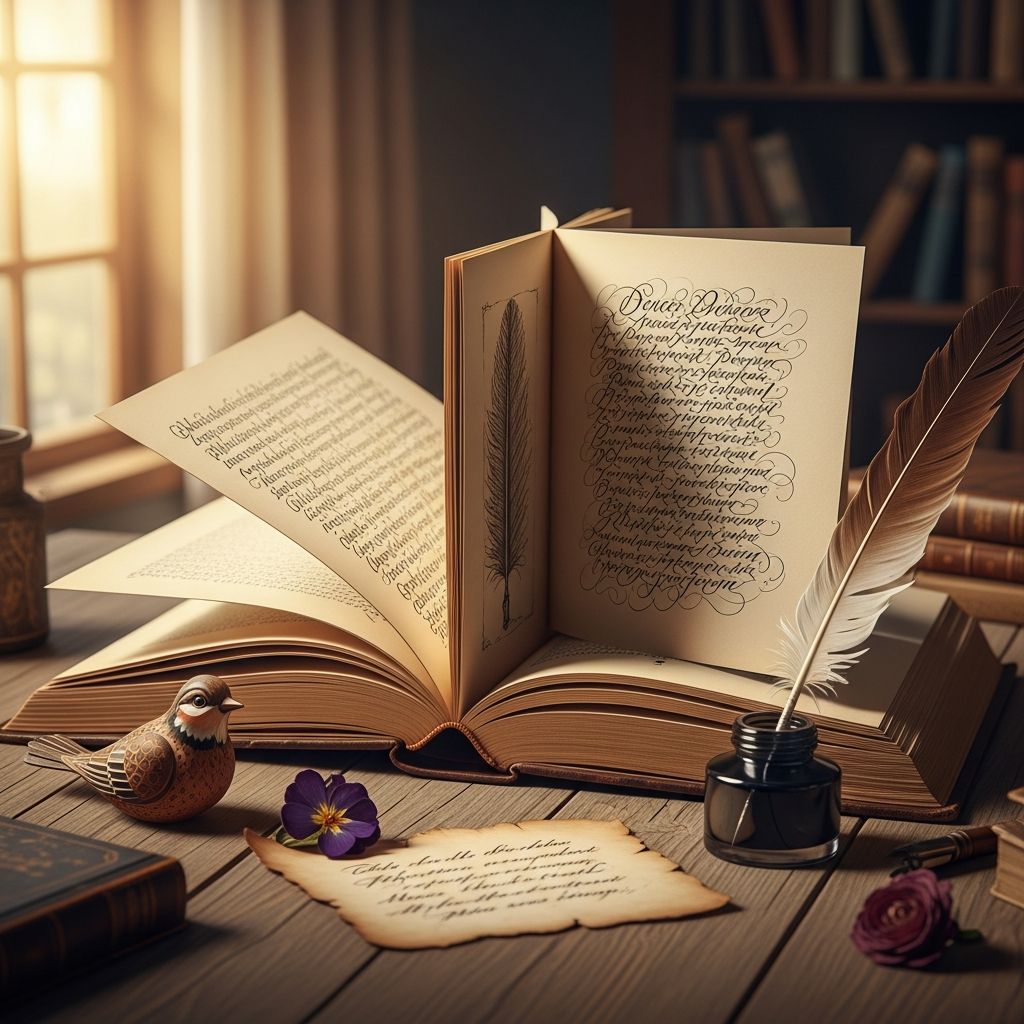
Poetry stands as one of humanity’s oldest and most profound forms of expression, weaving language into tapestries of sound, rhythm, and meaning that resonate deeply within us. Derived from the Greek term poiesis, meaning ‘to make’ or ‘to create,’ it transforms words into something more than mere communication—into art that evokes emotions, paints vivid images, and challenges perceptions.
The Core of Poetic Creation
At its heart, poetry is the deliberate crafting of language to produce aesthetic effects beyond straightforward narrative. Unlike prose, which prioritizes clarity and linear storytelling, poetry employs rhythm, sound patterns, and layered meanings to engage the senses and intellect simultaneously. It often compresses ideas into potent forms, using devices like repetition, metaphor, and ambiguity to invite multiple interpretations.
This creation process positions the poet as a maker, akin to a sculptor shaping marble. Each poem emerges as a unique ‘made thing,’ a verbal construct that captures fleeting human experiences in enduring form. As scholars note, poetry predates written prose in most cultures, originating in oral traditions where rhythm aided memory and communal recitation.
Historical Roots and Evolution
Poetry’s lineage traces back to ancient civilizations. In preliterate societies, it served practical purposes: epics preserved histories, chants invoked rituals, and lyrics celebrated love or war. The Greek root poieo underscores this act of invention, evolving through Latin poesis into modern understandings.
From Homer’s Iliad to Shakespeare’s sonnets, poetry adapted to cultural shifts. The Romantic era redefined it as an ‘overflow of powerful feelings recollected in tranquility,’ emphasizing personal emotion. Today, it spans free verse to structured forms, reflecting diverse voices in a globalized world.
Key Elements That Define Poetry
Poetry distinguishes itself through specific linguistic tools. Here’s a breakdown:
- Rhythm and Meter: The heartbeat of poetry, created by stressed and unstressed syllables. Iambic pentameter, for instance, mimics natural speech patterns.
- Rhyme and Sound Devices: Assonance (vowel echoes), consonance (consonant repetitions), and alliteration enhance musicality.
- Imagery and Figurative Language: Metaphors connect unlike ideas, similes use ‘like’ or ‘as,’ symbolizing deeper truths.
- Lineation and Stanza: Breaks and groupings organize thought, creating pauses for emphasis unlike prose paragraphs.
- Repetition: Refrains or repeated elements build structure and intensity, making patterns palpable.
These elements allow poetry to convey nuance prose cannot, layering literal and symbolic meanings.
Diverse Forms Across Traditions
| Form | Origin | Key Features | Example |
|---|---|---|---|
| Sonnet | Italy/England | 14 lines, iambic pentameter, volta (turn) | Shakespeare’s Sonnet 18 |
| Haiku | Japan | 5-7-5 syllables, nature focus, seasonal reference | Matsuo Bashō’s frog pond |
| Free Verse | Modern West | No fixed meter or rhyme, organic flow | Walt Whitman’s Leaves of Grass |
| Villanelle | France | 19 lines, two refrains, terza rima influence | Dylan Thomas’ ‘Do Not Go Gentle’ |
| Ghazal | Persia/Urdu | Couples with refrain, themes of love/loss | Rumi’s mystical verses |
These forms illustrate poetry’s adaptability, from rigid structures to fluid expressions, each suited to cultural contexts.
Poetry Versus Prose: A Clear Distinction
Prose conveys information sequentially, bound by grammar and logic. Poetry, conversely, prioritizes form and feeling, often subverting syntax for impact. Consider: prose states ‘The sun set behind the mountain’; poetry might evoke ‘Mountains swallow the sun’s final fire.’ The latter stirs imagination through compression and imagery.
Boundaries blur in prose poetry or novelistic verse, yet poetry’s essence lies in its heightened language and evocative power.
The Emotional and Cultural Power of Poems
Poetry captures the ineffable: joy, grief, wonder. It fosters empathy by immersing readers in others’ perspectives. Culturally, it preserves identities—think African griots or Indigenous oral epics.
Neurologically, its rhythms engage brain areas for music and emotion, explaining its memorability. In therapy, it aids expression; in activism, it amplifies voices.
How Poets Craft Their Work
Creation begins with inspiration—observation, emotion, idea. Poets revise meticulously, tuning sound and sense. Tools like diction (word choice) and syntax shape tone. Reading aloud tests rhythm; feedback refines ambiguity.
Modern poets use digital tools for experimentation, yet the core remains human intuition crafting language’s magic.
Poetry in Contemporary Life
Today, poetry thrives on social media (Instagram sonnets), slams, and hip-hop. It addresses climate, identity, inequality. Accessibility grows via apps and open mics, democratizing the art.
Frequently Asked Questions (FAQs)
What makes a piece of writing poetry?
A poem uses rhythmic, aesthetic language with repetition, imagery, or form to evoke emotion beyond literal meaning.
Can anyone write poetry?
Yes—poetry requires no formal training, only willingness to experiment with words and feelings.
Why read poetry?
It sharpens empathy, language skills, and emotional intelligence while offering solace and insight.
Is free verse real poetry?
Absolutely; it relies on organic rhythm and line breaks rather than traditional meter.
How does poetry impact society?
It challenges norms, preserves culture, and inspires change through powerful, memorable expression.
Conclusion: The Enduring Magic
Poetry remains vital, a mirror to the soul and society. Its indefinable essence—rhythm, image, emotion—ensures it evolves yet endures.
References
- Poetry – Wikipedia — Wikipedia contributors. 2023-10-01. https://en.wikipedia.org/wiki/Poetry
- What is Poetry — Poetry.org. Accessed 2023. https://www.poetry.org/whatis.htm
- Poetry | Meaning, Examples, Definition, Types, Terms, & Facts — Encyclopædia Britannica. 2023-09-15. https://www.britannica.com/art/poetry
- Poetry | Academy of American Poets — Poets.org. 2023. https://poets.org/glossary/poetry
- What, Exactly, is Poetry? — Annie Finch. 2022-05-20. https://anniefinch.com/poetics-needs-categories/what-is-poetry/
- What Is Poetry? – Ploughshares — Ploughshares. 2023-02-10. https://pshares.org/blog/what-is-poetry/

Medha Deb is an editor with a master's degree in Applied Linguistics from the University of Hyderabad. She believes that her qualification has helped her develop a deep understanding of language and its application in various contexts. Medha specializes in the areas of beauty, health, sports, and wellness and is committed to ensuring that the content on the website is…