
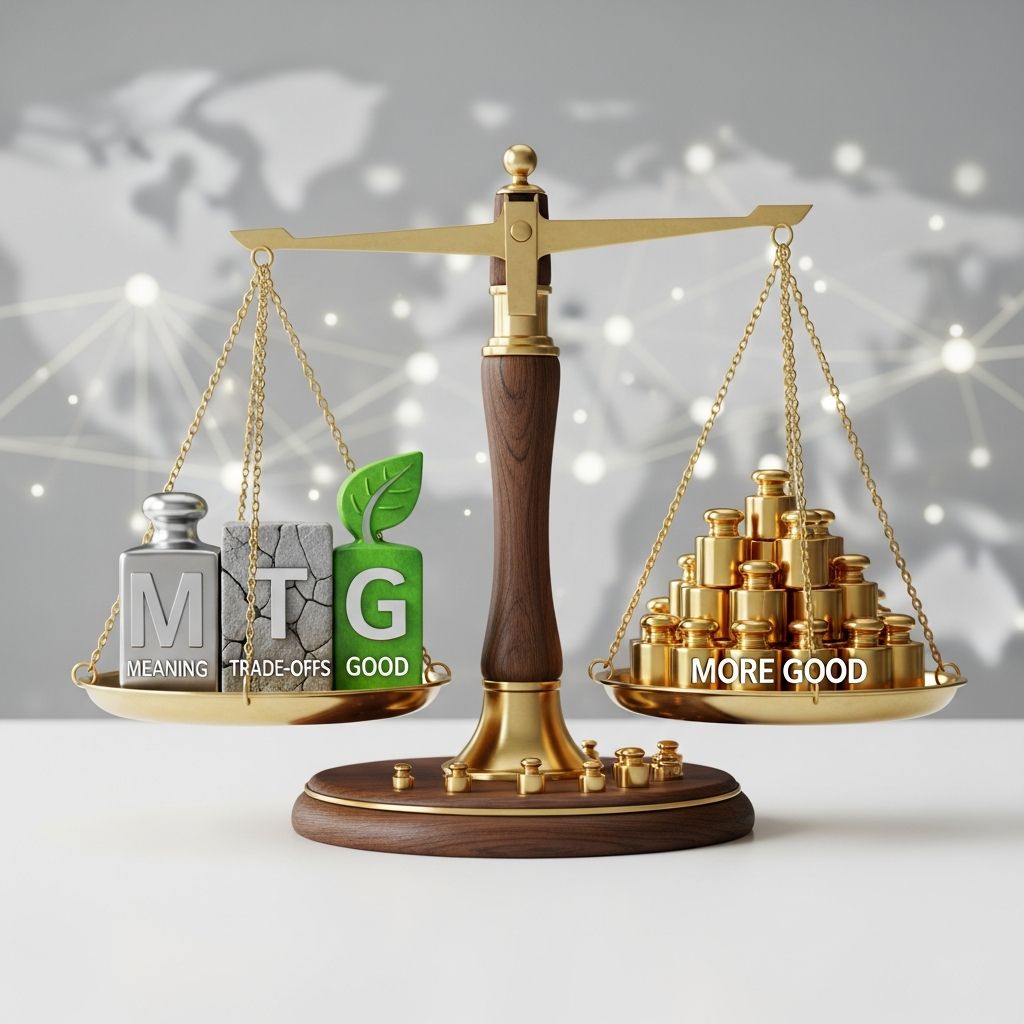
People often say they want to “make a difference,” but it is surprisingly hard to say exactly what that means, compare different ways of helping, or check whether our efforts are working. This article explains a practical way to think about social impact so you can direct your time, money, and career toward doing the most good you can.
1. A Working Definition of Social Impact
At its core, social impact is the effect an action has on the well-being of other people and the world they live in. It includes both positive and negative consequences, intended and unintended, across short and long time horizons.
- Positive social impact: actions that improve lives, reduce suffering, or expand opportunities (for example, vaccinating children, strengthening institutions, or cutting air pollution).
- Negative social impact: actions that worsen health, increase inequality, accelerate climate change, or undermine social trust.
- Mixed impact: actions that help in some ways but also create harms, such as a development project that boosts incomes but displaces local communities.
Modern discussions of impact emphasize lasting changes, not just outputs. Building a school matters less than whether children actually learn more and lead better lives as a result.
2. Why Defining Social Impact Is Harder Than It Looks
Defining social impact raises several tricky questions that are often glossed over in everyday talk about “doing good.”
2.1. Whose well-being counts?
Common views in global health and development treat each person’s well-being as equally important, regardless of nationality, income, or background. This implies:
- A life saved in a low-income country matters just as much as a life saved in a rich one.
- Helping people who are much worse off often produces far larger improvements in well-being per dollar or per hour of effort.
2.2. Which outcomes matter?
Public policy and health economics commonly measure impact using outcomes like:
- Mortality: deaths prevented or years of life saved.
- Morbidity: reductions in illness, pain, or disability, often summarized in metrics such as quality-adjusted life years (QALYs) or disability-adjusted life years (DALYs).
- Economic outcomes: changes in income, wealth, or job quality.
- Subjective well-being: self-reported life satisfaction and happiness.
Different ethical theories weight these differently, but in practice many high-impact interventions improve several of these outcomes at once (for example, malaria prevention increases life expectancy and economic productivity).
2.3. How do we compare very different kinds of good?
Real choices often involve trading off:
- Saving lives now vs. reducing existential risks that could affect future generations.
- Boosting incomes vs. improving health.
- Helping many people by a small amount vs. a few people by a large amount.
Economists and global health researchers use cost-effectiveness analysis and similar tools to make these comparisons more transparent, even if imperfect.
3. Key Dimensions of Social Impact
A helpful way to assess an action’s total impact is to consider four core dimensions that are widely used in philanthropy and impact evaluation.
| Dimension | Guiding Question | Why It Matters |
|---|---|---|
| Scale | How big is the problem, and how big could the impact be? | Large-scale issues like global health, extreme poverty, or climate change create huge potential for impact. |
| Neglectedness | How many resources are already going toward this problem? | Problems with fewer existing resources often offer greater room for additional impact. |
| Tractability | Can additional effort realistically make progress? | Some problems are huge but currently very hard to influence; others respond well to evidence-based interventions. |
| Counterfactual impact | What would have happened if you did nothing? | If others would have done the same work anyway, your unique contribution may be small. |
Using these dimensions together helps avoid focusing only on emotionally salient issues or visible actions and instead highlights where additional effort can do the most good at the margin.
4. Types and Levels of Social Impact
Social impact can be grouped by type of change and by level at which change happens.
4.1. Common types of impact
- Health impact: preventing disease, improving mental health, reducing environmental exposures like air pollution.
- Economic impact: increasing incomes, creating jobs, or improving financial inclusion.
- Educational impact: improving learning outcomes, access to schooling, or early childhood development.
- Environmental impact: cutting greenhouse gas emissions, protecting ecosystems, reducing waste.
- Social and institutional impact: strengthening governance, human rights, or social cohesion.
4.2. Individual, organizational, and systemic impact
Impact occurs at multiple, interconnected levels:
- Individual level: changes in a person’s health, income, or opportunities (for example, one student receiving a scholarship).
- Organizational level: how institutions embed social goals into their strategies, cultures, and operations.
- Systemic level: changes to policies, markets, norms, or technologies that affect large populations (for example, regulatory reforms or global agreements).
System-level changes can sometimes deliver dramatically larger long-term benefits, but they are also harder to achieve and measure.
5. Why Intentions Are Not Enough
Many initiatives are launched with good intentions but have little effect or even cause harm. Social science research and impact evaluations underline several reasons why intentions alone are not a reliable guide to impact.
- Complex systems: economies, health systems, and ecosystems respond in nonlinear and sometimes unexpected ways.
- Unintended consequences: for example, poorly designed aid can distort local markets or create dependency.
- Opportunity cost: resources spent on low-impact projects could instead support proven, cost-effective programs.
- Measurement bias: organizations may highlight easily counted outputs (workshops held, people reached) rather than real changes in lives.
Because of this, high-impact work is usually grounded in evidence, clear theories of change, and a willingness to update or shut down programs that do not work as hoped.
6. How Researchers Measure Social Impact
Different fields have developed methods for assessing social impact more rigorously. While each has strengths and weaknesses, together they provide tools for making more informed decisions.
6.1. Experimental and quasi-experimental studies
In global health and development, randomized controlled trials and related methods help estimate causality: did the program itself cause the observed improvements? For example, large-scale studies have evaluated interventions such as:
- Insecticide-treated bed nets to prevent malaria.
- Cash transfer programs to reduce poverty and improve health.
- Educational interventions like remedial tutoring.
6.2. Cost-effectiveness analysis
Cost-effectiveness compares how much good different options achieve per unit of resource (such as per dollar spent). Global health institutions often express this as cost per QALY gained or DALY averted.
This approach:
- Highlights large differences in impact between programs.
- Supports transparent trade-offs when allocating scarce resources.
- Encourages redirecting funding from less effective to more effective interventions.
6.3. Frameworks for social and environmental performance
Outside global health, organizations use frameworks such as:
- Logic models / theory of change: mapping how inputs lead to activities, outputs, outcomes, and long-term impact.
- Impact reporting standards: structured reporting on environmental, social, and governance (ESG) factors.
- Outcome-based metrics: for example, changes in graduation rates, emissions, or income levels rather than just program participation.
7. Practical Ways to Increase Your Social Impact
Whether you are an individual, a professional, or part of an organization, you can increase your impact by being more intentional and evidence-informed.
7.1. As an individual
- Give where evidence suggests your money goes further: independent evaluators and academic research can point to charities that save or improve lives at relatively low cost, particularly in low-income settings.
- Use your career deliberately: your choice of occupation, sector, and roles can swamp the impact of smaller lifestyle decisions. Roles in research, policy, or high-impact nonprofits may have especially large leverage in some contexts.
- Build scarce skills: expertise in areas like epidemiology, AI safety, climate modeling, or public policy can multiply your long-term impact.
- Advocate thoughtfully: when you speak or vote on public issues, try to understand both evidence and trade-offs, not just slogans.
7.2. As part of an organization
- Clarify your mission in terms of outcomes: define what concrete changes in the world you aim to create.
- Prioritize high-leverage activities: focus on actions that can scale, influence others, or shift systems rather than only doing what is most visible.
- Embed measurement and learning: collect meaningful data, commission independent evaluations where appropriate, and be ready to change course.
- Avoid impact-washing: be transparent about both successes and limitations; overclaiming harms trust and can misdirect resources.
8. Common Pitfalls in Thinking About Social Impact
Several recurring patterns lead well-meaning people to overestimate or misdirect their impact.
- Equating visibility with impact: media coverage or social media engagement does not guarantee that a program meaningfully improves lives.
- Focusing on inputs instead of outcomes: hours volunteered or money spent say little about actual results.
- Ignoring counterfactuals: if someone else would have filled your role or funded the project, your personal contribution is smaller than it appears.
- Short-termism: prioritizing immediate wins over durable changes, such as policy or technological shifts that alter long-term trajectories.
- Narrow moral circles: caring only about nearby or familiar groups can overlook opportunities to help far more people elsewhere.
9. Frequently Asked Questions (FAQs)
Q1: Is social impact only about charity and nonprofits?
No. Governments, businesses, researchers, and individuals all shape social outcomes. Public policies, technologies, and business practices often have larger aggregate impacts—positive or negative—than traditional charity.
Q2: How can I compare working on climate change, global health, and poverty?
Use the dimensions of scale, neglectedness, tractability, and personal fit. Climate change affects the entire planet and future generations; global health and poverty programs often have rigorous evidence and high cost-effectiveness in specific contexts. The best choice may depend on where your skills and opportunities align with large, solvable gaps.
Q3: Do small individual actions, like recycling, really matter?
They can matter symbolically and as part of wider cultural shifts, but research suggests that high-leverage actions—such as supporting effective advocacy, policy change, or highly cost-effective charities—usually produce much larger expected impact per person.
Q4: How certain do we need to be before acting?
Social decisions are often made under uncertainty. Instead of demanding certainty, many researchers recommend acting on the best available evidence while diversifying efforts, seeking robustly good options, and revising decisions as new data arrive.
Q5: Can pursuing personal fulfillment and social impact align?
Often yes. Many people report higher life satisfaction when they feel they contribute to something larger than themselves, and meaningful work can be a major source of purpose. However, maximizing impact may sometimes involve difficult trade-offs, so alignment is not automatic.
References
- Social Impact: What It Means and Why It Matters Today — Sopact. 2023-06-15. https://www.sopact.com/use-case/social-impact
- Social Impact: Meaning, Importance, and How to Measure It — UpMetrics. 2023-04-10. https://blog.upmetrics.com/social-impact
- The best examples of social impact to become a social entrepreneur — Worldpackers. 2022-11-08. https://www.worldpackers.com/articles/social-impact-examples
- 10 Great Examples of Social Impact and Reasons Why They Are Great — Edge of Possible. 2023-08-01. https://edgeofpossible.com/great-examples-of-social-impact-why/
- Social Impact: Definition And Examples 2024 — Virtue Impact. 2024-01-12. https://www.virtueimpact.com/post/social-impact-definition-and-examples-2024
- Social Impact Definition: How to Measure Social Impact — MasterClass. 2021-09-02. https://www.masterclass.com/articles/social-impact

- Integrated M.A. in Applied Linguistics, University of Hyderabad
- 5+ years in editorial, instructional, SEO, and research-based writing
Sneha is a relationships and lifestyle writer with a strong foundation in applied linguistics and certified training in relationship coaching. She brings over five years of writing experience to theskillvault, crafting thoughtful, research-driven content that empowers readers to build healthier relationships, boost emotional well-being, and embrace holistic living. Her writing and insights reflect the belief that beauty, happiness, and wellness…