
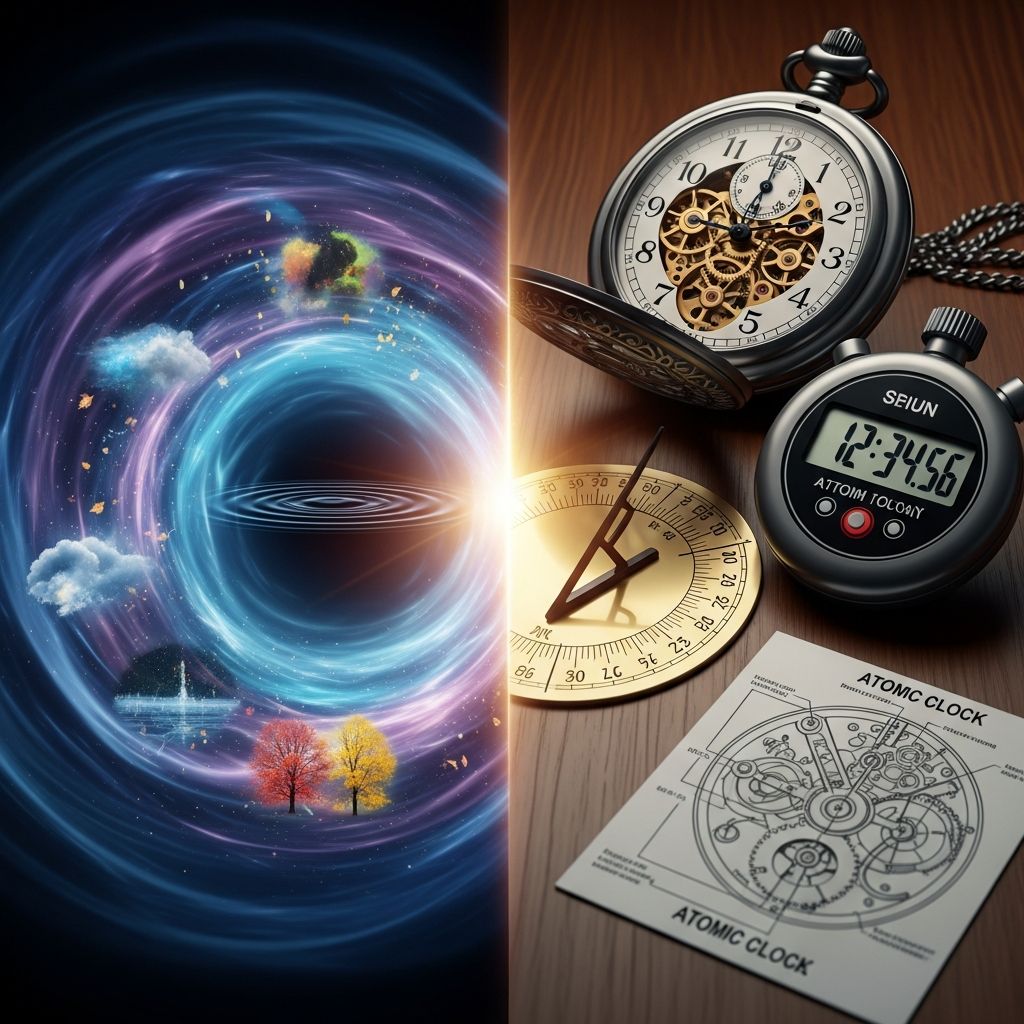
Time governs our daily lives, scientific inquiries, and philosophical musings, serving as the invisible thread connecting past, present, and future. Defined as the continuous progression of existence in an irreversible sequence, time enables us to sequence events, measure durations, and quantify change rates in both material reality and conscious experience.
The Fundamental Nature of Time
At its core, time is a dimension distinct from the three spatial ones, often called the fourth dimension. It lacks spatial extent but forms a continuum where events unfold in a linear order: past precedes present, which anticipates future. This apparent irreversibility, known as the arrow of time, arises from thermodynamic principles like entropy increase, ensuring processes like a shattered glass do not spontaneously reassemble.
Physicists operationally define time as “what a clock reads,” counting periodic events such as the vibrations of a cesium atom defining the SI second. This practical approach sidesteps deeper ontological questions but anchors measurements in repeatable phenomena.
Historical Perspectives on Time
Ancient civilizations tied time to celestial cycles: sundials tracked shadows, water clocks measured flow, and lunar phases guided calendars. Aristotle viewed time as the measure of change between before and after, while Newton later posited absolute time flowing uniformly, independent of observers or space—a universal backdrop for motion.
Isaac Newton’s 17th-century framework treated time as an arrow traveling straight, with identical seconds everywhere in the cosmos, from Earth to distant planets. This classical view dominated until challenged by relativity.
Time in Modern Physics: Relativity’s Revolution
Albert Einstein’s special relativity (1905) shattered Newton’s absolutes, revealing time as relative to the observer’s velocity. Time dilation occurs: for a moving clock, intervals lengthen compared to a stationary one, formalized as \( t’ = t / \sqrt{1 – v^2/c^2} \), where \( v \) is speed and \( c \) is light speed.
Hermann Minkowski’s 1908 insight fused space and time into space-time, a four-dimensional manifold with coordinates (x, y, z, ct). Here, time joins space mathematically, but events trace worldlines influenced by motion.
General relativity (1915) further integrates gravity as space-time curvature caused by mass-energy. Near massive bodies like black holes, time slows dramatically—a phenomenon verified by GPS satellites adjusting for weaker gravitational fields.
Quantum Mechanics and the Time Challenge
In quantum theory, time remains a parameter, not an observable operator like position or momentum. The Schrödinger equation evolves states with respect to time: \( i\hbar \partial \psi / \partial t = H \psi \), treating it classically.
Reconciling quantum mechanics with general relativity in quantum gravity theories, like loop quantum gravity, suggests time might emerge from more fundamental discrete structures, challenging its continuum status.
| Theory | View of Time | Key Implication |
|---|---|---|
| Newtonian | Absolute, uniform flow | Same everywhere, independent of motion |
| Special Relativity | Relative to velocity | Time dilation for fast-moving objects |
| General Relativity | Curved with space | Gravitational time dilation |
| Quantum | Background parameter | Emergent in some theories |
Measuring Time: From Sundials to Atomic Clocks
Human-scale timekeeping relies on Earth’s rotation (day), orbit (year), and Moon’s phases (month). The Gregorian calendar refines solar years to 365.2425 days, averting drift.
Modern precision uses atomic clocks: cesium-133 atoms oscillate 9,192,631,770 times per second, defining the SI second since 1967. Optical lattice clocks now surpass this, with accuracies rivaling part in 10^18, vital for relativity tests and GPS.
- Cesium Fountain Clocks: NIST-F2 achieves 1-second-in-300-million-years accuracy.
- Optical Clocks: Use strontium or ytterbium for femtosecond precision.
- Applications: Synchronize global networks, detect gravitational waves.
Biological and Psychological Dimensions of Time
Biological clocks regulate circadian rhythms via suprachiasmatic nucleus, syncing to 24-hour light-dark cycles. Heartbeats, respiration, and sleep-wake patterns mark personal time, though subjective perception varies—time flies in joy, drags in boredom.
Psychologically, time relates to consciousness; Henri Bergson argued quantitative clock-time (temps) differs from qualitative duration (durée), emphasizing lived experience over spatialized measurement.
Philosophical Debates: Does Time Truly Exist?
Presentism holds only the present exists; past is memory, future potential. Eternalism, supported by relativity, posits all times equally real in a block universe, where future events are as fixed as past ones.
McTaggart’s A-series (past-present-future) contrasts B-series (earlier-later), questioning time’s reality if tensed properties lead to contradictions. Relational theories see time as derived from event changes, absent in a static universe.
Time Dilation: Real-World Evidence
Experiments confirm relativity:
- Muons from cosmic rays live longer due to speed-induced dilation.
- Atomic clocks on airplanes run slower than ground counterparts (Hafele-Keating, 1971).
- GPS: Satellite clocks tick faster by 38 microseconds/day without corrections.
Future Frontiers: Time in Cosmology and Beyond
The Big Bang marks cosmic time’s start 13.8 billion years ago, with expansion stretching space-time. Black hole event horizons halt external time progression. In quantum cosmology, time may not be fundamental; Wheeler-DeWitt equation yields timeless wavefunctions.
Emerging ideas like causal set theory discretize space-time, potentially quantizing time itself.
Frequently Asked Questions
What is the arrow of time?
The arrow of time describes time’s unidirectional flow, driven by increasing entropy, distinguishing past from future.
Does time travel exist?
Forward time travel via dilation is real (e.g., astronauts age slightly less), but backward travel violates causality and known physics.
Is time an illusion?
Philosophers debate this; relativity’s block universe suggests all moments coexist, making flow illusory, yet we experience passage.
How accurate are atomic clocks?
They lose less than a second over billions of years, underpinning global time standards.
What is space-time?
A four-dimensional continuum merging space and time, curved by mass, per Einstein’s relativity.
References
- Time – Wikipedia — Wikipedia contributors. 2026 (continuously updated). https://en.wikipedia.org/wiki/Time
- Time | Definition, History, Measurement, & Facts — Encyclopædia Britannica. 2023-10-15. https://www.britannica.com/science/time
- Time — Internet Encyclopedia of Philosophy. 2024 (accessed). https://iep.utm.edu/time/
- What is time? – Space — Space.com. 2023-05-25. https://www.space.com/time-how-it-works
- Time.is – exact time, any time zone — Time.is. 2026 (real-time). https://time.is

Medha Deb is an editor with a master's degree in Applied Linguistics from the University of Hyderabad. She believes that her qualification has helped her develop a deep understanding of language and its application in various contexts. Medha specializes in the areas of beauty, health, sports, and wellness and is committed to ensuring that the content on the website is…