
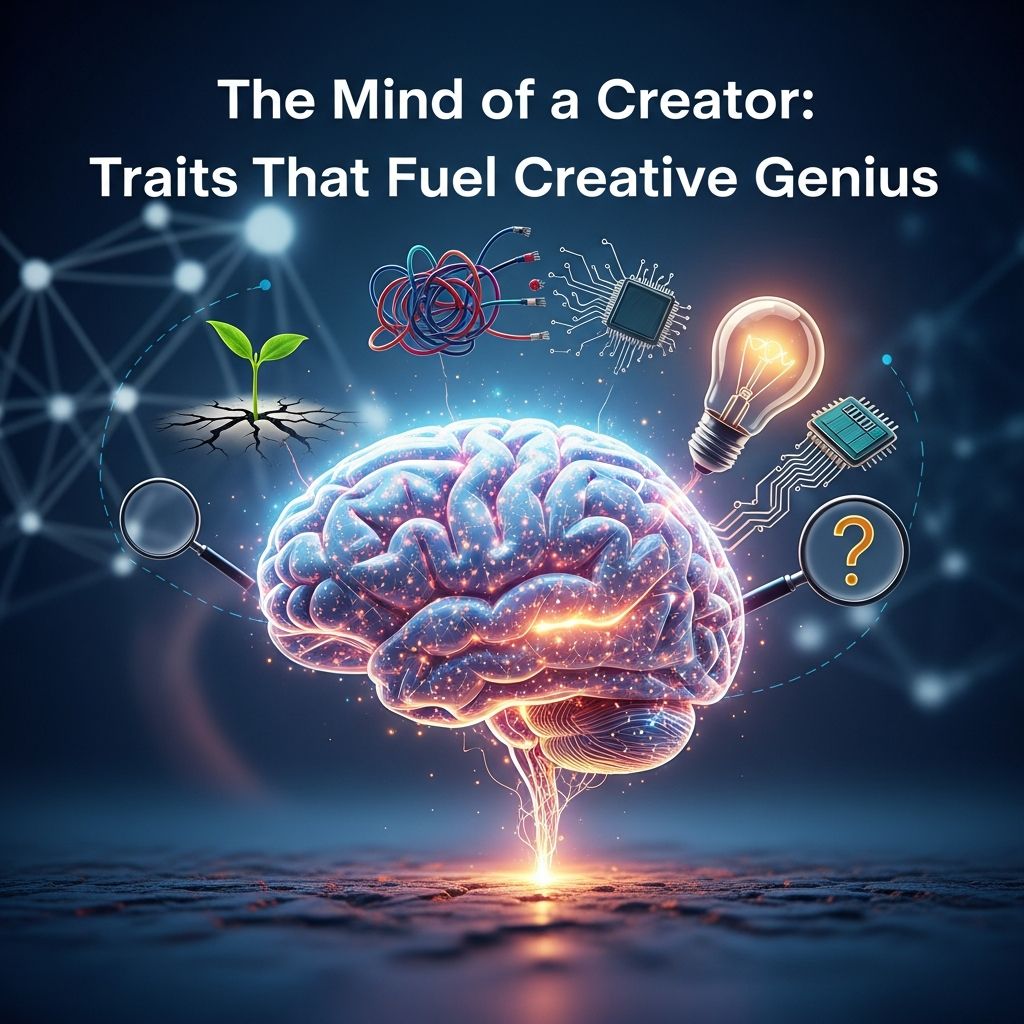
The Inner World of Creative Thinkers
Behind every breakthrough idea, every original work of art, and every innovative solution lies a particular kind of mind. Creative people are not simply those who paint, write, or design; they are individuals whose thinking patterns, emotional responses, and behavioral tendencies diverge from conventional norms in ways that make originality possible. Their minds operate in a state of constant exploration, balancing seemingly opposing forces—curiosity and focus, playfulness and discipline, sensitivity and resilience. Understanding this inner landscape is key to recognizing, nurturing, and collaborating with creative talent.
Openness: The Foundation of Creative Thought
Among all personality dimensions, openness to experience stands out as the most consistent predictor of creative achievement. This trait encompasses a deep desire to explore ideas, emotions, aesthetics, and unfamiliar experiences. Creative individuals are rarely content with surface-level understanding; they seek complexity, nuance, and depth.
Openness manifests in several ways:
- Intellectual curiosity – a relentless drive to learn, question assumptions, and engage with abstract concepts.
- Aesthetic sensitivity – an appreciation for beauty, form, and emotional resonance in art, music, design, and language.
- Emotional depth – a willingness to confront and express complex feelings, often drawing from personal and universal emotional experiences.
- Imaginative thinking – the ability to generate vivid mental images, hypothetical scenarios, and alternative realities.
People high in openness are more likely to experiment with new ideas, embrace ambiguity, and tolerate uncertainty—conditions that are essential for creative breakthroughs. They are less bound by tradition and more willing to challenge established norms, which allows them to see possibilities where others see only constraints.
Curiosity as a Driving Force
If openness is the soil, curiosity is the seed that grows into creative work. Creative individuals are not passive consumers of information; they are active seekers of knowledge. They ask “why,” “how,” and “what if” not just in their professional domains but across disciplines, cultures, and everyday experiences.
This curiosity is not random; it is often highly focused and persistent. A creative scientist might spend years investigating a single phenomenon, while a writer might immerse themselves in history, psychology, or philosophy to enrich their storytelling. The key is that curiosity is not just about gathering facts—it is about making connections between seemingly unrelated domains.
Research in cognitive psychology shows that creative people excel at divergent thinking: the ability to generate multiple, varied solutions to a problem. This capacity is fueled by a broad knowledge base and a habit of exploring ideas for their own sake, not just for immediate utility.
Flexibility and Cognitive Agility
Creative minds are characterized by cognitive flexibility—the ability to shift perspectives, adapt to new information, and approach problems from multiple angles. This is not just about being open-minded; it is about actively restructuring one’s thinking in response to changing circumstances.
Flexible thinkers:
- Can move between abstract and concrete thinking as needed.
- Are comfortable with ambiguity and can tolerate incomplete or conflicting information.
- Are willing to abandon a favored idea when evidence suggests a better alternative.
- Can integrate insights from different fields, leading to interdisciplinary innovation.
Neuroscientific studies suggest that highly creative individuals can simultaneously activate brain networks that are typically at odds with each other—such as the default mode network (associated with imagination and daydreaming) and the executive control network (associated with focused attention and evaluation). This neural flexibility allows them to juggle contradictory modes of thought and produce novel, yet coherent, ideas.
Playfulness and Seriousness in Balance
One of the most striking paradoxes of the creative personality is the coexistence of playfulness and seriousness. Creative people often approach problems with a sense of experimentation, treating ideas as toys to be rearranged, combined, and tested. This playful attitude reduces the fear of failure and encourages risk-taking.
At the same time, they are deeply serious about their work. They invest significant time, energy, and emotional commitment into refining and perfecting their ideas. This combination allows them to:
- Generate a large volume of ideas without premature self-censorship.
- Subject those ideas to rigorous evaluation and refinement.
- Defend their vision when necessary, while remaining open to constructive feedback.
Playfulness fuels exploration; seriousness ensures execution. Without play, creativity becomes rigid and formulaic. Without seriousness, it remains unstructured and unrealized.
Independence and Nonconformity
Creative individuals often exhibit a strong sense of independence. They are less likely to conform to social or professional expectations simply because “that’s how it’s always been done.” This nonconformity is not mere rebellion; it is a principled stance rooted in a desire to find better ways of doing things.
Key aspects of this independence include:
- Autonomy in thinking – forming their own opinions rather than relying on authority or consensus.
- Self-direction – setting their own goals and working toward them with minimal external supervision.
- Resistance to groupthink – challenging assumptions and offering alternative perspectives, even when unpopular.
- Willingness to take risks – pursuing ideas that others might dismiss as impractical or too ambitious.
This independence can sometimes be misunderstood as arrogance or aloofness, but it is more accurately a reflection of deep conviction and a commitment to originality. Creative people are often willing to endure criticism, rejection, or isolation if it means staying true to their vision.
Risk-Taking and Tolerance for Failure
Innovation requires stepping into the unknown, and creative people are generally more comfortable with uncertainty than most. They understand that not every idea will succeed, and they view failure not as a personal defect but as an inevitable part of the creative process.
Highly creative individuals typically:
- Are willing to test unconventional ideas, even when success is uncertain.
- See mistakes as learning opportunities rather than definitive judgments of ability.
- Persist through setbacks, often refining and iterating on failed attempts.
- Are motivated by intrinsic rewards (curiosity, mastery, expression) rather than external validation alone.
This tolerance for failure is closely linked to self-confidence. Creative people often possess a strong belief in the value of their work, even when others do not immediately recognize it. This inner confidence allows them to continue working in the face of doubt, criticism, or lack of immediate results.
Emotional Sensitivity and Depth
Creative individuals are often more emotionally sensitive than average. They experience emotions more intensely and are more attuned to the emotional undercurrents in themselves and others. This sensitivity can be both a strength and a challenge.
On the positive side, emotional depth:
- Enriches artistic expression and storytelling.
- Enhances empathy, allowing for deeper connections with audiences or collaborators.
- Provides raw material for creative work, as personal and observed emotional experiences become sources of inspiration.
On the other hand, this sensitivity can make creative people more vulnerable to stress, anxiety, and self-doubt. The same intensity that fuels powerful work can also lead to emotional exhaustion if not managed with self-awareness and healthy boundaries.
Passion and Intrinsic Motivation
At the heart of creative achievement is passion. Creative people are typically driven by a deep, internal motivation to explore, create, and express. This is not the same as external rewards like money, fame, or status; while these may be welcome, they are rarely the primary driver.
Intrinsic motivation manifests as:
- A genuine love for the process of creating, not just the end product.
- A willingness to invest time and effort without immediate payoff.
- A sense of purpose or mission that transcends personal gain.
- Resilience in the face of obstacles, because the work itself is meaningful.
Studies of highly creative individuals across fields—from science to the arts—consistently highlight passion as a key factor in sustained creative output. When people are intrinsically motivated, they are more likely to persist through challenges, experiment freely, and produce work that is both original and authentic.
Discipline and Persistence
Contrary to the stereotype of the erratic, undisciplined artist, creative success almost always requires discipline and persistence. Ideas are only the beginning; turning them into reality demands consistent effort, focus, and the ability to work through periods of doubt and stagnation.
Creative individuals who achieve lasting impact typically:
- Establish routines and habits that support regular creative work.
- Set goals and structure their time to balance exploration with execution.
- Push through creative blocks rather than waiting for inspiration to strike.
- Revise and refine their work repeatedly, often over long periods.
This disciplined approach is what separates occasional flashes of brilliance from sustained creative contribution. It is the bridge between inspiration and impact.
Self-Confidence and Humility in Tension
Another paradox in the creative personality is the coexistence of self-confidence and humility. Creative people often have a strong belief in their unique perspective and the value of their work, yet they also recognize the limits of their knowledge and the importance of learning from others.
This balance allows them to:
- Defend their vision when necessary, without becoming rigid or defensive.
- Accept criticism and feedback as tools for improvement.
- Collaborate effectively, valuing others’ contributions while maintaining their own voice.
- Stay open to growth and evolution throughout their careers.
Extreme self-confidence without humility can lead to arrogance and isolation; extreme humility without self-confidence can result in self-doubt and underachievement. The most effective creative individuals navigate this tension skillfully.
Practical Implications: Nurturing Creative Potential
Understanding the traits of creative people is not just an academic exercise; it has real-world implications for education, leadership, and personal development.
In Education
- Encourage curiosity and exploration, not just rote learning.
- Value divergent thinking and multiple solutions to problems.
- Provide opportunities for interdisciplinary learning and creative expression.
- Teach students to tolerate ambiguity and learn from failure.
In the Workplace
- Create environments that support autonomy and experimentation.
- Recognize and reward risk-taking and innovation, not just efficiency.
- Allow time for reflection, daydreaming, and unstructured thinking.
- Foster psychological safety so that people feel safe sharing unconventional ideas.
For Personal Growth
- Cultivate openness by exposing yourself to new experiences, ideas, and cultures.
- Practice curiosity by asking questions and seeking deeper understanding.
- Develop discipline through consistent creative practice, even when motivation is low.
- Balance playfulness and seriousness in your approach to projects.
Frequently Asked Questions
Q: Are creative people born or made?
A: While some people may have a natural inclination toward creativity, creative thinking can be developed through practice, exposure to diverse experiences, and deliberate effort. Traits like openness, curiosity, and flexibility can be nurtured over time.
Q: Do creative people tend to be more introverted?
A: Creative individuals vary widely in their social preferences. Some are highly introverted and thrive in solitude, while others are extroverted and energized by collaboration. Many fall somewhere in between, functioning as ambiverts who can work effectively in both settings.
Q: Is there a link between creativity and mental health?
A: Research suggests that creative individuals may be more prone to certain emotional challenges due to heightened sensitivity and intensity. However, creativity can also be a powerful tool for emotional regulation, self-expression, and resilience. The relationship is complex and varies greatly from person to person.
Q: How can I become more creative?
A: You can enhance creativity by cultivating curiosity, exposing yourself to new experiences, practicing divergent thinking, allowing time for daydreaming and reflection, and embracing failure as part of the learning process. Regular creative practice in any domain—writing, drawing, problem-solving, or even cooking—can strengthen creative muscles over time.
Q: Are scientists as creative as artists?
A: Absolutely. Scientific discovery requires imagination, hypothesis generation, and the ability to see patterns and connections that others miss. Many of the greatest scientific breakthroughs have come from creative leaps, not just logical deduction. Creativity is essential in both the arts and sciences.
References
- Openness to Experience and Creative Achievement: A Meta-Analysis — Psychology Bulletin, 2005. https://doi.org/10.1037/0033-2909.131.4.528
- Neural Mechanisms of Creative Cognition — Harvard University, 2018. https://news.harvard.edu/gazette/story/2018/03/neural-mechanisms-of-creative-cognition/
- Ten Habits of Highly Creative People — Greater Good Science Center, UC Berkeley. https://greatergood.berkeley.edu/article/item/ten_habits_of_highly_creative_people

- Integrated M.A. in Applied Linguistics, University of Hyderabad
- 5+ years in editorial, instructional, SEO, and research-based writing
Sneha is a relationships and lifestyle writer with a strong foundation in applied linguistics and certified training in relationship coaching. She brings over five years of writing experience to theskillvault, crafting thoughtful, research-driven content that empowers readers to build healthier relationships, boost emotional well-being, and embrace holistic living. Her writing and insights reflect the belief that beauty, happiness, and wellness…