
Your resume only has a few seconds to convince a recruiter that you are worth a closer look. To make those seconds count, you need the right sections, in the right order, with the right details.
This guide walks you through every part of a modern resume: what is mandatory, what is optional, and how to decide what to include for your situation.
Core Sections Every Resume Should Include
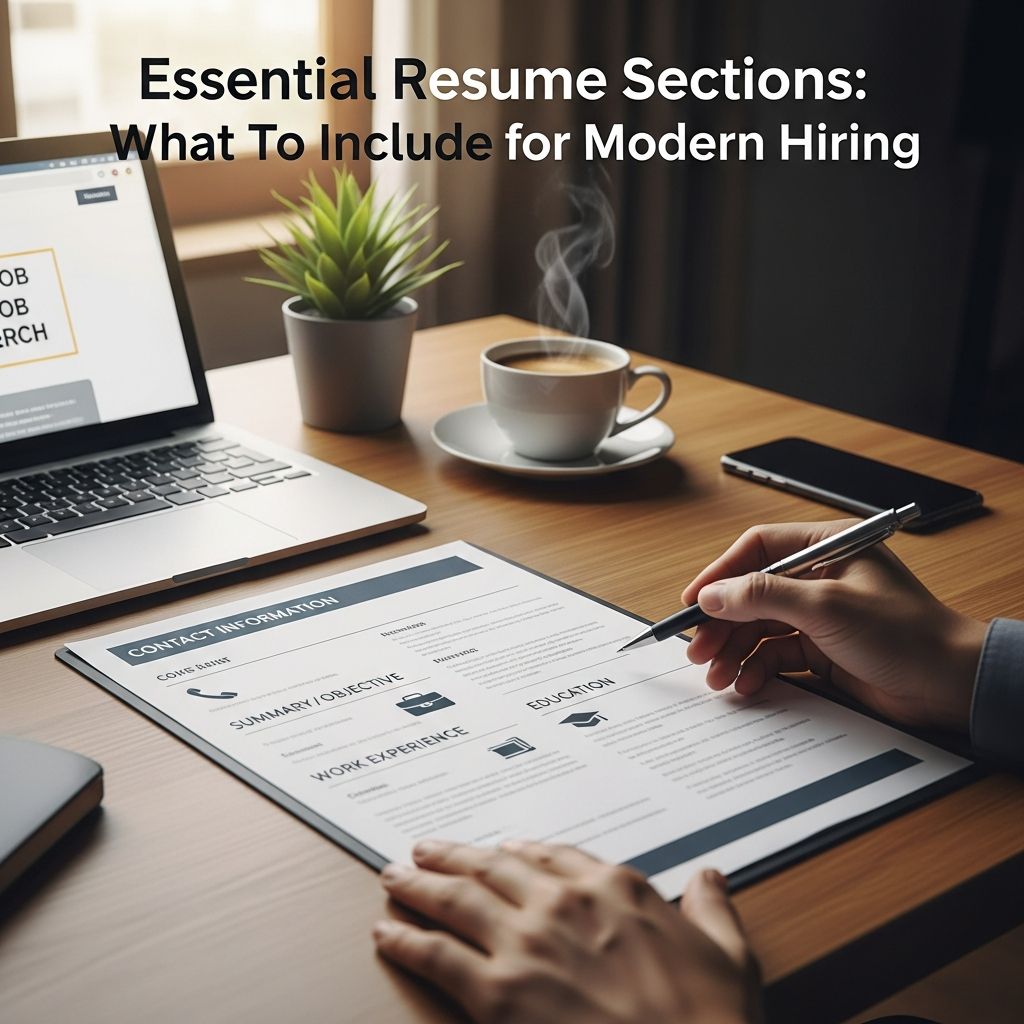
Most career services and employer guides agree that strong resumes share the same foundational building blocks: clear identification, a concise profile, evidence of experience, skills, and education.
- Contact and headline
- Professional summary or objective
- Work experience
- Skills
- Education
Once these are in place, you can add optional sections strategically, depending on your career stage and goals.
Contact Details and Headline: Start Strong
The top of your resume should instantly answer two questions: Who are you? and What do you do?
Must-have contact information
- Full name – Use the name you use professionally.
- Phone number – A mobile number that you reliably answer.
- Professional email – A simple address that includes your name (avoid nicknames or outdated providers).
- Location – Typically city and state/region; full address is no longer required in most markets.
Optional but powerful additions
- Target job title – A headline like “Senior Data Analyst” or “Entry-Level Marketing Coordinator” aligned with the role.
- LinkedIn profile – Only if it is complete and matches your resume.
- Online portfolio or GitHub – Essential in design, writing, software, and research-heavy roles.
Profile Section: Summary or Objective?
Under your name and contact details, include a short paragraph or set of bullet points that set the tone for the rest of your resume. Research from major career centers shows this helps employers quickly understand your fit.
| Type | Best for | What to focus on |
|---|---|---|
| Professional summary | Experienced candidates, career climbers | Key achievements, years of experience, signature skills, industry focus |
| Career objective | Students, recent graduates, career changers | Career goals, relevant coursework, transferable skills, what you want to contribute |
What to include in 2–4 impactful lines
- Who you are professionally (e.g., “Human resources generalist” or “Computer science graduate”).
- Relevant experience or education (years, industries, or key projects).
- Top 3–5 strengths matched to the job description.
- A hint of results (e.g., improved, reduced, increased, delivered) using measurable outcomes where possible.
Work Experience: The Proof of Your Value
For most hiring decisions, the work experience section carries the most weight. Employer and university guidance consistently recommends a reverse-chronological format: most recent role first, then work backwards.
Essential elements for each role
- Job title – Use the official title; if unclear, add a brief clarifier.
- Company name and location – City and country (or state).
- Dates of employment – Month and year for start and end, or “Present” for current roles.
- 3–6 bullet points describing your responsibilities and achievements.
How to write high-impact bullet points
Career experts recommend emphasizing accomplishments over duties and using strong action verbs and numbers where possible.
- Open with an action verb: led, analyzed, created, implemented, improved.
- Describe the task or challenge you handled.
- Highlight the result using metrics when available (percentages, time saved, revenue, cost reductions).
- Connect results to business outcomes (customer satisfaction, efficiency, quality, revenue).
Adapting if you have limited experience
- Students and graduates – Include internships, part-time work, campus jobs, and major projects that mimic workplace tasks.
- Career changers – Focus on roles where you used transferable skills such as communication, data analysis, leadership, or planning.
- Employment gaps – Consider including freelance work, volunteering, or relevant courses during that period.
Skills: What You Can Do Right Now
Applicant Tracking Systems (ATS) scan for skills and keywords that match the job ad. Your skills section should make it clear you meet the role’s technical and behavioral requirements.
Types of skills to list
- Technical skills – Software, tools, programming languages, laboratory methods, equipment, or platforms specific to your field.
- Methodologies – Agile, Scrum, Six Sigma, qualitative research, data modeling, UX research methods.
- Languages – Indicate your proficiency level (e.g., native, fluent, professional working proficiency).
- Soft skills – Communication, teamwork, leadership, time management. Support these elsewhere with real examples.
Best practices for your skills section
- Mirror keywords from the job posting where they genuinely apply to you.
- Group related skills (e.g., “Data Analysis,” “Design Tools,” “Languages”) for easier scanning.
- Avoid long, unstructured lists; keep it to the abilities that matter most for this role.
Education: Credentials and Academic Strength
Your education section can be brief or detailed depending on how early you are in your career. University career services note that it often appears near the top for students and near the bottom for experienced professionals.
What to include for each qualification
- Degree name – e.g., Bachelor of Science in Economics.
- Institution – University or college name and location.
- Graduation date – Month and year, or “Expected” with your projected graduation date.
Optional educational details
- GPA – Include if it is strong for your field and you are early in your career.
- Relevant coursework – Only list classes that clearly relate to the job.
- Academic honors – Scholarships, dean’s list, honors programs.
- Thesis or capstone – Helpful when applying to research, policy, or analytical roles.
Optional Sections That Strengthen Your Resume
Once core sections are complete, you can include additional categories that underline your strengths without cluttering the page.
Certifications and professional development
Employers place high value on relevant certifications, especially in regulated industries or technical fields.
- Include certification name, issuing organization, and year earned.
- Add licenses where required (e.g., professional engineer, nursing license).
- List notable short courses or bootcamps related to the role.
Projects and portfolios
- Highlight 2–5 key projects with brief descriptions and outcomes.
- Include links to portfolios, code repositories, or publications when appropriate.
- Select projects that mirror the tasks you would do in the target job.
Volunteer work and extracurricular activities
- Showcase roles where you led initiatives, organized events, or managed budgets and people.
- Connect volunteer tasks to transferable skills such as leadership, communication, or problem-solving.
Awards, publications, and professional memberships
- Awards – Scholarships, employee recognition, competitions.
- Publications – Peer-reviewed articles, book chapters, conference papers (particularly for academic or research roles).
- Professional associations – Membership in relevant industry organizations.
Formatting Choices That Support Your Content
What you include on your resume matters most, but how it looks can determine whether anyone reads it. Recent resume trend analyses emphasize simple, clean layouts over heavily designed templates.
Layout and structure tips
- Use a reverse-chronological structure for most candidates; it is familiar to recruiters and ATS.
- Keep the document to one page for most early-to-mid career professionals; two pages are acceptable for extensive experience.
- Use clear section headings and consistent styling (font, size, spacing).
- Leave enough white space so the page is easy to skim.
ATS-friendly design practices
- Choose common fonts (e.g., Arial, Calibri, Times New Roman) that parse correctly in applicant systems.
- Avoid putting crucial information in headers, footers, images, or text boxes.
- Use standard headings like “Experience,” “Education,” and “Skills” that ATS can recognize.
What to Leave Off Your Resume
Knowing what to exclude is as important as knowing what to include. Many recruiters and career services recommend leaving out information that is outdated, irrelevant, or potentially confusing.
- Irrelevant jobs from many years ago that add no value to your current target role.
- Personal details such as marital status, religion, age, or a full home address, unless required by local norms or law.
- Unprofessional email addresses or social media profiles unrelated to your work.
- Lengthy paragraphs that make achievements hard to find; use bullet points instead.
- Graphics-heavy templates that may confuse ATS systems.
Quick Checklist: Do You Have the Right Content?
Before sending your resume, use this list to verify that every section earns its place.
- Contact details are complete, professional, and up to date.
- A clear profile (summary or objective) highlights your fit for this job.
- Experience bullets emphasize achievements and results, not just duties.
- Skills closely match the job requirements and are easy to scan.
- Education is accurate and positioned appropriately for your career level.
- Optional sections (certifications, projects, volunteer work) support your target role.
- Formatting is clean, consistent, and ATS-friendly.
Frequently Asked Questions (FAQs)
Q: What is the most important section on a resume?
For most experienced candidates, the work experience section is the primary focus, because it shows how you have applied your skills to real problems. For students or recent graduates, education and projects may carry similar weight.
Q: How many skills should I list?
Aim for roughly 8–15 targeted skills, grouped logically. Including too many can dilute your message; focus on abilities that directly support the job description.
Q: Do I need separate resumes for different jobs?
You do not need a completely new document every time, but you should tailor your summary, skills, and experience bullets to each posting so the most relevant information appears first and uses the employer’s key terms.
Q: Should I include hobbies and interests?
Hobbies are optional and usually belong near the bottom of the page. Include them only if they showcase relevant skills (e.g., leadership in a sports team, coding side projects) or help express a specific cultural fit.
Q: Is a photo necessary on my resume?
In many countries and industries, photos are discouraged to reduce bias and protect candidate privacy. Check local norms, but when in doubt, prioritize content over images and omit a headshot.
References
- The Best Resume Format for 2025 — ResumeGenius. 2025-01-05. https://resumegenius.com/blog/resume-help/resume-format
- How to Make a Resume in 2025: Beginner’s Guide — Novorésumé. 2025-02-10. https://novoresume.com/career-blog/how-to-write-a-resume-guide
- 10 Resume Writing Tips To Help You Land a Position — Indeed Editorial Team. 2024-06-24. https://www.indeed.com/career-advice/resumes-cover-letters/10-resume-writing-tips
- Current Resume Trends for 2025 — ResumeBuilder.com. 2025-03-12. https://www.resumebuilder.com/career-center/resume-trends/
- What’s the Best Resume Format in 2025? — Johnson & Johnson Careers. 2025-04-18. https://www.careers.jnj.com/en/employee-stories/career-tips/what-s-the-best-resume-format-in-2025/
- Create a Strong Resume — Harvard University Mignone Center for Career Success. 2024-09-01. https://careerservices.fas.harvard.edu/resources/create-a-strong-resume/
- 16 Top Resume Tips to Help You Land a Job in 2026 — Coursera Editorial Team. 2024-11-07. https://www.coursera.org/articles/resume-tips

- Integrated M.A. in Applied Linguistics, University of Hyderabad
- 5+ years in editorial, instructional, SEO, and research-based writing
Sneha is a relationships and lifestyle writer with a strong foundation in applied linguistics and certified training in relationship coaching. She brings over five years of writing experience to theskillvault, crafting thoughtful, research-driven content that empowers readers to build healthier relationships, boost emotional well-being, and embrace holistic living. Her writing and insights reflect the belief that beauty, happiness, and wellness…