
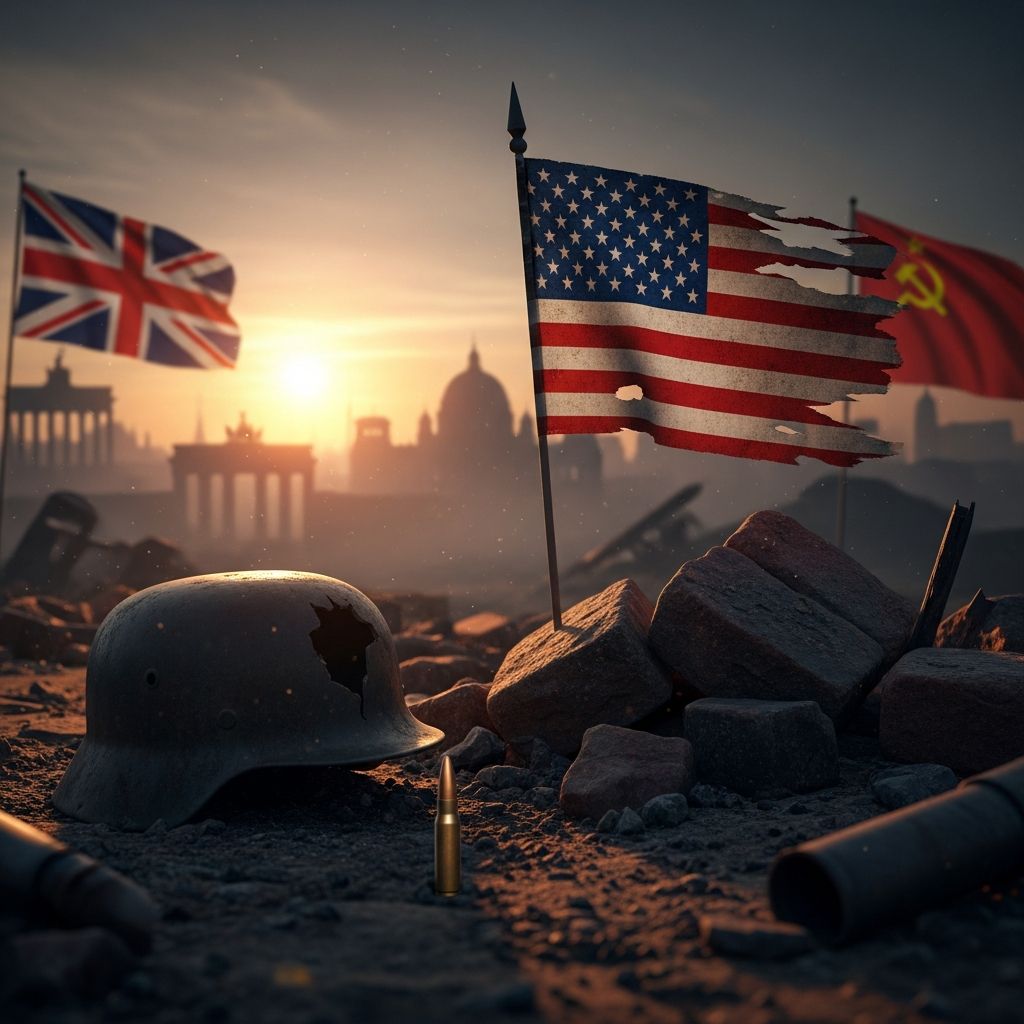
Understanding the Conclusion of the Second World War
The termination of World War II represents one of the most significant moments in modern history, marking the conclusion of a devastating global conflict that reshaped international relations and geopolitical structures. Unlike many wars that end on a single date, the conclusion of the Second World War occurred across different timeframes depending on the geographic theater of operations. The European theater witnessed Germany’s capitulation in May 1945, while the Pacific theater saw Japan’s formal surrender several months later in September. These distinctions reflect the complex nature of managing simultaneous conflicts across vast distances and among numerous allied powers with varying strategic objectives.
The European Theater: Germany’s Path to Unconditional Surrender
By early 1945, Nazi Germany faced imminent collapse as Allied forces advanced from multiple directions. Soviet armies pressed westward through Eastern Europe while American and British forces pushed eastward through France and the Low Countries. Hitler’s regime, recognizing the futility of continued resistance, began contemplating surrender terms. On April 30, 1945, Adolf Hitler committed suicide in his Berlin bunker, removing the figurehead of the Nazi regime and paving the way for negotiations with Allied powers.
Following Hitler’s death, German military leadership initiated formal surrender proceedings. On May 7, 1945, German armed forces signed an unconditional surrender document at the headquarters of United States General Dwight D. Eisenhower in Reims, France. This pivotal agreement stipulated that Germany would cease all military operations and place itself entirely under Allied control. The surrender took effect the following day, May 8, 1945, at 11:01 PM Central European Time, officially concluding hostilities in the European theater.
The date May 8, 1945, became known as Victory in Europe Day, or V-E Day, celebrated across Western nations as the day when Nazi Germany’s military threat was neutralized. However, due to time zone differences and the Soviet Union’s separate operational calendar, Soviet forces announced their “Victory Day” on May 9, 1945, commemorating the same event from their perspective. This distinction highlights the complexities of coordinating global military operations across different time zones and command structures.
Strategic Events Leading to German Capitulation
The road to German surrender involved numerous military and political developments that weakened the Nazi regime’s capacity to continue warfare:
- The Battle of Britain (July-October 1940): German attempts to establish air superiority over the United Kingdom failed, preventing the planned invasion of Britain and marking Germany’s first major military setback.
- Operation Barbarossa (June 1941): Germany’s massive invasion of the Soviet Union opened a catastrophic second front that would drain German military resources for the remainder of the war.
- The Eastern Front Collapse (1943-1945): Soviet counteroffensives at Stalingrad, Kursk, and subsequent campaigns pushed German armies westward and devastated German military capabilities.
- D-Day Invasion (June 6, 1944): The Allied invasion of Normandy established a foothold in Western Europe and began the liberation of Nazi-occupied territories.
- Liberation of France (August 1944): Allied forces rapidly advanced through France, with Free French and American troops entering Paris on August 25, 1944, and reaching the German border by September.
- Soviet Advance into Germany (January-May 1945): Soviet forces invaded Germany from the east, culminating in the assault on Berlin and forcing German military leaders to acknowledge inevitable defeat.
The Pacific Theater: Japan’s Delayed Capitulation
While Germany’s surrender concluded the European conflict, the war against Japan continued for four additional months. The Japanese military, despite facing overwhelming Allied superiority, initially resisted surrender negotiations. The Potsdam Conference, held from July 19 through August 2, 1945, brought together the leaders of the United States, United Kingdom, and Soviet Union to determine postwar arrangements and establish surrender terms for Japan.
During this conference, Soviet leader Joseph Stalin agreed that the Soviet Union would declare war on Imperial Japan within 90 days of Germany’s surrender. Additionally, the Allied leaders issued the Potsdam Declaration on July 26, 1945, demanding Japan’s unconditional surrender or face “prompt and utter destruction.” The declaration outlined specific surrender conditions and threatened devastating consequences if Japan refused to comply.
Japan’s initial silence regarding the Potsdam Declaration was interpreted by Western powers as a rejection of Allied terms. In response, the United States deployed new military technology to accelerate Japan’s capitulation. On August 6 and August 9, 1945, American forces dropped atomic bombs on Hiroshima and Nagasaki respectively, introducing nuclear weapons to warfare and inflicting unprecedented civilian casualties. Simultaneously, the Soviet Union declared war on Japan on August 8, 1945, and launched military operations in Manchuria.
These coordinated pressures precipitated a dramatic shift in Japanese decision-making. On the night of August 9, 1945, Japanese Emperor Hirohito convened his cabinet and determined that Japan must accept the Potsdam Declaration’s terms to prevent complete annihilation of the Japanese nation. This critical decision initiated a sequence of diplomatic communications between Japanese and Allied leadership.
The Surrender Process and Formal Ceremonies
Japan’s acceptance of surrender terms occurred through a carefully choreographed sequence of announcements and ceremonies. President Harry S. Truman announced Japan’s intention to surrender to the American public on August 14, 1945, at 7:00 PM Washington time. Emperor Hirohito’s address confirming Japan’s acceptance was broadcast within Japan at noon local time on August 15, 1945, creating what Americans called V-J Day (Victory over Japan Day). Although celebrations erupted across the United States and globally upon hearing news of Japan’s capitulation, the formal surrender ceremony remained pending.
The official surrender ceremony took place on September 2, 1945, aboard the USS Missouri battleship in Tokyo Bay. Japanese military representatives signed surrender documents in a formal ceremony attended by representatives of all major Allied powers, including American, British, Soviet, and Chinese officials. This date marked the official conclusion of World War II and the definitive end of hostilities in the Pacific theater.
Comparing European and Pacific Surrender Dates
| Theater | Key Date | Surrender Signing | Formal Ceremony |
|---|---|---|---|
| Europe | May 8, 1945 (V-E Day) | May 7, 1945 in Reims | Military surrender only |
| Pacific | September 2, 1945 | September 2, 1945 in Tokyo Bay | Formal ceremony aboard USS Missouri |
The Distinction Between Military and Political Conclusions
An important distinction exists between when World War II militarily ended and when the formal state of war legally concluded. While September 2, 1945, represents the universally recognized date when World War II officially ended with Japan’s formal surrender, the actual conclusion of hostilities and the legal termination of the war involve different dates. The state of war between Japan and the Allied powers was not formally concluded until the Treaty of San Francisco came into force on April 20, 1952. This seven-year gap between military surrender and formal peace treaty reflects the complexities of postwar negotiations, occupation arrangements, and international diplomacy required to establish lasting peace.
Global Impact and Commemorations
The end of World War II transformed global politics and society fundamentally. The conflict resulted in an estimated 70-85 million deaths and left much of Europe and Asia in ruins. The conclusion of hostilities initiated the process of reconstructing devastated nations, establishing international institutions like the United Nations, and reshaping the international order. Different nations commemorate the end of the war on dates significant to their particular experiences: May 8 remains the primary victory date in Western Europe, while May 9 continues as the official holiday in Russia and several former Soviet states.
The military lessons learned during World War II’s conclusion influenced subsequent international relations and military strategy. The development and use of atomic weapons, demonstrated dramatically in Japan’s destruction, introduced nuclear deterrence as a central element of Cold War strategy. The unconditional surrender requirement established precedent for subsequent military conflicts and peace negotiations.
Frequently Asked Questions
Q: Why did World War II end on different dates in Europe and the Pacific?
A: Germany and Japan were separate combatants fighting in different geographic theaters. Germany surrendered in May 1945 after its territory was invaded and Hitler died. Japan continued fighting until August-September 1945, when atomic bombs, Soviet entry into the war, and military pressure forced capitulation. The vast distances and different strategic situations meant surrender timelines differed significantly.
Q: What is the difference between V-E Day and V-J Day?
A: V-E Day (May 8, 1945) commemorates Germany’s unconditional surrender and the end of World War II in Europe. V-J Day (August 15, 1945, in the United States) marks Japan’s announcement of surrender intention, though the formal surrender ceremony occurred on September 2, 1945, in Tokyo Bay.
Q: Did World War II officially end in 1945?
A: While military hostilities ceased in 1945, the formal state of war continued until the Treaty of San Francisco came into force on April 20, 1952. This treaty officially concluded the war between Japan and the Allied powers, establishing the legal conclusion of World War II.
Q: Why did Germany surrender before Japan?
A: Germany faced invasion of its own territory by Soviet and Western Allied forces, culminating in the capture of Berlin. Japan, as an island nation separated from direct invasion until late in the war, resisted surrender longer. Only when facing atomic bombs and Soviet declaration of war did Japan finally capitulate.
Q: Where did the formal surrender ceremonies take place?
A: Germany signed its surrender document in Reims, France, at General Eisenhower’s headquarters on May 7, 1945. Japan signed its formal surrender aboard the USS Missouri battleship in Tokyo Bay on September 2, 1945, in a ceremony attended by representatives of all major Allied powers.
References
- World War II Key Dates — United States Holocaust Memorial Museum. 2021-11-15. https://encyclopedia.ushmm.org/content/en/article/world-war-ii-key-dates
- World War II — Wikipedia. Accessed 2026-04-04. https://en.wikipedia.org/wiki/World_War_II
- 80 Years Since the End of World War II — National Archives Foundation. 2025-08-28. https://archivesfoundation.org/documents/80-years-since-the-end-of-world-war-ii/
- 5 Things You May Not Know About the End of World War II — Joint Base San Antonio. Accessed 2026-04-04. https://www.jbsa.mil/News/News/Article/616720/5-things-you-may-not-know-about-the-end-of-world-war-ii/
- The End of World War II 1945 — The National WWII Museum. Accessed 2026-04-04. https://www.nationalww2museum.org/war/topics/end-world-war-ii-1945

Medha Deb is an editor with a master's degree in Applied Linguistics from the University of Hyderabad. She believes that her qualification has helped her develop a deep understanding of language and its application in various contexts. Medha specializes in the areas of beauty, health, sports, and wellness and is committed to ensuring that the content on the website is…