
The Composer’s Final Journey: Understanding Mozart’s Burial in Vienna
Wolfgang Amadeus Mozart, one of history’s most celebrated composers, passed away on December 5, 1791, at the age of 35. Following his death, he was laid to rest in a manner that reflected the burial practices and social conventions of late 18th-century Vienna. The location of his grave has fascinated historians, music enthusiasts, and tourists for centuries, spawning numerous myths and misconceptions about where the legendary musician ultimately came to rest. This exploration of Mozart’s burial site reveals both the documented historical facts and the enduring mysteries surrounding his remains.
The Circumstances Surrounding Mozart’s Death and Interment
Mozart’s passing marked a significant moment in the cultural life of Vienna and the broader European musical world. Contemporary accounts describe the profound impact his death had on the city’s residents and the international music community. Despite his significant contributions to classical music and his relatively high social standing as a court musician, Mozart’s funeral and burial followed the standard protocols of his era rather than reflecting any exceptional treatment.
The funeral service took place at the Stephansdom, Vienna’s most prominent cathedral, where a relatively modest ceremony was conducted. The emperor at the time had implemented various regulations regarding burials, including restrictions on the use of new coffins and a requirement that bodies be wrapped in linen shrouds to facilitate decomposition. These were practical measures enacted during a period when wood was in short supply and cemetery space needed to be efficiently managed. Following the funeral service, Mozart’s body was transported to a cemetery located outside the city’s walls, a common practice for burials during this period.
St. Marx Cemetery: Vienna’s Historic Burial Ground
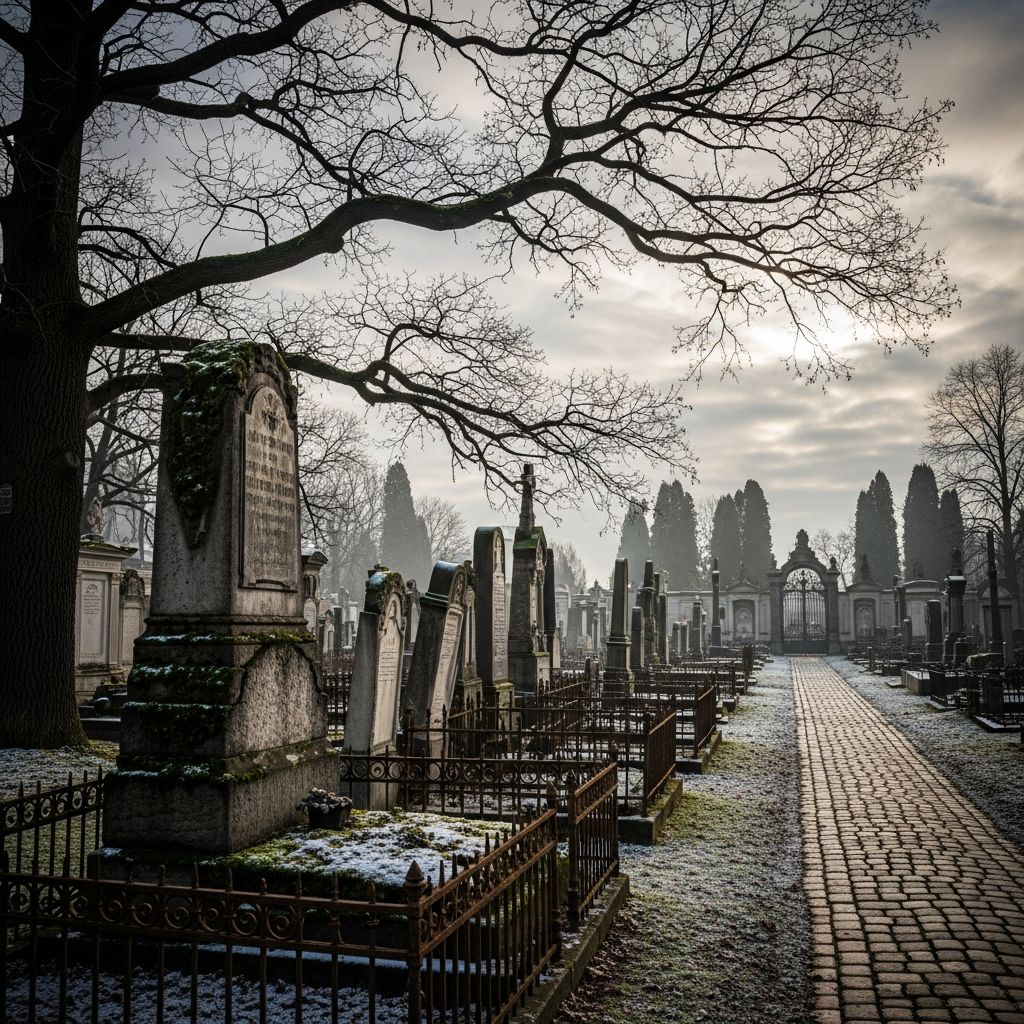
The St. Marx Cemetery, known formally as Sankt Marxer Friedhof, is situated in Vienna’s third district, specifically in the Landstraße area. Established in 1784, the cemetery operated as an active burial ground until 1874, serving the residents of Vienna for approximately ninety years. Today, it stands as the last remaining Biedermeier cemetery in Vienna, preserving architectural styles and burial customs from the 19th century. The cemetery’s gates remain open to the public, and it functions as a peaceful park that attracts visitors interested in history, architecture, and the stories preserved within its grounds.
The physical environment of St. Marx Cemetery reflects its historical significance and cultural heritage. Ancient gravestones, elaborate mausoleums, and mature vegetation create an atmosphere distinct from modern urban settings. The cemetery is particularly striking during spring months when lilac blossoms add color and fragrance to the landscape. Despite its current peaceful character, the cemetery exists within a complex urban environment, surrounded by modern infrastructure that contrasts sharply with its historical atmosphere.
The Unmarked Grave: Separating Myth from Reality
A persistent and romanticized narrative suggests that Mozart was buried in a pauper’s grave due to financial hardship. This account, popularized by dramatic interpretations including the film “Amadeus,” presents an image of Mozart’s body being unceremoniously dumped into a mass grave during inclement weather, with no mourners present to mark the occasion. The reality, however, differs significantly from this theatrical portrayal.
Mozart was indeed buried in an unmarked grave, but this practice was not extraordinary or indicative of poverty or shame. Rather, unmarked graves were standard burial practice during the late 18th century in Vienna, regardless of a person’s social or economic status. The absence of a visible marker reflected the burial regulations and customs of the period, not a reflection on Mozart’s importance or his family’s financial circumstances. The practice of using unmarked graves was a widespread convention that applied to many individuals across various social classes.
Mozart’s widow, Konstanze, did not immediately attempt to locate her husband’s precise burial location. For nearly fifty years following his death, the exact spot where Mozart lay remained unknown or unrecorded in accessible cemetery records. This lengthy gap between Mozart’s burial and any organized effort to identify his grave speaks to the practical realities of cemetery management in that era, when burial records were sometimes incompletely maintained and graves were occasionally disturbed to accommodate new interments.
The Search for Mozart’s Grave: Historical Efforts and Discoveries
The quest to identify Mozart’s burial location became more urgent during the mid-19th century, as the composer’s reputation grew and public interest in his life intensified. By this time, Mozart had become recognized as one of the greatest composers in history, and locating his grave became a matter of cultural significance for Vienna and the broader musical world.
Efforts to pinpoint Mozart’s grave included searches conducted by his widow during her later years and investigations by notable musicians and historians such as Vincent Novello in 1829. These searches faced significant challenges, as cemetery records from 1791 were incomplete, and the passage of decades made precise identification difficult. Additionally, the cemetery had undergone numerous changes, and graves had been disturbed or relocated over the years.
In 1855, cemetery authorities established a memorial stone at what was believed to be Mozart’s burial site based on available records and historical documentation. This stone served as a marker for visitors seeking to pay respects to the composer. Later, in 1859, a more elaborate memorial was commissioned, designed by sculptor Hanns Gasser. This professional monument replaced the earlier marker and provided a more fitting tribute to Mozart’s legacy. Over subsequent years, additional embellishments including stone sculptures and columns were added to create the memorial visitors encounter today.
The Question of Mozart’s Remains: What Happened to His Body?
One of the most intriguing aspects of Mozart’s burial involves the question of whether his remains actually remain in the grave marked at St. Marx Cemetery. Historical burial practices from the late 18th century provide crucial context for understanding this mystery.
During Mozart’s era, graves were not necessarily permanent. Cemetery regulations typically permitted the reuse of burial sites after approximately ten years, allowing the bones of the deceased to be removed and the ground to be repurposed for new burials. This practice maximized the efficient use of cemetery space and was a standard procedure rather than an exception. Given that Mozart died in 1791, his grave would have been eligible for reopening and reuse around 1801, just a decade after his burial.
Historical records do not clearly document what happened to Mozart’s remains during the 19th century. It is quite possible that his bones were exhumed when the grave site was scheduled for reuse and either moved to another location, transferred to an ossuary, or lost to history. Some sources suggest that if Mozart’s remains had been relocated, they may have been moved to Vienna’s Central Cemetery (Zentralfriedhof), where a more prominent and permanent monument could have been established. However, no definitive evidence confirms where his actual skeletal remains currently reside.
Mysterious Artifacts and Unverified Claims
The uncertainty surrounding Mozart’s remains has led to various claims regarding his skeletal materials. Most notably, a skull held by the Mozarteum Foundation in Salzburg has been alleged to be Mozart’s by some researchers and historians. However, scientific testing conducted on this skull has yielded inconclusive results, unable to definitively establish its authenticity or connection to the composer. Without reliable forensic evidence or documented provenance, the skull remains a curiosity rather than confirmed proof of Mozart’s identity.
Such uncertainties are not unusual when dealing with historical remains, particularly those from the 18th century, when documentation practices were less rigorous and skeletal remains were frequently moved or commingled. The lack of definitive proof regarding Mozart’s remains adds an additional layer of intrigue to the story of his burial and the enduring mystery of his final resting place.
Visiting St. Marx Cemetery Today
The St. Marx Cemetery remains accessible to the public and welcomes visitors interested in Mozart, history, and the cemetery’s unique character. The cemetery is located at Leberstraße 6-8 in Vienna’s third district and can be easily accessed via streetcar line 71. The memorial marking the presumed location of Mozart’s grave serves as a focal point for visitors, though it is important to recognize that this marker indicates the believed burial site rather than confirmed location.
The cemetery itself offers visitors more than simply a historical landmark. Its preservation as one of Vienna’s last remaining Biedermeier cemeteries provides insight into 19th-century burial practices, architectural styles, and aesthetic values. The combination of historic gravestones, mature trees, and flowering plants creates an environment that appeals to those interested in history, art, architecture, and natural beauty. The peaceful atmosphere stands in stark contrast to the surrounding modern urban environment, offering visitors a retreat into Vienna’s cultural past.
Distinguishing Between Monuments and Actual Burial Sites
An important distinction must be made between commemorative monuments and actual burial locations. Vienna’s Central Cemetery (Zentralfriedhof) contains a monument dedicated to Mozart, but this is not his actual grave, despite common misconceptions. This monument serves as an alternative tribute location for those unable to visit St. Marx Cemetery or seeking to pay respects at Vienna’s largest and most famous cemetery. The existence of multiple Mozart memorials throughout Vienna reflects the composer’s cultural significance and the various ways communities choose to honor his memory.
The Legacy of Uncertainty
The circumstances surrounding Mozart’s burial illustrate broader historical realities about record-keeping, burial practices, and the passage of time. While modern sensibilities expect precise documentation and permanent burial locations, 18th-century practices operated under different assumptions and requirements. The gradual evolution of cemetery management, record-keeping standards, and cultural attitudes toward commemoration shaped how Mozart’s burial site has been understood and interpreted across generations.
The enduring interest in Mozart’s burial location reflects not merely curiosity about a historical figure but also broader human desires to connect with cultural icons and preserve their memory. The combination of documented facts, reasonable historical inferences, and remaining mysteries creates a compelling narrative that continues to fascinate visitors to Vienna.
Frequently Asked Questions About Mozart’s Burial
Q: Was Mozart buried in poverty due to financial difficulties?
A: No. While Mozart faced financial challenges during his life, his unmarked grave was not a reflection of poverty but rather a standard burial practice of 18th-century Vienna applied to people across various social classes.
Q: Can visitors see Mozart’s actual remains at St. Marx Cemetery?
A: No. Mozart’s remains are no longer present at the cemetery, as 18th-century burial practices allowed grave sites to be reused after approximately ten years. It is uncertain where his actual remains are located today.
Q: Is the monument at St. Marx Cemetery the original marker from 1791?
A: No. The current memorial was established in 1859 and was designed by sculptor Hanns Gasser to mark the presumed location of Mozart’s grave based on historical records.
Q: Why did it take so long to identify Mozart’s grave?
A: Cemetery records from 1791 were incomplete, and Mozart’s widow did not seek to locate his grave for nearly fifty years after his death. By that time, accurate records were no longer available.
Q: Is there a Mozart grave at Vienna’s Central Cemetery?
A: Vienna’s Central Cemetery contains a monument dedicated to Mozart, but it is not his actual burial site. The monument serves as a secondary memorial for those visiting Vienna’s largest cemetery.
Q: What is the significance of the skull held at the Mozarteum Foundation?
A: A skull allegedly belonging to Mozart is held by the Mozarteum Foundation in Salzburg, but scientific testing has been inconclusive, and its authenticity remains unverified.
References
- St. Marx Cemetery – Wikipedia — Wikipedia Foundation. Retrieved from https://en.wikipedia.org/wiki/St._Marx_Cemetery
- Cemetery of St. Marx — Wien.info (Vienna Tourism). Retrieved from https://www.wien.info/en/see-do/sights-from-a-to-z/cemetery-st-marx-342450
- Mozart’s Grave in Vienna — Visiting Vienna. Retrieved from https://www.visitingvienna.com/footsteps/mozarts-grave/
- Wolfgang Amadeus Mozart Memorial — Find a Grave. Retrieved from https://www.findagrave.com/memorial/4482/wolfgang_amadeus-mozart
- Mozart’s Death: Sorting Out Fact from Fiction — Colorado Public Radio. 2022. Retrieved from https://www.cpr.org/2022/10/31/mozarts-death-sorting-out-fact-from-fiction/

Medha Deb is an editor with a master's degree in Applied Linguistics from the University of Hyderabad. She believes that her qualification has helped her develop a deep understanding of language and its application in various contexts. Medha specializes in the areas of beauty, health, sports, and wellness and is committed to ensuring that the content on the website is…