
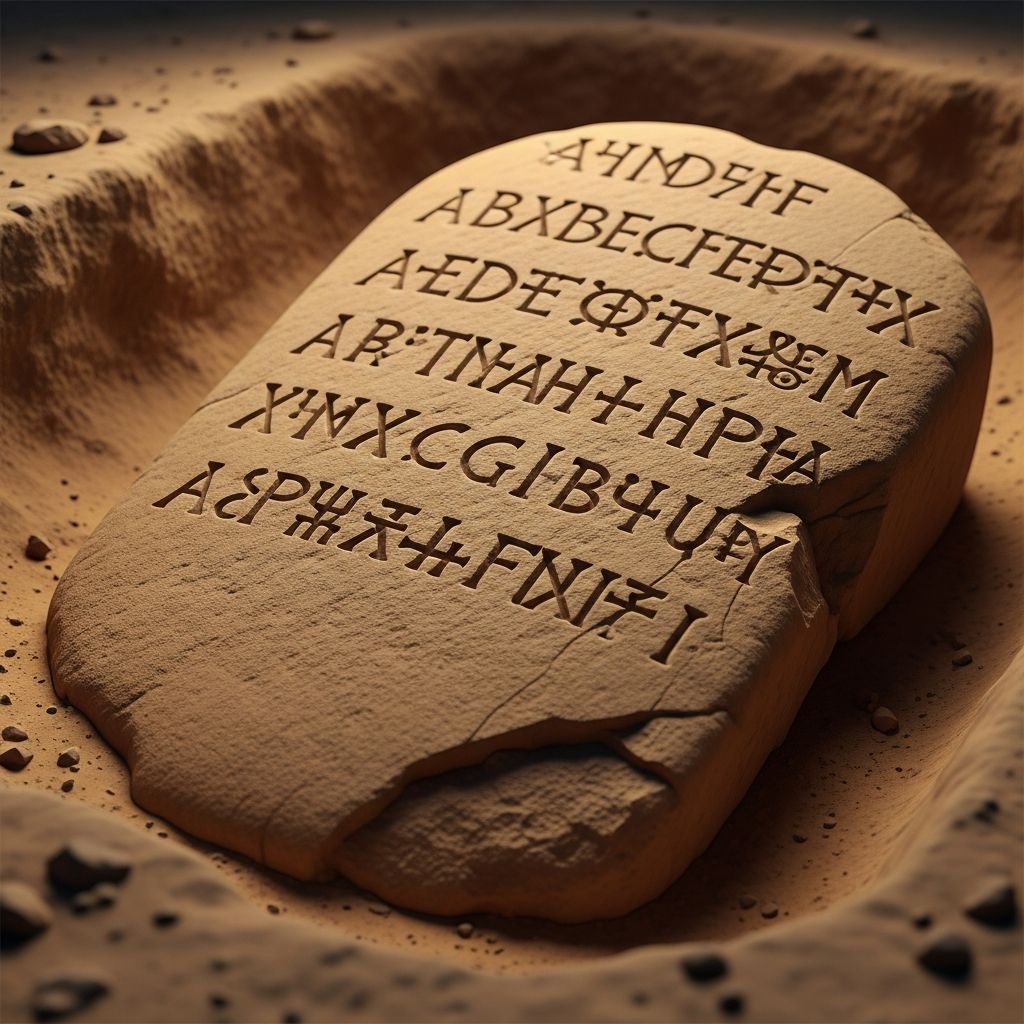
The invention of the alphabet marked a pivotal moment in human communication, simplifying the recording of language through individual sound symbols rather than complex pictograms or syllables. This breakthrough, attributed to the **Proto-Sinaitic script** around 1850 BCE in the Sinai Peninsula, laid the foundation for nearly all modern writing systems.
Pre-Alphabetic Writing Systems: Setting the Stage
Before the alphabet, ancient civilizations relied on intricate scripts. In Mesopotamia, **cuneiform** emerged around 3200 BCE, using wedge-shaped marks on clay tablets to represent syllables and words. This system, developed by Sumerians, was versatile for administration, literature, and religion but required learning thousands of signs.
Simultaneously, Egyptian **hieroglyphs**, dating to circa 3250 BCE, combined logographic and phonetic elements. Hieroglyphs depicted objects and sounds, serving monumental inscriptions and papyrus records. Both systems were elite tools, accessible mainly to scribes due to their complexity.
- Cuneiform: Syllabic-logographic, pressed into wet clay with reeds.
- Hieroglyphs: Pictorial, carved or inked, with over 700 common signs.
- Limitations: High learning curve, restricted literacy to professionals.
These precursors influenced alphabetic innovation by exposing Semitic workers to phonetic principles, inspiring a simpler adaptation.
Birth of Proto-Sinaitic: The Semitic Breakthrough
The **Proto-Sinaitic script**, discovered in 1904-1905 at Serabit el-Khadim turquoise mines by Flinders Petrie, represents the earliest known alphabet. Canaanite laborers under Egyptian control adapted hieroglyphs into 22-30 acrophonic signs, where each symbol’s name began with the sound it represented (e.g., ‘aleph’ for ox, denoting a glottal stop).
Inscriptions, often graffiti, date to approximately 1850 BCE at Wadi el-Hol and Serabit el-Khadim. These consonantal markers (abjad) wrote West Semitic languages without vowels, a revolutionary simplification.
| Proto-Sinaitic Sign | Hieroglyph Origin | Sound | Modern Descendant Example |
|---|---|---|---|
| House pictogram | Egyptian ‘pr’ | /b/ | B in Latin |
| Ox head | Egyptian ‘wp’ | /ʔ/ | A in Greek (alpha) |
| Water waves | Egyptian ‘n’ | /m/ | M in Phoenician |
This script’s portability and ease democratized writing, spreading via trade and migration.
Recent Discoveries: Pushing Origins Back 500 Years
A 2024 find at Tell Umm el-Marra in Syria challenges traditional timelines. Cuneiform cylinders, carbon-dated to 2400 BCE, bear marks interpreted as proto-alphabetic by experts like Christopher Rollston. If confirmed, this predates Proto-Sinaitic by 500 years, suggesting multiple invention sites or earlier diffusion.
Rollston posits the alphabet was invented once, with all systems deriving from a single root. These artifacts, if alphabetic, could represent that ur-alphabet, rewriting literacy history from Egypt-centric to broader Near Eastern origins.
From Proto-Sinaitic to Phoenician: Refinement and Spread
By 1500 BCE, Proto-Sinaitic evolved into the **Phoenician alphabet**, a standardized 22-consonant abjad used by maritime traders. Abstracted from pictographs, it inscribed monuments, ostraca, and coins across the Levant, Cyprus, and North Africa.
Phoenician’s endurance stemmed from its phonetic efficiency and adaptability. Key innovations included right-to-left writing and consistent sound-letter mapping.
- Spread: Via Phoenician colonies from Spain to Carthage.
- Influence: Aramaic, Hebrew, and South Arabian scripts branched off.
- Legacy: Basis for over 50 ancient alphabets.
Greek Adaptation: The First True Alphabet
Around 800 BCE, Greeks borrowed Phoenician script, adding vowels for a ‘true’ alphabet. Herodotus credits Cadmus with transmission, though evidence points to Euboean traders.
Greek innovations: Left-to-right direction, vowel letters (e.g., Phoenician ‘aleph’ became ‘alpha’ /a/). This enabled precise Homer transcription and philosophy recording.
By 776 BCE (first Olympics), inscriptions proliferated, fueling democracy and science.
Roman and Latin: Global Dominance
Etruscans adapted Greek circa 700 BCE, passing it to Romans by 600 BCE. The **Latin alphabet** started with 21 letters, later expanding to 23 (adding G, Z).
Rome’s empire disseminated it across Europe, evolving into national variants (e.g., French with accents).
| Script | Date | Key Feature | Region |
|---|---|---|---|
| Proto-Sinaitic | ~1850 BCE | Consonantal, pictographic | Sinai/Egypt |
| Phoenician | ~1200 BCE | Abstracted abjad | Levant/Mediterranean |
| Greek | ~800 BCE | Vowels added | Greece |
| Latin | ~700 BCE | Italic adaptation | Italy/Europe |
Global Branches: Beyond the West
Proto-Sinaitic descendants include Brahmic scripts (via Aramaic to India, ~300 BCE) for Sanskrit and modern Indic languages, and Ge’ez for Ethiopian tongues.
Arabic (7th century CE) refined Phoenician for Quranic recitation, influencing Persian and Urdu.
Who Invented It? Debates and Theories
Was it illiterate miners seeking expression, as Orly Goldwasser argues, or educated Semites? Evidence favors multilingual workers blending Egyptian phonetics with Semitic needs.
Herodotus’ Phoenician origin myth holds partial truth, confirmed by archaeology.
Impact on Civilization
The alphabet boosted literacy, commerce, law, and knowledge preservation. It enabled the Axial Age’s philosophical boom and persists in 60% of world languages.
Frequently Asked Questions (FAQs)
What is the oldest known alphabet?
The Proto-Sinaitic script from ~1850 BCE in Sinai, though Syrian finds suggest 2400 BCE origins.
How did hieroglyphs lead to the alphabet?
Semitic workers repurposed hieroglyphic shapes for sounds, ignoring meanings.
Why is Greek called the first ‘true’ alphabet?
It included vowels alongside consonants, unlike consonantal abjads.
How many letters in ancient Phoenician?
22 consonants, no vowels.
Does the Latin alphabet derive directly from Phoenician?
Indirectly, via Etruscan and Greek intermediaries.
References
- The first alphabet may be 500 years older than previously thought — El País (English). 2024-12-30. https://english.elpais.com/science-tech/2024-12-30/the-first-alphabet-may-be-500-years-older-than-previously-thought.html
- Who invented the alphabet? The Origins of abc — I Love Typography. 2010-08-07. https://ilovetypography.com/2010/08/07/where-does-the-alphabet-come-from/
- History of the alphabet — Wikipedia. N/A. https://en.wikipedia.org/wiki/History_of_the_alphabet
- Writing History — American Scientist. N/A. https://www.americanscientist.org/article/writing-history
- Alphabet Origins: From Kipling to Sinai — The Metropolitan Museum of Art. 2014. https://www.metmuseum.org/exhibitions/listings/2014/assyria-to-iberia/blog/posts/alphabet
- Who Really Invented the Alphabet—Illiterate Miners or Educated Sophisticates? — Biblical Archaeology Society. N/A. https://www.biblicalarchaeology.org/daily/ancient-cultures/daily-life-and-practice/who-really-invented-the-alphabet-illiterate-miners-or-educated-sophisticates/

Medha Deb is an editor with a master's degree in Applied Linguistics from the University of Hyderabad. She believes that her qualification has helped her develop a deep understanding of language and its application in various contexts. Medha specializes in the areas of beauty, health, sports, and wellness and is committed to ensuring that the content on the website is…