
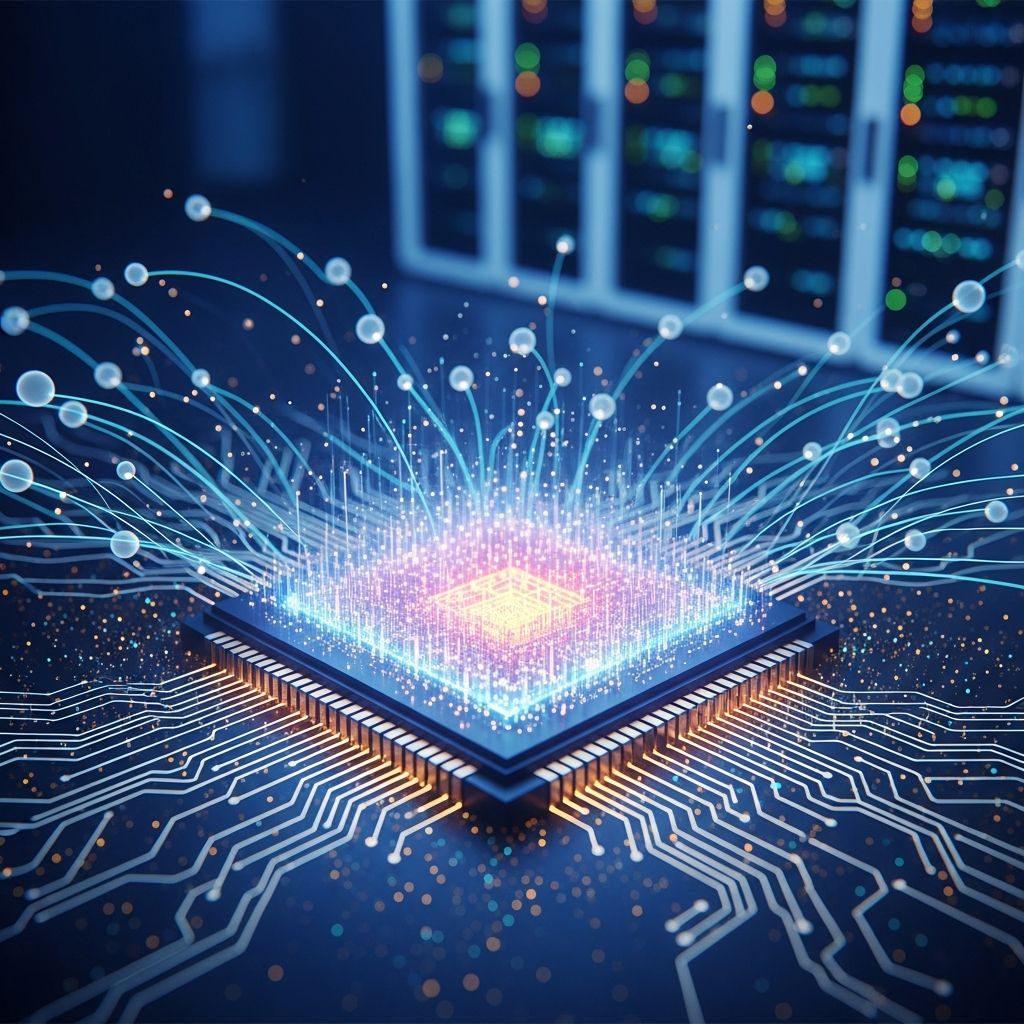
Why AI Hardware Matters More Than Ever
Artificial intelligence is no longer just software running on generic computers. Today’s most powerful AI models require specialized physical systems—chips, memory, interconnects, and entire data center architectures—designed specifically for massive parallel computation and low-latency inference. Behind every breakthrough in large language models, computer vision, and autonomous systems is a team of engineers building the hardware that makes it possible.
AI hardware is the foundation of modern AI progress. Without faster, more efficient, and more scalable compute, even the most elegant algorithms would remain theoretical. This makes expertise in AI hardware one of the most consequential technical paths in the 21st century, not just for performance and cost, but for safety, access, and governance.
What Does an AI Hardware Expert Actually Do?
An AI hardware expert works at the intersection of computer architecture, semiconductor design, and machine learning. Their role is not limited to designing faster chips; it spans the entire stack from transistor-level optimization to system-level integration and even policy-relevant questions about how compute is used and controlled.
Core responsibilities include:
- Designing and optimizing AI accelerators such as GPUs, TPUs, and domain-specific chips for neural networks.
- Improving memory bandwidth, on-chip communication, and power efficiency for AI workloads.
- Co-designing hardware and software to maximize performance of training and inference pipelines.
- Prototyping and validating new architectures, often in collaboration with AI researchers and systems engineers.
- Working on reliability, security, and fault tolerance in AI compute systems.
Depending on the organization, an AI hardware expert might focus on:
- Chip design: RTL, verification, physical design, and tape-out of AI-specific processors.
- System architecture: Designing server racks, interconnect topologies, and data center layouts optimized for AI clusters.
- Hardware-software co-design: Tuning compilers, runtime systems, and libraries to exploit hardware features.
- Security and governance: Developing hardware-based monitoring, access controls, and tamper-resistant designs for high-stakes AI systems.
Where AI Hardware Fits in the AI Ecosystem
AI progress depends on three key inputs: algorithms, data, and compute. While algorithms and data get much of the public attention, compute is the physical bottleneck that determines how fast and how far AI can advance.
AI hardware experts directly influence:
- Training speed: Faster chips and better interconnects reduce the time and cost to train large models.
- Deployment efficiency: Efficient inference hardware enables AI in edge devices, mobile phones, and embedded systems.
- Energy consumption: Optimized hardware reduces the environmental footprint of AI, which is critical as models grow larger.
- Accessibility: Cost-effective hardware can democratize access to powerful AI, while concentrated supply chains can create geopolitical dependencies.
Because compute is tangible, measurable, and tied to a relatively concentrated global supply chain, it also becomes a natural focus for governance. Hardware experts are increasingly involved in questions like:
- How can we monitor and verify the amount of compute used for training frontier models?
- Can hardware features be used to enforce safety constraints or access controls?
- How do we secure AI systems against tampering, side-channel attacks, and unauthorized use?
Technical Skills and Knowledge Areas
To become an expert in AI hardware, you need a strong foundation in both computer engineering and machine learning. The most valuable profiles combine deep technical skills with an understanding of how hardware choices affect real-world AI systems.
Core Engineering Competencies
- Digital design and VLSI: RTL design, synthesis, timing analysis, and physical implementation of digital circuits.
- Computer architecture: Understanding of pipelining, caching, memory hierarchies, and parallel architectures (SIMD, MIMD, etc.).
- Low-power design: Techniques for reducing power consumption in AI chips, including voltage scaling, clock gating, and power islands.
- Interconnect and networking: On-chip networks, high-speed I/O, and data center interconnects for distributed training.
- Verification and testing: Formal methods, simulation, emulation, and post-silicon validation.
AI and Systems Knowledge
- Machine learning fundamentals: Understanding of neural network architectures, training dynamics, and inference requirements.
- Distributed systems: Knowledge of how large models are partitioned across multiple chips and machines.
- Compilers and runtimes: Familiarity with frameworks like TensorFlow, PyTorch, and their compilation and optimization pipelines.
- Performance modeling: Ability to model and predict the performance of AI workloads on different hardware configurations.
Emerging and Policy-Relevant Areas
- Hardware security: Secure boot, trusted execution environments, side-channel resistance, and tamper detection.
- Cryptography and privacy: Hardware support for homomorphic encryption, secure multi-party computation, and differential privacy.
- Supply chain and manufacturing: Understanding of semiconductor fabrication, packaging, and global supply chain dynamics.
- Compute governance: How hardware can be used to monitor, limit, or audit compute usage for safety and regulatory purposes.
Career Paths and Where to Start
There is no single path into AI hardware, but most successful experts follow one of several trajectories, often combining formal education with hands-on experience.
Academic and Research Routes
- PhD in computer architecture or VLSI: Ideal for those aiming to lead research in novel AI accelerators or contribute to cutting-edge designs at top labs.
- Master’s in electrical engineering or computer science: A strong option for entering industry roles in chip design, system architecture, or hardware-software co-design.
- Undergraduate in EE/CS: A solid foundation for internships and entry-level roles, especially when combined with projects in FPGA, ASIC design, or systems programming.
Industry and Practical Experience
- Internships at semiconductor or AI companies: Companies like NVIDIA, AMD, Intel, Google, and startups in AI hardware offer valuable exposure to real-world design challenges.
- Open-source and personal projects: Contributing to open-source hardware projects, building FPGA-based accelerators, or optimizing ML workloads on existing hardware can build a strong portfolio.
- Transition from software or systems roles: Software engineers with strong systems knowledge can move into hardware-software co-design, compilers, or performance engineering roles.
Policy and Governance-Oriented Paths
- Technical roles in government or think tanks: Experts with hardware knowledge are increasingly needed in agencies and organizations working on AI regulation, export controls, and compute monitoring.
- Research in compute governance: Studying how hardware can be used to enforce safety constraints, limit access to powerful compute, or increase transparency in AI development.
- Security and standards bodies: Contributing to hardware security standards, cryptographic protocols, and best practices for secure AI systems.
Impact and Long-Term Significance
A career in AI hardware is uniquely positioned to shape the trajectory of AI in several high-impact ways:
Accelerating Beneficial AI
- Faster, more efficient hardware can reduce the cost and energy of training useful models in healthcare, climate science, and scientific discovery.
- Edge AI hardware enables privacy-preserving, low-latency applications in medicine, education, and assistive technologies.
Improving Safety and Control
- Hardware-based monitoring can help track and audit the use of powerful AI systems, making it easier to detect misuse.
- Secure hardware designs can prevent tampering, unauthorized access, and deployment of unsafe models.
- Design choices (e.g., limiting peak performance or enabling kill switches) can be baked into hardware to support safety policies.
Shaping Geopolitical and Economic Dynamics
- AI hardware is a strategic technology with implications for national security, economic competitiveness, and global power balances.
- Experts in semiconductor supply chains and manufacturing can help reduce dependencies and increase resilience.
- Work on open, accessible hardware platforms can promote a more equitable distribution of AI capabilities.
Challenges and Trade-offs
While the field is highly impactful, it also comes with significant challenges:
- High barriers to entry: AI hardware requires deep technical knowledge and often advanced degrees, especially for chip design roles.
- Long development cycles: Designing and manufacturing a new chip can take years, which can be frustrating compared to faster-moving software fields.
- Concentration of power: A small number of companies and countries dominate advanced semiconductor manufacturing, raising concerns about access and control.
- Trade-offs between performance, safety, and openness: Optimizing for raw speed may conflict with security, transparency, and equitable access.
Navigating these trade-offs requires not just technical skill, but also careful thinking about ethics, policy, and long-term consequences.
How to Evaluate If This Path Is Right for You
Consider a career in AI hardware if you:
- Enjoy deep technical work in computer architecture, digital design, or systems engineering.
- Are fascinated by how abstract algorithms translate into physical circuits and real-world performance.
- Want to work on problems that are both technically challenging and strategically important for the future of AI.
- Are comfortable with long timelines and complex systems, and are willing to invest in advanced education or specialized training.
- Are interested in the intersection of technology, security, and policy, and want to contribute to safer, more responsible AI development.
If you’re more drawn to rapid iteration, direct product development, or pure algorithmic research, other AI-adjacent roles (like ML engineering, systems engineering, or AI research) might be a better fit.
FAQs About a Career in AI Hardware
What’s the difference between an AI hardware engineer and a general computer hardware engineer?
A general computer hardware engineer works on CPUs, memory systems, and general-purpose computing platforms. An AI hardware expert specializes in architectures optimized for machine learning workloads, such as matrix multiplication, high-bandwidth memory, and distributed training, often designing custom accelerators rather than general-purpose processors.
Do I need a PhD to work in AI hardware?
Not necessarily. Many industry roles in chip design, verification, and systems engineering are accessible with a master’s or even a strong bachelor’s degree plus relevant experience. However, a PhD is often required for leading research in novel architectures or for academic and some policy-oriented roles.
Can I transition into AI hardware from a software background?
Yes, especially into areas like hardware-software co-design, compilers, performance engineering, and systems programming. Strong knowledge of ML frameworks, distributed systems, and low-level programming (C++, CUDA, etc.) is valuable. Some engineers transition via roles in ML infrastructure or systems engineering before moving deeper into hardware.
What industries hire AI hardware experts?
Key employers include:
- Semiconductor companies (NVIDIA, AMD, Intel, Qualcomm, etc.)
- Big tech companies with large AI efforts (Google, Meta, Microsoft, Amazon, etc.)
- AI-focused startups building new accelerators or systems
- Cloud providers and data center operators
- Government agencies and research labs working on AI, security, and compute governance
How does AI hardware relate to AI safety and governance?
Because compute is physical, measurable, and tied to a concentrated supply chain, it offers concrete levers for governance. Hardware experts can help design systems that:
- Monitor and report compute usage for large models.
- Enforce access controls and safety constraints at the hardware level.
- Support secure, auditable, and tamper-resistant AI deployments.
This makes AI hardware expertise highly relevant to efforts to ensure that powerful AI is developed and used responsibly.
References
- International Roadmap for Devices and Systems (IRDS) — IEEE. 2023. https://irds.ieee.org/
- AI Compute Trends and Projections — OpenAI. 2023. https://openai.com/research/ai-and-compute
- Hardware Security and Trust — National Institute of Standards and Technology (NIST). 2022. https://www.nist.gov/itl/applied-cybersecurity/hardware-security

- Integrated M.A. in Applied Linguistics, University of Hyderabad
- 5+ years in editorial, instructional, SEO, and research-based writing
Sneha is a relationships and lifestyle writer with a strong foundation in applied linguistics and certified training in relationship coaching. She brings over five years of writing experience to theskillvault, crafting thoughtful, research-driven content that empowers readers to build healthier relationships, boost emotional well-being, and embrace holistic living. Her writing and insights reflect the belief that beauty, happiness, and wellness…