
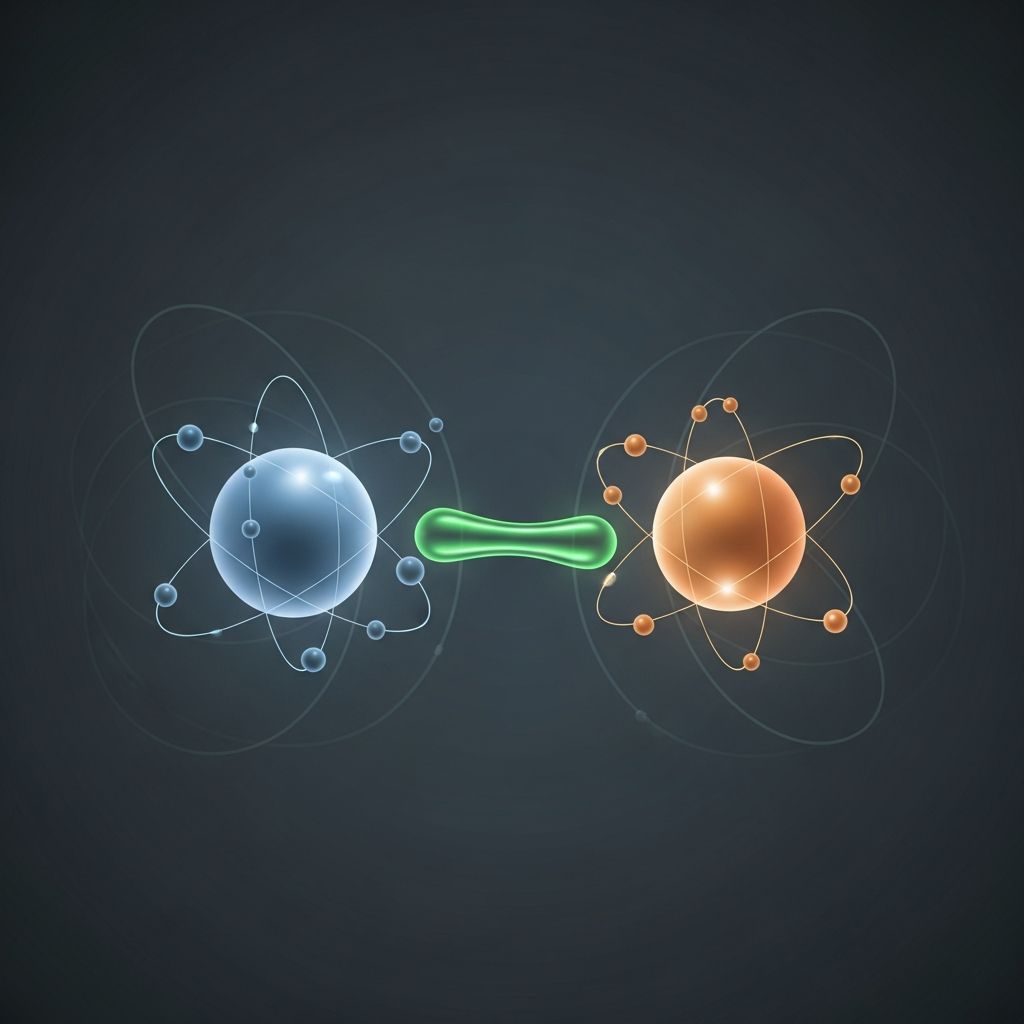
Atoms combine to form bonds primarily to attain a state of lower potential energy and greater stability, mimicking the electron configurations of noble gases through processes like electron sharing or transfer.
Seeking Stability: The Driving Force Behind Bonding
In the realm of chemistry, stability reigns supreme. Isolated atoms exist in higher-energy states due to incomplete outer electron shells. By forming bonds, they rearrange electrons to minimize energy, creating configurations akin to noble gases like helium or neon, which possess full valence shells and rarely react.
This pursuit of stability arises from nature’s fundamental tendency to favor low-energy arrangements. When atoms bond, attractive electrostatic forces between positively charged nuclei and negatively charged electrons overpower repulsive forces between like charges, resulting in a net energy decrease.
Consider the potential energy curve of two approaching atoms: as they near each other, initial attraction dominates, pulling them together until repulsion from overlapping electron clouds balances the forces at the equilibrium bond length. This point represents the molecule’s most stable state, where bond breakage demands external energy input.
The Octet Rule: Nature’s Blueprint for Electron Happiness
Central to understanding bonding is the octet rule, which posits that atoms strive for eight electrons in their outermost shell, resembling noble gases. Helium, with its duplet (two electrons), is an exception, but most elements target an octet for maximal stability.
For instance, sodium (Na) has one valence electron, while chlorine (Cl) has seven. Sodium readily loses its electron to chlorine, achieving a stable neon-like configuration for Na⁺ and argon-like for Cl⁻. This electron transfer exemplifies ionic bonding.
Nonmetals, lacking sufficient electrons for an octet alone, share pairs in covalent bonds. Oxygen in water (H₂O) shares electrons with two hydrogens, completing its octet while hydrogens achieve duplets.
- Duplet rule applies to hydrogen and lithium, seeking two valence electrons.
- Octet rule governs second-period elements like carbon, nitrogen, oxygen, and fluorine.
- Exceptions include expanded octets in phosphorus or sulfur compounds, accommodating more than eight electrons via d-orbitals.
Ionic Bonds: Electrostatic Attractions Between Opposites
Ionic bonds form when metals transfer valence electrons to nonmetals, yielding cations and anions held by strong electrostatic forces. This occurs between elements with large electronegativity differences, typically greater than 1.7.
Sodium chloride (NaCl) illustrates this perfectly: Na donates an electron to Cl, forming Na⁺ and Cl⁻ ions in a crystalline lattice. The lattice energy—the energy released upon ion assembly—far exceeds dissociation energy, rendering the solid highly stable.
Key characteristics of ionic bonds include:
- High melting and boiling points due to strong attractions.
- Conductivity in molten or aqueous states from mobile ions.
- Brittleness from disrupted lattices under shear stress.
In biological contexts, ionic bonds underpin structures like sodium-potassium pumps in cell membranes, facilitating nerve impulses.
Covalent Bonds: Sharing the Electron Wealth
Atoms with similar electronegativities share electrons in covalent bonds, forming molecules where nuclei are surrounded by paired valence electrons. Single bonds involve one shared pair, doubles two, and triples three, as in N₂ (triple bond).
Electronegativity dictates bond polarity: equal sharing yields nonpolar bonds (e.g., O₂), while unequal sharing creates polar bonds (e.g., HCl), with partial charges (δ⁺ and δ⁻).
| Bond Type | Example | Polarity | Strength |
|---|---|---|---|
| Nonpolar Covalent | H₂, Cl₂ | None | Moderate |
| Polar Covalent | H₂O, NH₃ | Partial charges | Moderate to strong |
| Coordinate Covalent | NH₄⁺ | One atom donates both electrons | Strong |
Covalent networks, like diamond’s carbon lattice, exhibit extreme hardness and high melting points, showcasing bonding’s versatility.
Metallic Bonds: A Sea of Mobile Electrons
Metals feature metallic bonds, where valence electrons delocalize into a “sea” surrounding positive ions, enabling conductivity, malleability, and luster.
Copper wires conduct electricity because electrons flow freely under voltage. Alloys like brass blend metals, altering properties via varied electron densities.
Unlike localized ionic or covalent bonds, metallic bonds allow atoms to shift positions without fracturing the structure, explaining ductility.
Beyond the Basics: Variations and Exceptions
While the octet rule guides most bonding, exceptions abound. Boron in BF₃ forms three bonds with only six electrons, stable due to electron deficiency. Hypervalent molecules like SF₆ expand beyond octets using d-orbitals.
Weak secondary bonds—hydrogen, dipole-dipole, London dispersion—supplement primary bonds in macromolecules like DNA, where hydrogen bonds between base pairs stabilize the double helix.
Quantum mechanics underpins bonding theories: valence bond theory describes orbital overlap, while molecular orbital theory views bonds as delocalized electron waves.
Real-World Implications of Atomic Bonding
Bonding dictates material properties. Ionic salts dissolve in water via ion hydration, essential for electrolytes. Covalent polymers like polyethylene form flexible plastics.
In biochemistry, peptide bonds link amino acids into proteins, covalent disulfide bridges fold them, and ionic interactions stabilize quaternary structures.
Understanding bonding enables innovations: nanomaterials leverage quantum bonding effects for superconductivity; pharmaceuticals target bond disruptions in enzymes.
Frequently Asked Questions (FAQs)
What is the primary reason atoms form chemical bonds?
Atoms bond to lower their potential energy and achieve stable electron configurations, often following the octet rule.
How does electronegativity influence bond type?
High differences (>1.7) lead to ionic bonds; similar values yield covalent bonds; intermediate cases produce polar covalent bonds.
Can atoms form more than three bonds?
No natural compounds exceed triple bonds; quadruple bonds are theoretical or unstable.
Why are noble gases inert?
They possess full valence shells (duplet for He, octet for others), requiring high energy to disrupt.
What role do metallic bonds play in everyday life?
They enable electrical wiring, structural metals in construction, and catalytic converters in vehicles.
Advanced Perspectives on Bonding Energetics
Bond dissociation energy quantifies bond strength: C-H at 413 kJ/mol versus N≡N at 941 kJ/mol. Lattice energies for ionics reach thousands of kJ/mol, explaining their solidity.
Hybridization refines covalent bonding: sp³ in methane tetrahedralizes bonds; sp² in ethene enables π-overlap for doubles.
In solids, band theory extends metallic bonding: valence bands overlap conduction bands, facilitating electron mobility in conductors versus insulators.
Thermodynamics governs spontaneity: ΔH (enthalpy) decreases upon bond formation, with ΔS influencing entropy in molecular versus atomic states.
Evolutionary chemistry reveals life’s reliance on weak bonds for adaptability—covalent backbones with dynamic hydrogen bonds allow responsive biological machines.
References
- Why Atoms Form Chemical Bonds — RevisionDojo. 2023. https://www.revisiondojo.com/blog/why-atoms-form-chemical-bonds
- 5.1: Why Atoms Form Bonds — Chemistry LibreTexts (South Puget Sound Community College). 2023-10-15. https://chem.libretexts.org/Courses/South_Puget_Sound_Community_College/CHEM_110:_Chemical_Concepts/05:_Chemical_Bonds_Ionic_Bonds_and_Ionic_Compounds/5.01:_Why_Atoms_Form_Bonds
- 4.1.2: Why Do Atoms Form Bonds? — Chemistry LibreTexts (South Puget Sound Community College). 2023-10-15. https://chem.libretexts.org/Courses/South_Puget_Sound_Community_College/Chem_121:_Introduction_to_Chemistry/04:_Chapter_4_-_Ionic_Bonding/4.01:_What_is_a_Chemical_Bond/4.1.02:_Why_Do_Atoms_Form_Bonds
- Why Do Atoms Bond? (Video Transcript) — SciShow (YouTube). 2013-06-12. https://www.youtube.com/watch?v=JOL-nUt_vfo
- Why do atoms bond together? — PCC Group Product Portal. 2023. https://www.products.pcc.eu/en/academy/why-do-atoms-bond-together/

Medha Deb is an editor with a master's degree in Applied Linguistics from the University of Hyderabad. She believes that her qualification has helped her develop a deep understanding of language and its application in various contexts. Medha specializes in the areas of beauty, health, sports, and wellness and is committed to ensuring that the content on the website is…