
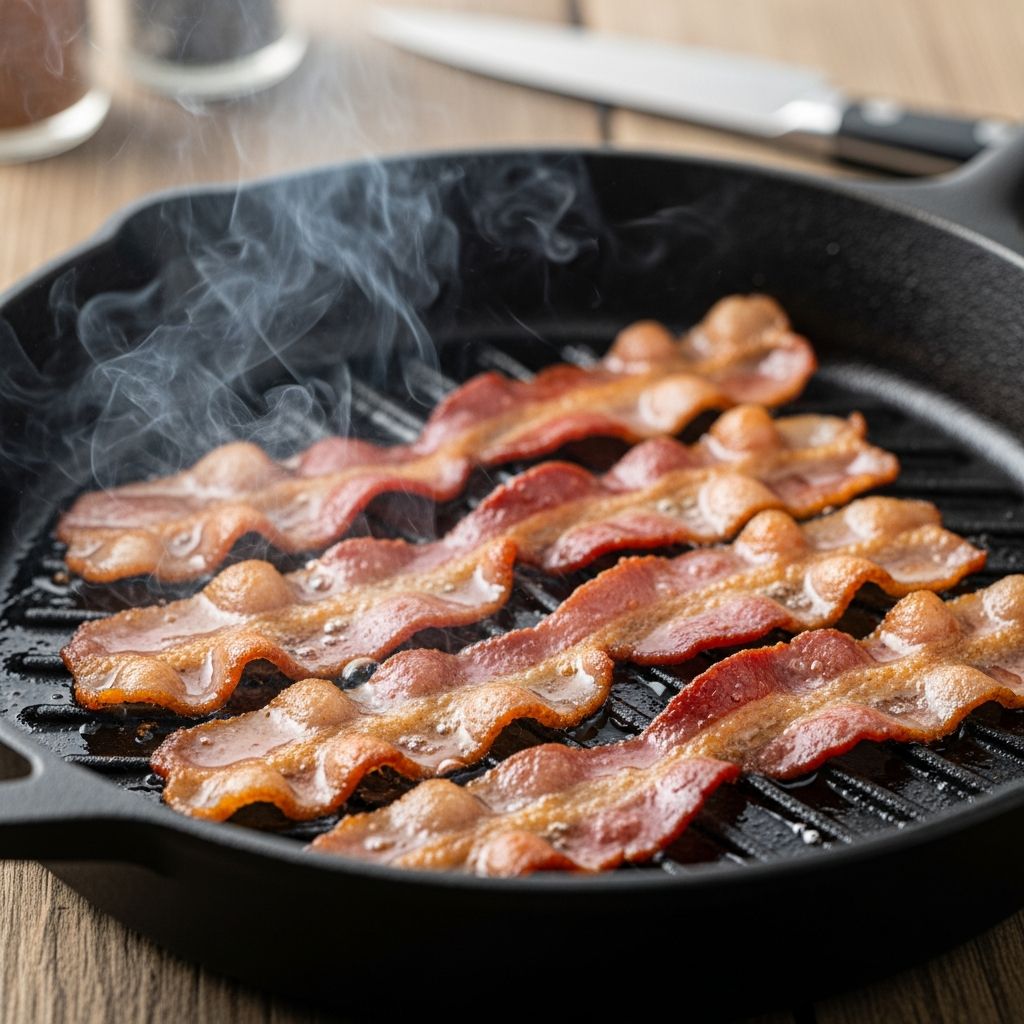
Bacon’s scent has a magnetic pull, drawing people from every corner of the home the moment it hits the pan. This phenomenon stems from a complex interplay of chemical reactions triggered by heat, resulting in hundreds of volatile compounds that tantalize our senses.
Understanding the Core Chemistry: The Maillard Reaction
At the heart of bacon’s appealing fragrance lies the **Maillard reaction**, a non-enzymatic process where amino acids from proteins react with reducing sugars under high temperatures. Discovered by French chemist Louis-Camille Maillard in 1912, this reaction is responsible for the browning and flavor development in many cooked foods, but it shines uniquely in bacon.
When bacon sizzles, temperatures between 140°C and 165°C activate this reaction. Sugars like glucose and fructose in the meat combine with free amino acids, forming a cascade of intermediates that rearrange into melanoidins—brown pigments—and a symphony of aroma molecules. Unlike simple caramelization, the Maillard reaction involves nitrogen from proteins, yielding compounds with meaty, roasted notes.
- Amino acids provide the protein backbone, breaking down into reactive components.
- Reducing sugars act as partners, facilitating molecular rearrangements.
- Heat accelerates the process, typically above 140°C for optimal aroma production.
This reaction not only colors bacon to its crispy golden hue but releases approximately 150 distinct volatile compounds, far more than in plain pork, making its smell incomparable.
Key Players in Bacon’s Signature Scent Profile
Bacon’s aroma is a blend of hydrocarbons, aldehydes, ketones, alcohols, and nitrogenous heterocyclics like pyrazines and pyridines. These compounds evaporate easily, carrying the scent through the air.
| Compound Type | Examples | Contribution to Aroma |
|---|---|---|
| Hydrocarbons | Alkanes, alkenes | Subtle base notes, providing depth |
| Aldehydes | Hexanal, nonanal | Nutty, green, and fatty scents |
| Ketones | 2,3-Butanedione | Buttery, caramel-like undertones |
| Pyrazines & Pyridines | 2,5-Dimethylpyrazine, 2-ethyl-5-methylpyrazine | Roasty, meaty, bacon-specific character |
Nitrogen-containing pyrazines are particularly crucial; they form only in cured meats like bacon due to nitrites used in processing. A 2004 study by Spanish researchers compared fried bacon to pork loin, finding bacon-exclusive pyrazines like 2,3-dimethylpyrazine that define its unique profile.
No single compound smells exactly like bacon—it’s their synergistic combination that creates the effect. As fats melt and volatilize these molecules, the aroma intensifies.
The Role of Curing Agents and Fat Content
Bacon isn’t just pork; it’s cured with salt, sugar, and sodium nitrite, which inhibit bacteria and enhance flavor. Nitrites react during cooking to form nitrosamines and contribute to pyrazine generation, absent in uncured pork.
Bacon’s high fat content—typically 40-50%—melts at around 35-40°C, releasing lipid-derived volatiles. These mix with Maillard products, amplifying the sensory explosion. Free fatty acids break down into aldehydes like (E,E)-2,4-decadienal, adding savory depth.
- Curing salts preserve and flavor, enabling unique reactions.
- Fats solubilize and carry aroma compounds.
- Sugars added during curing fuel the Maillard process.
Evolutionary and Sensory Appeal: Why We Crave It
Humans are wired to love bacon’s smell. Evolutionarily, pyrazines signal cooked, safe meat, while umami from glutamates triggers salivation and hunger.
Our olfactory receptors detect these volatiles, sending signals to the brain’s limbic system, evoking pleasure and memory. Studies show bacon aromas activate reward centers more than other meats, explaining its cultural ubiquity.
Comparing Bacon to Other Meats: What Sets It Apart
Plain pork loin frying produces hydrocarbons and aldehydes but lacks bacon’s pyrazine punch. Nitrites and curing make bacon distinct; experiments confirm uncured pork smells less enticing.
| Meat Type | Main Volatiles | Aroma Intensity |
|---|---|---|
| Bacon | Pyrazines (40%), aldehydes (30%) | High (150+ compounds) |
| Pork Loin | Hydrocarbons, alcohols | Moderate |
| Beef | Ketones, furans | High but different |
Practical Tips for Maximizing Bacon Aroma
To unleash peak scent:
- Medium heat: Avoid high temps that burn compounds.
- Start cold: Gradual rendering prevents splatter and ensures even reactions.
- Oven method: Low and slow at 200°C for uniform Maillard development.
- Quality matters: Nitrate-free bacon still aromas well but may differ slightly.
Air frying or microwaving suppresses volatiles due to enclosed cooking.
Health Considerations and Modern Twists
While irresistible, bacon’s nitrites form potential carcinogens like HCAs during high-heat cooking. Opt for moderate consumption and pair with veggies.
Plant-based bacons mimic via pea protein and smoke flavors, but lack true Maillard complexity without animal fats.
Frequently Asked Questions (FAQs)
What is the Maillard reaction in simple terms?
The Maillard reaction is a chemical process where proteins and sugars in food react under heat to create browning, flavor, and aroma compounds.
Why does bacon smell better than other pork?
Curing agents like nitrites produce unique pyrazines not found in fresh pork, enhancing the meaty scent.
Can vegetarians recreate bacon smell?
Yes, using coconut aminos, liquid smoke, and high-protein plants triggers similar Maillard-like reactions.
Does cooking method affect aroma?
Yes, pan-frying maximizes volatiles; microwaving minimizes them due to steam entrapment.
Is bacon’s smell universal?
Most omnivores find it appealing due to evolutionary cues for cooked protein safety.
Conclusion: A Scent for the Ages
Bacon’s aroma is culinary chemistry at its finest—a testament to how simple ingredients transform into sensory bliss. Next time you cook, savor the science.
References
- This is why bacon smells so good — TIME. 2015-05-26. https://time.com/119186/explaining-bacon-smell/
- Why Bacon smells sooooo good! — Spiceworks Community. 2014-05-31. https://community.spiceworks.com/t/why-bacon-smells-sooooo-good/308714
- Why Does Bacon Smell So Delicious? — Britannica. Accessed 2026. https://www.britannica.com/video/science-aroma-bacon/-207336
- This Is Why Bacon Smells So Good — Peak Scientific. Accessed 2026. https://www.peakscientific.com/discover/news/this-is-why-bacon-smells-so-good/
- Why Does Bacon Smell So Good? | COLOSSAL QUESTIONS — YouTube (Colossal). Accessed 2026. https://www.youtube.com/watch?v=mqXyn7a9UOA
- The Science of Bacon: What Makes It So Irresistible? — The Old Dutch Cupboard. Accessed 2026. https://theolddutchcupboard.com/the-science-of-bacon-what-makes-it-so-irresistible/
- Why Bacon Smells So Good [PDF] — American Chemical Society. Accessed 2026. https://www.acs.org/content/dam/acsorg/education/students/highschool/chemistryclubs/infographics/why-bacon-smells-so-good.pdf

Medha Deb is an editor with a master's degree in Applied Linguistics from the University of Hyderabad. She believes that her qualification has helped her develop a deep understanding of language and its application in various contexts. Medha specializes in the areas of beauty, health, sports, and wellness and is committed to ensuring that the content on the website is…