
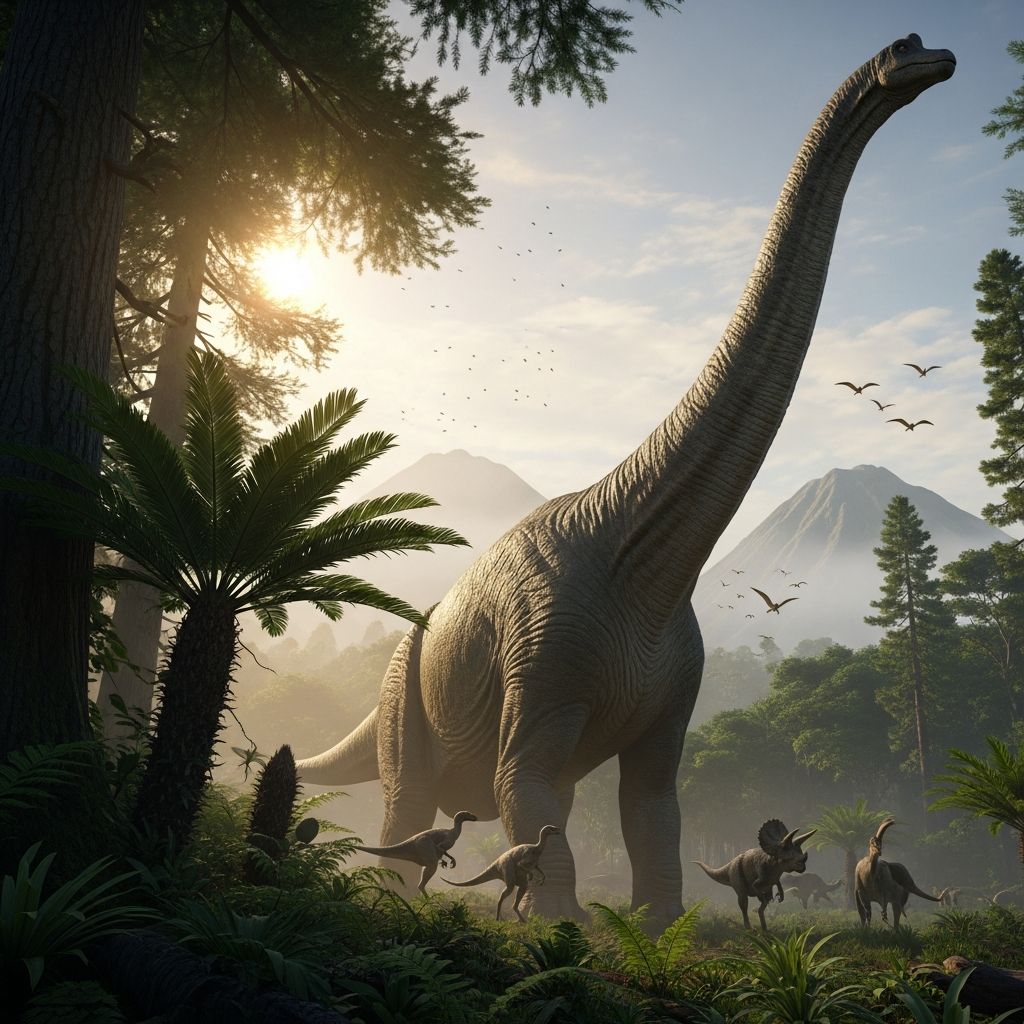
Dinosaurs dominated Earth for over 165 million years, with many species reaching sizes unimaginable in modern ecosystems. Titanosaurs and sauropods like Argentinosaurus weighed up to 100 tons, while theropods like Tyrannosaurus rex stretched over 40 feet long. This phenomenon, known as gigantism, arose from a confluence of environmental abundance, physiological efficiencies, and evolutionary dynamics.
Environmental Foundations for Massive Growth
The Mesozoic Era (252-66 million years ago) featured warmer global climates with atmospheric CO2 levels four times higher than today. This greenhouse effect spurred lush vegetation, providing herbivorous dinosaurs with vast food resources. Without polar ice caps, higher sea levels created expansive shallow seas and wetlands, fostering diverse ecosystems rich in ferns, cycads, and conifers.
Herbivores like sauropods capitalized on this bounty. Their enormous bodies required massive caloric intake—estimated at hundreds of kilograms of plants daily—but plentiful foliage made sustained growth feasible. Carnivores followed suit, enlarging to tackle these giants, creating an evolutionary feedback loop.
- Warm climate: Reduced seasonal scarcity, enabling year-round foraging.
- High CO2: Accelerated plant growth, amplifying food availability.
- Continental configurations: Supercontinents like Pangaea concentrated resources in habitable zones.
Anatomical Marvels Supporting Immense Sizes
Dinosaurs possessed unique skeletal and respiratory features that defied gravitational limits. Unlike sprawling reptiles, they maintained an upright, pillar-like posture, distributing weight efficiently across columnar limbs. Sauropods evolved wide hips for stability and spacious guts to process fibrous plants slowly, extracting maximum nutrients.
Lightweight pneumatized bones, riddled with air sacs akin to modern birds, reduced overall mass while maintaining strength. These sacs extended into vertebrae, forming expansive cervical regions for long necks—up to 50 feet in Supersaurus—allowing access to treetop foliage without constant movement.
| Dinosaur Feature | Adaptation Benefit | Example Species |
|---|---|---|
| Upright Stance | Energy-efficient locomotion | All dinosaurs |
| Air Sacs & Hollow Bones | Reduced weight by 15-20% | Titanosaurs |
| Long Necks | Expanded feeding range | Brachiosaurus |
| Soft Foot Pads | Weight distribution | Sauropods |
Theropods like T. rex benefited from bipedalism for speed and power, though their size prioritized predation on large prey.
Respiratory and Metabolic Efficiencies
A bird-like unidirectional breathing system, with air flowing continuously through lungs via air sacs, maximized oxygen extraction. This efficiency supported high metabolisms in colossal bodies, countering myths of elevated Mesozoic oxygen (levels were comparable to today). Sauropods likely exhibited variable metabolism: rapid juvenile growth transitioning to efficient adulthood, minimizing energy needs.
Large body volume-to-surface ratios minimized heat loss, aiding thermoregulation. Juveniles grew quickly, laying eggs for rapid population replenishment, giving giants reproductive edges.
Evolutionary Dynamics and Cope’s Rule
Cope’s Rule posits that lineages trend toward larger sizes over time. A 2012 National Museum of Natural History study analyzing dinosaur femurs confirmed this pattern in many clades, though not universally, with statistical models revealing no hard upper size limits. Gigantism filled ecological niches: herbivores deterred predators, carnivores exploited mega-prey.
This ‘arms race’ intensified: small herbivores enlarged for safety, prompting predator hypertrophy. Resource partitioning—sauropods atop canopies, smaller herbivores below—minimized competition.
Debunking Persistent Myths
Popular theories like lower gravity or hyper-oxygenated air have been refuted. Earth’s mass stabilized early, precluding gravity shifts, and oxygen hovered at 20-30%, insufficient for extreme gigantism. Modern elephants and whales achieve comparable sizes under current conditions, underscoring physiological over environmental primacy.
Advantages and Vulnerabilities of Scale
Gigantism conferred protections: predation immunity, famine endurance via fat reserves, and long-distance migration. However, vulnerabilities emerged—droughts starved giants faster, overheating risked despite cooling necks/tails.
- Predator Deterrence: Adults invulnerable except to pack hunters.
- Resource Access: Niche exploitation without interference.
- Thermoregulation: Internal heat retention.
- Drawbacks: High baseline metabolism, mobility limits.
Modern Analogies and Implications
Today’s blue whales (200 tons) and African elephants illustrate gigantism’s viability. Dinosaur adaptations prefigure avian efficiency, linking them evolutionarily to birds. Studying these reveals biomechanics applicable to engineering and conservation.
Fossil evidence from Patagonia’s titanosaurs underscores Late Cretaceous peaks, before the K-Pg extinction reset scales.
Frequently Asked Questions (FAQs)
Why didn’t oxygen levels explain dinosaur size?
Mesozoic oxygen matched modern levels; bird-like respiration was key.
Could dinosaurs grow even larger?
Biomechanical limits near 100-150 tons; no evidence of exceeding.
Were all dinosaurs gigantic?
No, many were chicken-sized; gigantism clade-specific.
How did sauropods support their weight?
Hollow bones, air sacs, pillar limbs, foot pads.
Did climate directly cause gigantism?
Indirectly via food abundance; adaptations enabled exploitation.
Conclusion: A Perfect Evolutionary Storm
Dinosaur gigantism stemmed from intertwined factors: bountiful ecosystems, superior anatomy, efficient physiology, and selective pressures. This synergy allowed Mesozoic supremacy, offering timeless insights into life’s scalable limits.
References
- Why Were So Many Prehistoric Animals So Big? — HowStuffWorks. 2023. https://animals.howstuffworks.com/extinct-animals/why-were-prehistoric-animals-big.htm
- Why were dinosaurs so big? — BBC Science Focus Magazine. 2023-10-15. https://www.sciencefocus.com/nature/why-were-dinosaurs-so-big
- The Time of Giants: How Did Dinosaurs Get So Big? — Discover Magazine. 2010-10-19. https://www.discovermagazine.com/the-time-of-giants-how-did-dinosaurs-get-so-big-45124
- Why were dinosaurs so big? The secrets of titanosaurs’ super size — Natural History Museum. 2023. https://www.nhm.ac.uk/discover/why-were-dinosaurs-so-big.html
- Why Did Dinosaurs Grow So Huge? Unraveling the Mystery! (Video Transcript) — YouTube. 2023. https://www.youtube.com/watch?v=bmVhFqEJcDI
- Why did some dinosaurs grow so big? — USGS.gov. 2023. https://www.usgs.gov/faqs/why-did-some-dinosaurs-grow-so-big

Medha Deb is an editor with a master's degree in Applied Linguistics from the University of Hyderabad. She believes that her qualification has helped her develop a deep understanding of language and its application in various contexts. Medha specializes in the areas of beauty, health, sports, and wellness and is committed to ensuring that the content on the website is…