
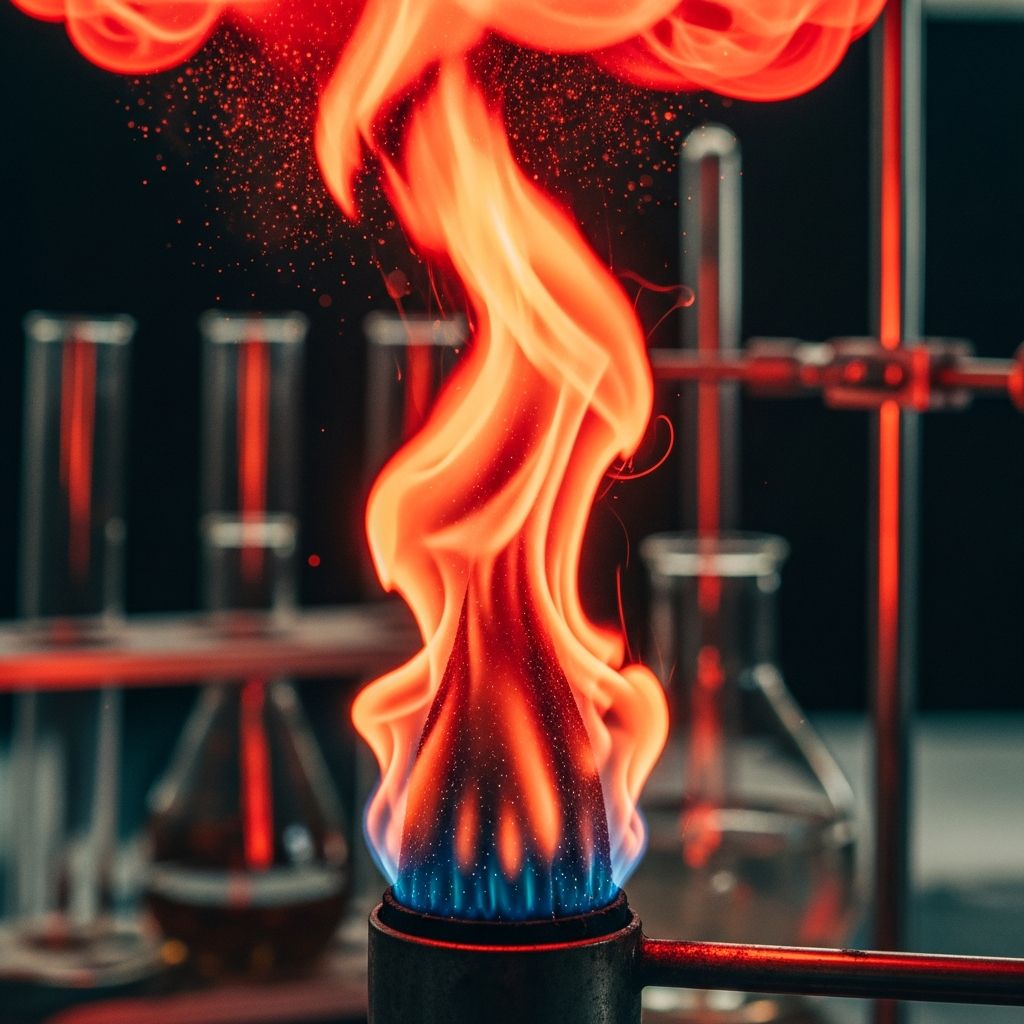
Fire has captivated humanity for millennia, providing warmth, light, and the means to cook food. Yet, its intense heat demands respect due to the potential for severe burns and destruction. At its core, fire’s scorching temperatures stem from a rapid chemical process called combustion, where fuel rapidly oxidizes, releasing far more energy than required to initiate the reaction. This excess energy manifests as heat and light, sustaining the blaze until fuel or oxygen depletes.
Understanding Combustion: The Heart of Fire’s Heat
Combustion is an exothermic reaction, meaning it generates heat. For fire to ignite, three elements must converge: fuel (like wood or gasoline), oxygen (typically from air), and an ignition source (such as a spark or match). Once started, the reaction becomes self-sustaining through a chain process. Bonds in the fuel molecules break, reacting with oxygen to form products like carbon dioxide and water, while liberating stored chemical energy.
The key to fire’s heat lies in energy imbalance. The activation energy to break initial bonds is minimal compared to the energy released when new, stable bonds form in the products. This net energy release heats surrounding gases, creating visible flames—plasma-like ionized gases that glow from excited electrons dropping energy levels.
- Fuel: Provides the carbon and hydrogen compounds that react.
- Oxygen: Acts as the oxidizer, enabling rapid oxidation.
- Heat: Initiates and propagates the chain reaction.
Without continuous supply of any element, the fire extinguishes, as seen when fuel burns out in a controlled campfire.
Flame Temperatures: Not All Fires Burn Equally Hot
Fire temperature varies widely based on fuel type, oxygen availability, and environmental factors like pressure. Common wood fires reach 600–1,200°C (1,112–2,192°F), hot enough to ignite nearby materials. Propane torches hit 1,980°C (3,596°F), while specialized flames like cyanogen-oxygen exceed 5,000°C (9,032°F).
| Fuel Type | Average Temperature (°C) | Average Temperature (°F) | Common Use |
|---|---|---|---|
| Wood (natural draft) | 900 | 1,652 | Campfires, fireplaces |
| Charcoal (forced draft) | 1,390 | 2,534 | Grilling |
| Propane | 1,980 | 3,596 | Torch cutting |
| Magnesium | 2,100 | 3,812 | Pyrotechnics |
| Cyanogen-Oxygen | 5,400 | 9,752 | Laboratory research |
These values highlight why industrial applications demand precise flame control. Atmospheric oxygen limits most flames; enriching it boosts temperature.
Decoding Flame Colors and What They Reveal
Flame color indicates temperature and composition, offering clues about the fire’s nature. Lower temperatures produce deep red hues (600–800°C), transitioning to orange-yellow at 1,100°C, white at 1,300–1,500°C, and blue at 1,400–1,650°C. Violet flames signal extremes above 3,900°C, often from exotic fuels.
- Red/Orange: Soot particles incandescence in hydrocarbon flames like wood.
- Blue: Complete combustion of gases, minimal soot (e.g., natural gas).
- Green/Yellow: Impurities like copper salts in colored flames.
Diffusion flames (common in candles) mix fuel and oxygen gradually, yielding yellow from soot. Premixed flames burn cleaner and hotter with blue cores.
Types of Flames and Their Heat Profiles
Flames classify by mixing method. Diffusion flames, prevalent in everyday fires, have visible structure: cool blue base (reaction zone), bright yellow mantle (soot glow), and pale outer envelope (unburned gases). Premixed flames, like Bunsen burners, combust uniformly for higher efficiency and heat.
Plasma forms in hottest fires, ionizing gases into conductive states, as in welding arcs. Gravity aids convection, drawing fresh oxygen upward and expelling products, intensifying the blaze.
Physics of Heat Transfer from Flames
Beyond chemical origins, fire transfers heat via conduction (direct contact), convection (hot air currents), and radiation (infrared waves). Radiant heat warms distant objects without touch, explaining sunburn-like effects from intense fires. Molecules in flames vibrate rapidly from energy release, colliding to propagate heat.
Light emission ties to heat: excited electrons in hot gases revert states, releasing photons across visible and infrared spectra. Soot enhances glow via blackbody radiation.
Everyday Examples: From Campfires to Candles
A campfire demonstrates basics: wood volatiles vaporize, ignite in oxygen-rich air, producing 800–1,000°C heat. Candles wick wax upward, vaporizing it for a steady 1,400°C flame. The match’s spark provides activation energy, but combustion yields exponentially more.
Barbecues use charcoal’s high carbon content for sustained 700–1,200°C heat. Gas stoves offer controlled blue flames at 1,900°C for precise cooking.
Safety Considerations Around Hot Flames
Fire’s heat causes 75% of burn injuries via rapid tissue damage above 44°C. Never leave fires unattended; use barriers around campfires. Extinguishers disrupt the fire triangle by cooling, smothering, or starving fuel.
- Keep flammables 3 meters from flames.
- Use water cautiously on grease fires (opt for smothering).
- Install smoke detectors for early warning.
Advanced Fire Science: Beyond Everyday Blazes
In labs, carbon subnitride flames reach 6,000K by breaking strong N≡N bonds, releasing immense energy. Wildfires vary: grass at 500°C, crown fires at 1,200°C. Space lacks convection, making fires spherical and dimmer.
Climate change intensifies wildfires via drier fuels, demanding advanced modeling.
Frequently Asked Questions (FAQs)
What makes fire feel hot from a distance?
Radiant heat and convection carry thermal energy away from the flame, warming skin without direct contact.
Can fire exist without oxygen?
Yes, with alternative oxidizers like chlorine, though rare and unstable.
Why do some flames burn cooler than others?
Incomplete fuel-oxidizer mixing or impurities lower efficiency, reducing peak temperatures.
Is blue fire always hotter than red?
Typically yes, indicating complete combustion, but exceptions exist with chemical dopants.
How quickly does fire heat spread?
Convection propagates heat at air current speeds, while radiation travels at light speed.
Exploring Fire’s Role in Nature and Technology
Fire shapes ecosystems, clearing underbrush for new growth. Technologically, controlled combustion powers engines: gasoline ignites at 500°C, expanding gases to drive pistons. Rocket fuels burn at 3,000°C for thrust.
Understanding fire’s heat advances firefighting foams and non-flammable materials. Nanotechnology studies nanoscale flames for efficient energy.
References
- Why Is Fire Hot? How Hot Is It? — Science Notes. 2023-05-15. https://sciencenotes.org/why-is-fire-hot-how-hot-is-it/
- Why Is Fire Hot? (SciShow Kids Video Transcript) — YouTube/SciShow Kids. 2018-12-10. https://www.youtube.com/watch?v=_4NoW8BIocY
- Fire — Wikipedia (sourced from primary combustion physics). 2026-04-01 (last edited). https://en.wikipedia.org/wiki/Fire
- Why Exactly does Fire get HOT? (Physics Explanation) — YouTube. 2023-08-20. https://www.youtube.com/shorts/aBA1gy8YZ9k

Medha Deb is an editor with a master's degree in Applied Linguistics from the University of Hyderabad. She believes that her qualification has helped her develop a deep understanding of language and its application in various contexts. Medha specializes in the areas of beauty, health, sports, and wellness and is committed to ensuring that the content on the website is…