
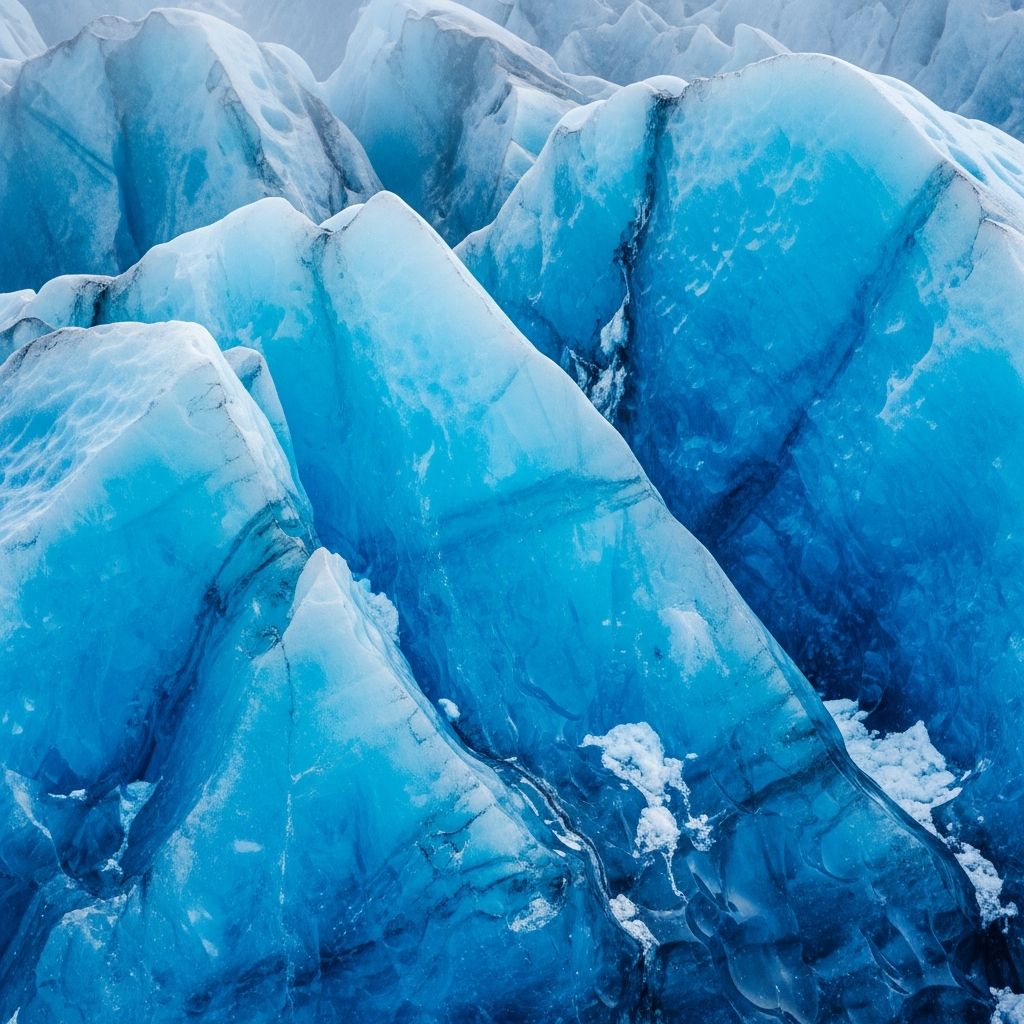
Dense glacier ice exhibits a vivid blue color due to the selective absorption of longer wavelengths of light, such as red and orange, while transmitting shorter blue wavelengths through its compressed crystal structure.
Understanding Light and Ice Basics
Visible light comprises a spectrum of colors, each with distinct wavelengths: red possesses the longest at approximately 700 nanometers, while violet has the shortest at 400 nanometers. When sunlight strikes ordinary snow or fresh ice, it reflects brightly white because air bubbles trapped within scatter all wavelengths equally, mimicking the effect of a mirror.
However, glacier ice tells a different story. Formed over centuries from accumulated snow, it undergoes immense pressure that expels air pockets, creating pure, dense ice crystals. This transformation is key to its coloration.
How Pressure Transforms Snow into Blue Ice
Snowflakes begin transparent but appear white in piles due to interstitial air scattering light. In glaciers, overlying layers compact this snow, squeezing out air and enlarging ice crystals. The resulting ice density approaches that of liquid water, around 0.917 grams per cubic centimeter, far surpassing typical ice.
- Initial snow accumulation traps air, yielding white appearance.
- Progressive burial applies gigapascals of pressure, collapsing bubbles.
- Crystal growth aligns molecules, optimizing light interaction paths.
This dense matrix alters light’s journey profoundly.
The Physics of Selective Light Absorption
Ice absorbs light via overtones of oxygen-hydrogen (O-H) bonds in water molecules, peaking in the red spectrum. Longer red wavelengths (low energy) match vibrational frequencies, getting trapped and converted to heat after multiple internal reflections.
Shorter blue wavelengths (high energy) pass through with minimal absorption, especially in thick ice where paths extend meters. Thus, observers see brilliant blue from crevasses or calving faces exposing deep layers.
| Light Color | Wavelength (nm) | Absorption in Dense Ice | Result |
|---|---|---|---|
| Red | 620-700 | High | Absorbed |
| Orange/Yellow | 570-620 | Moderate-High | Mostly Absorbed |
| Green | 495-570 | Moderate | Partially Transmitted |
| Blue | 450-495 | Low | Transmitted |
| Violet | 380-450 | Low | Transmitted/Scattered |
This table illustrates spectral behavior, confirming blue dominance.
Contrasting Glacier Ice with Everyday Ice
Freezer ice remains cloudy or clear-white from retained air bubbles scattering light uniformly. Lacking compression, it fails to filter colors. Conversely, glacial ice’s purity reveals intrinsic water blueness, observable in depths exceeding 3 meters even in liquid form.
Glaciers demand time: centuries for sufficient density. Young ice stays white until matured.
Real-World Examples and Visual Spectacles
In Iceland’s glaciers, compressed ice glows intensely blue as bubbles vanish, intensifying with thickness. Greenland’s icebergs calve revealing turquoise interiors, signaling ancient origins.
Glacier Bay National Park showcases pure blue in compact ice, akin to sapphire’s reflectance. Antarctica’s wind-scoured blue ice zones span vast areas, exposing old layers. New Zealand’s Tasman Glacier once flipped an iceberg, unveiling submerged blue untouched by air.
Scientific Experiments and Demonstrations
Laboratory tests with thick ice blocks mimic this: thin slabs look clear, thicker ones blue. Shine a light through 2-3 meters of pure ice; blue emerges vividly. PBS demonstrations in ice caves highlight red absorption, leaving blue.
These confirm: no air, no white; density dictates hue.
Myths and Misconceptions Debunked
Rayleigh scattering, sky-blue culprit, differs here. Glacial blue stems from absorption, not scatter. Impurities like dirt yield black/brown ice, not blue. Thin ice never blues; depth is essential.
Implications for Climate and Exploration
Blue ice indicates old, stable glaciers; its retreat signals warming, accelerating melt. NASA notes dense blue absorption of all but blue light. USGS affirms red absorption, blue transmission.
Blue patches aid ice-core dating, revealing millennia-old climate data.
Observing Blue Ice Safely
Visit calving fronts cautiously; crevasses expose blue but pose risks. Kayak iceberg lagoons for close views. Drones capture inaccessible blues.
Frequently Asked Questions
Why does regular ice look white but glacier ice blue?
Regular ice traps air bubbles scattering all light white; glaciers compress out air, absorbing reds and transmitting blue.
Does all blue ice mean the same age?
Bluer hue correlates with greater density and age, but varies by compression history.
Can blue ice melt differently?
Dense structure melts slower initially, but exposes faster once surfaced.
Is blue ice safe to drink?
Ancient purity makes it pristine, free of modern pollutants.
How thick must ice be for blue color?
Typically several meters; thinner appears clear or white.
Conclusion: Nature’s Optical Masterpiece
Blue glacier ice exemplifies physics in action: pressure forges density, molecules select spectra, yielding ethereal beauty. From Iceland to Antarctica, this phenomenon captivates, underscoring fragile cryospheric dynamics.
References
- Why is the ice blue? An introduction to glaciers in Iceland — Local Guide Iceland. Accessed 2026. https://localguide.is/why-is-the-ice-blue-an-introduction-to-glaciers-in-iceland/
- Why is glacier ice blue? — Woods Hole Oceanographic Institution. Accessed 2026. https://www.whoi.edu/ocean-learning-hub/ocean-facts/why-is-glacier-ice-blue/
- Why is the Ice Blue? In Glacier Bay — National Park Service (nps.gov). Accessed 2026. https://www.nps.gov/places/why-is-the-ice-blue-in-glacier-bay.htm
- Blue ice (glacial) — Wikipedia (informational, primary sources referenced). Accessed 2026. https://en.wikipedia.org/wiki/Blue_ice_(glacial)
- The Secret of Why Glacier Ice is Blue! (Transcript) — PBS Digital Studios / YouTube. 2016-04-01. https://www.youtube.com/watch?v=P7LKm9jtm8I
- Why is glacier ice blue? — U.S. Geological Survey (usgs.gov). Accessed 2026. https://www.usgs.gov/faqs/why-glacier-ice-blue
- Glacier Power: Why is Glacier Ice Blue? — NASA Earthdata. Accessed 2026. https://www.earthdata.nasa.gov/topics/cryosphere/glaciers/glacier-power/why-is-glacier-ice-blue

- Integrated M.A. in Applied Linguistics, University of Hyderabad
- 5+ years in editorial, instructional, SEO, and research-based writing
Sneha is a relationships and lifestyle writer with a strong foundation in applied linguistics and certified training in relationship coaching. She brings over five years of writing experience to theskillvault, crafting thoughtful, research-driven content that empowers readers to build healthier relationships, boost emotional well-being, and embrace holistic living. Her writing and insights reflect the belief that beauty, happiness, and wellness…