
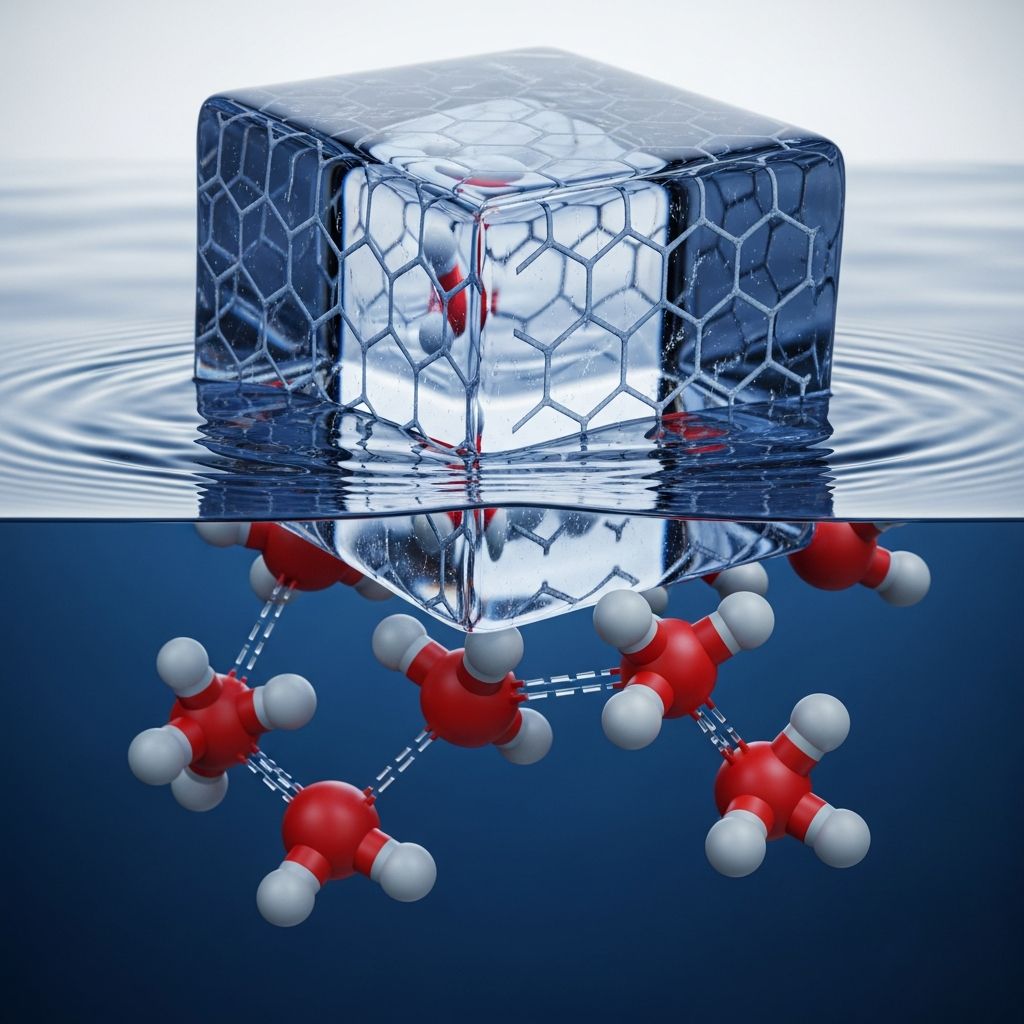
Ice floats on water because it possesses a lower density than liquid water, a rare property among substances where the solid form is less dense than the liquid. This phenomenon arises from the distinctive arrangement of water molecules during freezing, creating an open crystal structure that incorporates empty spaces.
The Fundamental Principle of Buoyancy
Buoyancy, governed by **Archimedes’ principle**, states that an object floats if the weight of the fluid it displaces exceeds its own weight. For ice, this occurs because its density (approximately 0.917 g/cm³) is about 9% less than that of liquid water (1 g/cm³ at 4°C). When submerged, ice displaces a volume of water weighing more than itself, generating an upward buoyant force that pushes it to the surface.
Density is mass per unit volume. Most substances contract upon freezing as molecules pack tightly, increasing density. Water, however, expands by about 9%, reducing its density and enabling flotation.
Molecular Architecture of Water
Water molecules (H₂O) feature a bent structure with oxygen at the center and two hydrogens, bonded covalently. Oxygen’s high electronegativity draws electrons, rendering it partially negative (δ⁻) and hydrogens partially positive (δ⁺). These polar molecules form **hydrogen bonds**—weak electrostatic attractions between δ⁺ hydrogen and δ⁻ oxygen of adjacent molecules.
In liquid water, molecules slide past each other, constantly forming and breaking hydrogen bonds, allowing close packing. As temperature drops to 0°C, kinetic energy decreases, stabilizing hydrogen bonds into a rigid framework.
Crystal Lattice: The Key to Lower Density
Frozen water organizes into a **hexagonal crystal lattice**, where each molecule bonds tetrahedrally to four others, forming a three-dimensional network with open spaces. This lattice resembles a honeycomb, trapping air pockets that increase volume without proportional mass gain.
- Each oxygen coordinates with four hydrogens from neighboring molecules.
- Hydrogen bonds dictate precise 104.5° angles, preventing tighter packing.
- Resulting voids make ice ~9% less dense than water.
This structure contrasts with liquid water’s dynamic packing, where molecules nestle closer. Research highlights hydrogen bonds’ flexibility in liquid allowing efficient packing, unlike ice’s rigidity.
Comparing Densities: Water vs. Other Substances
| Substance | Liquid Density (g/cm³) | Solid Density (g/cm³) | Does Solid Float? |
|---|---|---|---|
| Water | 1.00 | 0.917 | Yes |
| Ethanol | 0.789 | 0.806 | No |
| Mercury | 13.55 | 14.19 | No |
| Iron | 6.98 (melted) | 7.87 | No |
Water is exceptional; nearly all substances densify upon solidification. This table illustrates the anomaly, underscoring water’s uniqueness.
Ecological and Planetary Implications
Ice’s flotation insulates underlying water, preventing complete freezing of lakes and oceans. Aquatic life survives winters beneath this barrier, as heat loss slows dramatically. Ponds freeze from the top, maintaining liquid layers below for fish and microorganisms.
Globally, floating sea ice regulates climate by reflecting sunlight (high albedo) and influencing ocean currents. As ice forms, it expels salt, densifying underlying water that sinks, driving thermohaline circulation. Without floating ice, oceans might freeze from the bottom, devastating marine ecosystems.
Exceptions and Advanced Ice Forms
Not all ice floats universally. Under extreme pressures, like deep glaciers, ice polymorphs (e.g., Ice II, Ice III) form with higher densities, sinking in liquid water. At sea level, however, familiar Ice Ih (hexagonal ice) prevails and floats.
Supercooling or rapid freezing can trap more air, further reducing density, but the core principle remains hydrogen bonding.
Experimental Demonstrations
To verify, fill a glass with water and add ice cubes—they float, displacing their weight in water. Weigh equal volumes: 100 cm³ water (100g) vs. 100 cm³ ice (~91.7g).
- Measure ice cube volume and mass.
- Submerge in water; observe displacement.
- Calculate density: mass/volume < 1 g/cm³ confirms flotation.
Hot vs. cold water experiments show cooling increases density until 4°C, then ice forms less dense.
Frequently Asked Questions
Why is ice slippery?
Ice’s surface melts under pressure or friction, forming a quasi-liquid layer that reduces friction.
Does ice float in saltwater?
Yes, but less so; saltwater density (~1.025 g/cm³) reduces buoyancy, though ice still floats.
What if ice sank?
Lakes would freeze solid, killing aquatic life and disrupting global climate patterns.
Is water the only substance where solid floats on liquid?
One of few; others like gallium exhibit similar anomalies under specific conditions.
How does temperature affect water density?
Maximum at 4°C; above, expands; below, forms ice with even lower density.
Broader Scientific Context
This property stems from quantum effects in hydrogen bonding, enabling life’s emergence on Earth. In astrophysics, water ice on comets and moons behaves similarly, aiding habitability models.
Climate change accelerates ice melt, reducing insulation and altering ecosystems, emphasizing water’s anomalous behavior.
References
- Why Does Ice Float on Water? Structure, Density, & Buoyancy — Encyclopaedia Britannica. 2023. https://www.britannica.com/science/Why-Does-Ice-Float-on-Water
- Why does ice float on water? — BBC Science Focus Magazine. 2023-10-12. https://www.sciencefocus.com/science/why-does-ice-float-on-water
- Why does ice float? — CORDIS | European Commission. 2022-06-14. https://cordis.europa.eu/article/id/454697-why-does-ice-float
- Why Does Ice Float & Why is that AMAZING? — MathAndScience YouTube Channel. 2015-08-01. https://www.youtube.com/watch?v=jo2v2fRRsaI
- Exploring our world: Why does ice float? — Michigan State University Extension. 2018-01-22. https://www.canr.msu.edu/news/exploring_our_world_why_does_ice_float
- Why Does Ice Float? — The Children’s Museum of Indianapolis. 2023. https://www.childrensmuseum.org/blog/why-does-ice-float
- Why does ice float? — Live Science. 2023-11-20. https://www.livescience.com/chemistry/why-does-ice-float

Medha Deb is an editor with a master's degree in Applied Linguistics from the University of Hyderabad. She believes that her qualification has helped her develop a deep understanding of language and its application in various contexts. Medha specializes in the areas of beauty, health, sports, and wellness and is committed to ensuring that the content on the website is…