
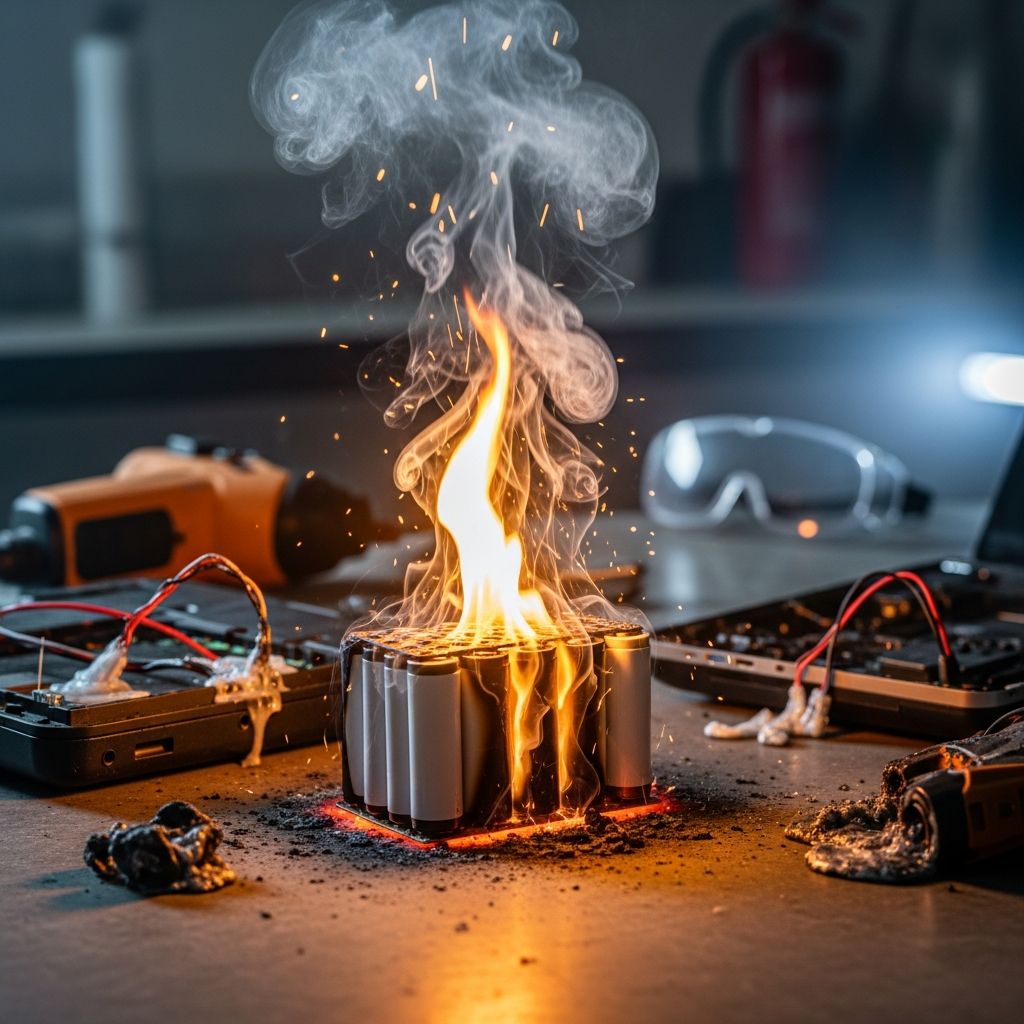
Lithium-ion batteries power everything from smartphones to electric vehicles, but their propensity for catching fire poses significant risks. These incidents often stem from thermal runaway, a self-sustaining reaction where heat buildup leads to catastrophic failure.
Understanding the Core Mechanism: Thermal Runaway
At the heart of most lithium battery fires is thermal runaway, a process where internal heat generation outpaces dissipation, triggering a chain reaction. It begins when a single cell overheats, often exceeding 130°C (266°F), causing the separator—a thin polymer layer between anode and cathode—to melt.
Once compromised, the electrodes contact, sparking an internal short circuit that releases stored energy as intense heat. This decomposes the electrolyte, producing flammable gases that can ignite. In battery packs, heat spreads to adjacent cells, amplifying the blaze.
- Initial Trigger: Heat from short circuits, overcharging, or trauma raises cell temperature.
- Separator Failure: Melts above 130°C, enabling direct electrode contact.
- Short Circuit: Rapid energy discharge generates more heat.
- Electrolyte Breakdown: Releases combustible vapors and oxygen from cathode materials.
- Propagation: Affects neighboring cells in packs, sustaining the fire.
This feedback loop makes suppression challenging, as batteries self-supply oxygen via cathode decomposition.
Primary Triggers of Battery Ignition
Several factors initiate thermal runaway, categorized into mechanical, electrical, and thermal abuses.
Mechanical Damage: The Impact Factor
Physical trauma like crushing, puncturing, or dropping deforms internal layers, forcing anode and cathode into contact for a ‘hard short.’ Vehicle collisions or mishandled e-bikes exemplify this risk, where deformed current collectors spark within the electrolyte slurry.
Dendrite formation adds insidious danger: During fast or cold charging, lithium ions form needle-like structures piercing the separator, creating delayed shorts.
Electrical Abuse: Overcharging and Shorts
Exceeding voltage limits (e.g., >3.65V for NMC cells) decomposes the cathode, releasing oxygen and heat. Faulty chargers or inadequate Battery Management Systems (BMS) fail to prevent this, especially in counterfeit products.
External shorts from damaged wiring or water exposure also spike currents, initiating runaway.
Thermal Stress: Heat and Environmental Extremes
Exposure to high ambient temperatures destabilizes cells, accelerating unwanted reactions. A 20% temperature rise exponentially speeds electrolyte decomposition, fueling runaway. Saltwater immersion corrodes components, risking shorts.
Chemistry Behind the Flames
Lithium-ion batteries use intercalation compounds: graphite anode, layered oxide cathodes (e.g., NMC: nickel-manganese-cobalt), and organic electrolyte.
| Chemistry Type | Stability | Fire Risk | Temp Threshold |
|---|---|---|---|
| NMC (Nickel-Manganese-Cobalt) | Moderate | High – Releases oxygen | 150°C (302°F) |
| LFP (Lithium Iron Phosphate) | High | Low – Strong P-O bonds | >300°C |
NMC cathodes break down easily, supplying oxidizer for sustained fires. LFP’s robust bonds prevent oxygen release, making it safer.
Real-World Scenarios and Statistics
Fires surge in e-mobility: Hoverboards, e-bikes, and EVs with subpar BMS have caused numerous incidents. Aviation bans large lithium batteries in cargo due to inextinguishable fires and pressure-induced ruptures.
NFPA reports rising home fires from devices like vapes and laptops, often from overcharging or damage. Counterfeits amplify risks with inferior separators and electrolytes.
Prevention Strategies for Consumers
- Use Certified Products: Opt for UL 1642 or IEC 62133 certified batteries with robust BMS.
- Proper Charging: Employ manufacturer chargers; unplug post-full charge to avoid voltage stress.
- Storage Best Practices: Keep at 30-50% charge in cool, dry areas; avoid extreme temps.
- Physical Protection: Use padded cases; inspect for swelling or heat.
- Travel Safely: Carry in cabins, not checked luggage per FAA rules.
Advanced Safety Technologies
Modern BMS monitor cell voltage, temperature, and balance charges. Innovations include ceramic-coated separators resisting dendrite penetration and solid-state electrolytes reducing flammability.
Fire-suppression systems in EVs use aerosol agents, though water is ineffective against self-oxidizing fires.
Responding to a Lithium Battery Fire
These fires resist standard extinguishers: Water conducts electricity; CO2 scatters ineffectively. Use Class D extinguishers or dry sand to smother. Evacuate, cool surroundings with water, and call professionals.
Warning signs: Hissing, smoke (electrolyte vapor), swelling, or unusual heat.
Frequently Asked Questions (FAQs)
Why are lithium batteries hard to extinguish?
They generate oxygen internally, sustaining combustion without external air.
Are all lithium batteries equally dangerous?
No; LFP is far safer than NMC due to thermal stability.
Can a swollen battery explode?
Yes, gas buildup from degradation can rupture the casing, ejecting flames.
Is fast charging always risky?
Not with quality BMS, but it heightens dendrite risk in cold conditions.
How to dispose of old lithium batteries?
Take to recycling centers; never trash—risks landfill fires.
Future Directions in Battery Safety
Research focuses on solid-state batteries eliminating liquid electrolytes, reducing fire risks. Phosphate-based cathodes and AI-driven BMS promise further gains. Regulatory pushes for global standards aim to curb incidents.
While lithium-ion dominates, safer chemistries like sodium-ion emerge for stationary storage.
References
- Why Do Lithium Batteries Catch Fire: Explained — EcoFlow US. 2023. https://homebattery.ecoflow.com/us/blog/why-do-lithium-batteries-catch-fire
- Lithium-ion battery fires are a growing public safety concern — Clemson News. 2023-10-10. https://news.clemson.edu/lithium-ion-battery-fires-are-a-growing-public-safety-concern-%E2%88%92-heres-how-to-reduce-the-risk/
- How Do You Put Out A Lithium-Ion Battery Fire? — Hiller Fire. 2023. https://hillerfire.com/insights/how-do-you-put-out-a-lithium-ion-battery-fire/
- Lithium-Ion Battery Fires: What You Need to Know — AAA. 2023. https://www.acg.aaa.com/connect/blogs/4c/insurance/lithium-ion-battery-fires-what-you-need-to-know
- Causes of Lithium Ion Battery Fires — Justrite. 2023. https://www.justrite.com/causes-of-lithium-ion-battery-fires
- Lithium-Ion Battery Safety — NFPA. 2025-01-15. https://www.nfpa.org/education-and-research/home-fire-safety/lithium-ion-batteries

Medha Deb is an editor with a master's degree in Applied Linguistics from the University of Hyderabad. She believes that her qualification has helped her develop a deep understanding of language and its application in various contexts. Medha specializes in the areas of beauty, health, sports, and wellness and is committed to ensuring that the content on the website is…