
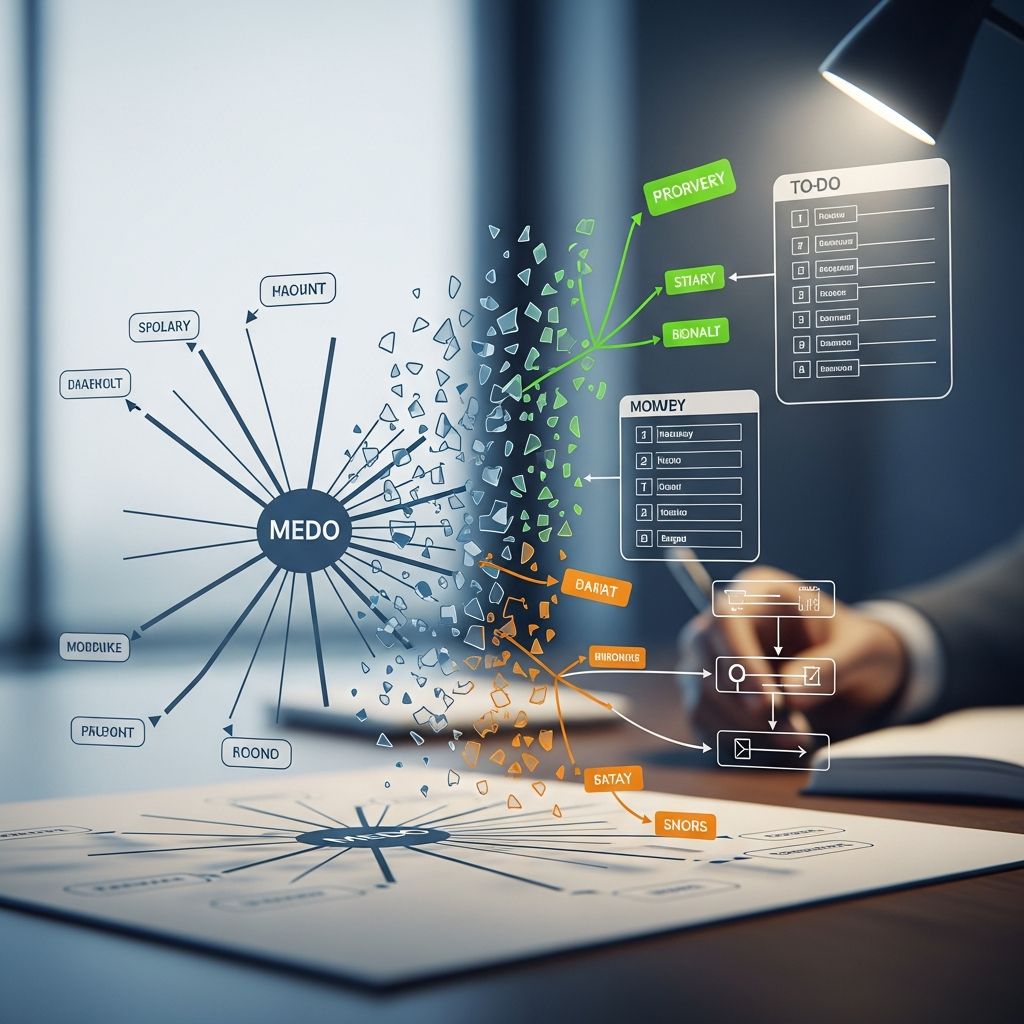
Mind mapping, a visual technique popularized for brainstorming and organizing ideas, often falls short in delivering true productivity gains. While it promises nonlinear thinking and creativity, research and practical application reveal significant limitations that can impede progress rather than accelerate it. This article examines five primary reasons to reconsider reliance on mind maps, drawing from empirical studies and cognitive science insights, and proposes more effective alternatives.
The Illusion of Structure in Visual Chaos
At first glance, mind maps appear to impose order on complex information through radiating branches from a central idea. However, this radial structure frequently devolves into visual clutter, especially as ideas proliferate. Cognitive load theory suggests that humans process information more efficiently in hierarchical, linear formats rather than sprawling diagrams, which demand constant eye scanning and mental reorientation.
Studies on information retrieval highlight this issue: nursing students using mind maps showed initial knowledge gains, but retention advantages diminished over time compared to structured notes, partly due to the effort required to navigate non-linear layouts. In professional settings, this translates to wasted time deciphering one’s own maps during reviews or presentations, undermining the tool’s purported efficiency.
- Overcrowded branches obscure key connections.
- Requires software or large paper, limiting accessibility.
- Scalability fails for large projects, leading to fragmented overviews.
Overemphasis on Visuals at the Expense of Depth
Mind mapping prioritizes images, colors, and keywords, which can foster superficial engagement. This approach aligns with dual-coding theory—combining visuals and words for memory—but often results in keyword-heavy nodes lacking substantive detail. Research indicates that while mind maps aid short-term recall, they underperform in promoting deep comprehension of nuanced concepts.
For instance, a randomized controlled trial among medical students found mind maps superior for one-week retention (mean score 8.9 vs. 8.5 for text, p=0.03), yet immediate post-intervention differences were insignificant, suggesting visuals boost novelty more than enduring understanding. Professionals chasing productivity may thus capture breadth but sacrifice the depth needed for actionable insights.
| Aspect | Mind Mapping | Linear Notes |
|---|---|---|
| Short-term Recall | Moderate gain | Comparable |
| Long-term Depth | Limited | Superior |
| Cognitive Load | High (visual parsing) | Low (sequential) |
Time-Intensive Creation Hinders Momentum
Constructing a comprehensive mind map demands significant upfront investment: sketching branches, selecting icons, and iterating layouts. Student surveys reveal 37-43% perceive it as time-consuming, with only marginal benefits in reasoning skills (83% agreement but offset by preparation effort). This sunk cost diverts energy from execution, a critical productivity killer.
In dynamic work environments, where ideas evolve rapidly, rigid map updates become burdensome. Contrast this with bullet journaling or task lists, which allow incremental refinement without full redesigns. Empirical evidence from writing studies supports this: pre-writing mind maps improved organization but not overall output quality proportionally to time spent.
Limited Adaptability to Sequential Tasks
Most real-world productivity involves linear processes—writing reports, coding programs, or executing projects—where mind maps’ nonlinear nature introduces friction. Meta-analyses on critical thinking show large effect sizes (g=0.73-1.54) for mind mapping in skill development, yet these gains are context-specific to exploratory phases, not implementation.
Transitioning from map to action often requires translating visuals back into lists or outlines, doubling workload. Computational thinking research confirms improvements in algorithmic skills via mind maps, but abstraction and decomposition lagged, indicating poor fit for step-by-step reasoning. For productivity, tools like Kanban boards better bridge ideation and execution.
Digital Dependencies and Collaboration Barriers
While digital tools like XMind or Miro enhance mind mapping, they introduce platform lock-in, subscription costs, and learning curves. Hand-drawn maps fare worse for sharing, as scans lose fidelity. Collaborative studies note engagement benefits, but in teams, linear documents (e.g., Google Docs) facilitate real-time edits without specialized software.
Furthermore, over-reliance on proprietary formats risks data silos. A review of lifelong learning tools found mind maps engaging for individuals but less so in group dynamics, where standardized formats prevail. Opt for versatile markdown or mind-map exporters to mitigate this.
Evidence-Based Alternatives to Elevate Your Workflow
Rather than mind mapping, adopt these research-supported methods for superior results:
- Hierarchical Outlining: Builds on natural left-to-right reading, enhancing retention per Journal of Educational Psychology findings.
- Cornell Note-Taking: Divides pages into cues, notes, and summaries, proven for active recall.
- Pomodoro with Task Chunking: Combines time-blocking with micro-lists for momentum.
- Digital Zettelkasten: Links atomic notes for emergent structure without visual overload.
- Flowcharting for Processes: Targeted visuals for workflows, avoiding general brainstorming pitfalls.
Incorporate these into daily routines: start with a 5-minute outline, review hierarchically, and iterate linearly. Studies affirm outlining’s edge in comprehension (Novak & Gowin, 1984, via concept mapping analogs).
Frequently Asked Questions (FAQs)
Is mind mapping ever useful?
Yes, for initial brainstorming in creative fields, but switch to linear formats for development and execution.
What replaced mind mapping for you?
Many shift to Notion databases or Obsidian graphs, blending structure with linkability without radial constraints.
Does research fully debunk mind mapping?
No—it’s effective for retention in specific contexts like medical education (10% long-term memory gain), but suboptimal for broad productivity.
How do I transition from mind maps?
Export branches as nested bullets; practice daily with simple lists to rebuild habits.
Are there hybrid approaches?
Combine brief mind sketches with detailed outlines for balanced ideation and action.
Conclusion: Reclaim Productivity Beyond Visuals
By recognizing mind mapping’s pitfalls—clutter, superficiality, time sinks, rigidity, and silos—you unlock pathways to streamlined thinking. Embrace linear, adaptable tools grounded in cognitive science for lasting gains. Experiment iteratively to find your optimal system.
(Word count: 1678)
References
- Assessing the efficacy of mind mapping as a learning technique to improve the information retrieval skills of nursing students — PMC/NCBI. 2024. https://pmc.ncbi.nlm.nih.gov/articles/PMC11639541/
- Effectiveness of Mind Mapping Technique in Information Retrieval among Medical College Students in Puducherry — PMC/NCBI. 2017-02-27. https://pmc.ncbi.nlm.nih.gov/articles/PMC5348998/
- The effectiveness of mind maps as an instructional approach for developing critical-thinking skills and dispositions — University of San Francisco Repository. 2023. https://repository.usfca.edu/diss/690/
- Mind Mapping: Scientific Research and Studies — Rackcdn (Evidence Report). 2014. https://b701d59276e9340c5b4d-ba88e5c92710a8d62fc2e3a3b5f53bbb.ssl.cf2.rackcdn.com/docs/Mind%20Mapping%20Evidence%20Report.pdf
- The influence of mind mapping on computational thinking skills and self-efficacy — Frontiers in Education. 2024. https://www.frontiersin.org/journals/education/articles/10.3389/feduc.2024.1479729/full

Medha Deb is an editor with a master's degree in Applied Linguistics from the University of Hyderabad. She believes that her qualification has helped her develop a deep understanding of language and its application in various contexts. Medha specializes in the areas of beauty, health, sports, and wellness and is committed to ensuring that the content on the website is…