
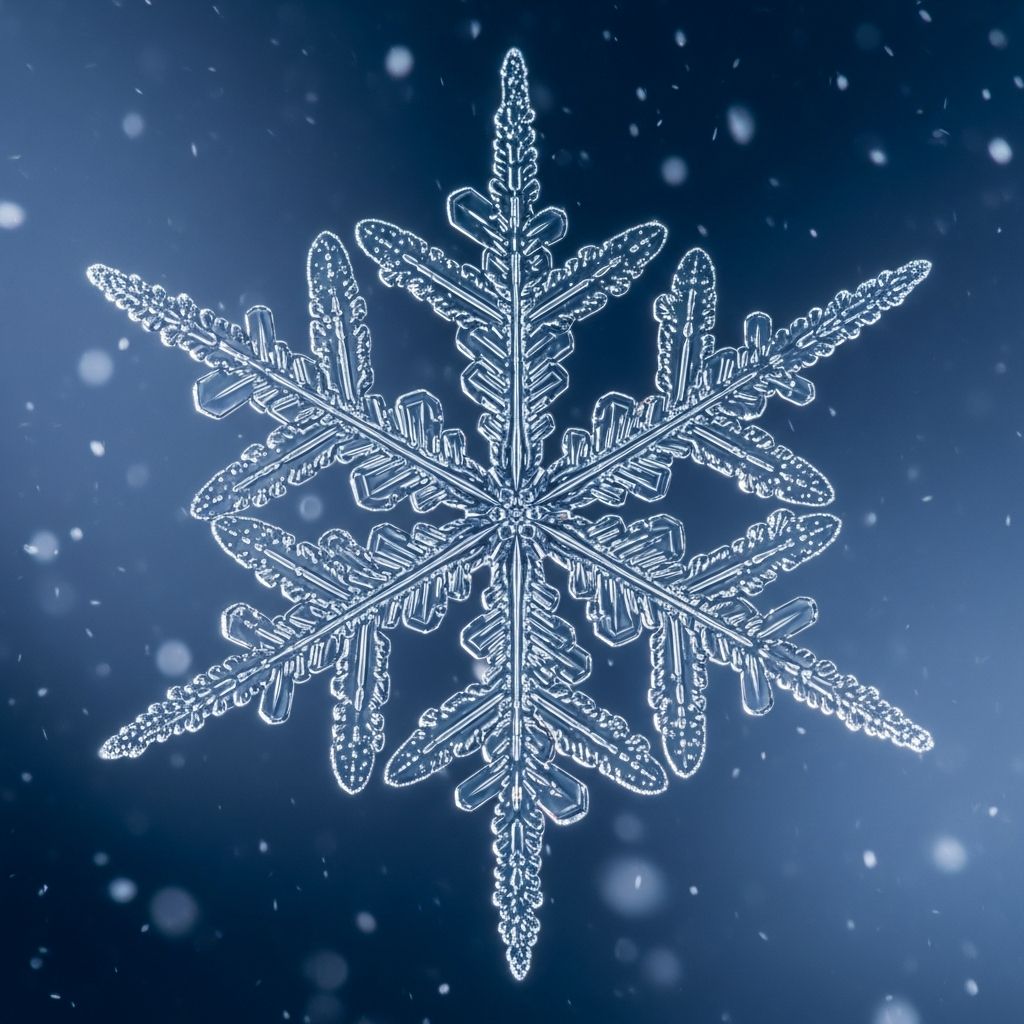
Snowflakes captivate observers with their delicate, intricate designs, each appearing as a tiny work of art sculpted by nature. This phenomenon arises from the physics of ice crystal growth in the atmosphere, where microscopic conditions dictate macroscopic beauty. While all snowflakes share a common hexagonal foundation due to water molecule bonding, their paths through varying temperatures, humidity, and air currents ensure individuality.
Foundations of Snowflake Formation
The journey of a snowflake begins high in the clouds, far above the ground. Water vapor, the gaseous form of H2O, exists abundantly in supersaturated air within clouds. When conditions cool below freezing, this vapor deposits directly onto tiny particles known as nuclei, such as dust or pollen, bypassing the liquid phase—a process called deposition.
This initial freezing forms a minuscule seed crystal. Water molecules, composed of two hydrogen atoms and one oxygen atom, arrange in a rigid hexagonal lattice due to hydrogen bonding. This symmetry mandates that every ice crystal develops six-fold symmetry from the start, manifesting as a basic hexagonal prism. No snowflake deviates from this core geometry, yet it serves as the canvas for future complexity.
- Nucleation sites: Dust motes or aerosols provide the starting point.
- Hexagonal prism: Initial shape with six flat faces and six vertices.
- Deposition growth: Vapor molecules attach preferentially to edges and corners.
As the crystal descends, it encounters a dynamic atmosphere. Growth accelerates at sharp edges because they offer higher surface energy, promoting branch development from the six corners.
Environmental Factors Shaping Individuality
What transforms identical hexagonal starters into diverse forms? The atmosphere’s variability plays the starring role. Temperature gradients, humidity fluctuations, and turbulence create microenvironments unique to each crystal’s trajectory.
Consider temperature: At around -15°C (5°F), simple plates or columns dominate. Warmer zones near -5°C (23°F) foster stellar dendrites with broad, branching arms. Colder realms below -20°C (-4°F) yield slender needles or intricate sector plates. These regimes dictate morphology.
| Temperature Range | Typical Crystal Type | Key Features |
|---|---|---|
| -2°C to -10°C | Plates | Flat, hexagonal discs |
| -10°C to -13°C | Columns | Elongated prisms |
| -13°C to -16°C | Dendrites | Branching stars |
| Below -22°C | Needles | Thin rods |
Humidity, or supersaturation levels, influences growth speed. High moisture accelerates branching, producing lacy patterns; low levels slow it, yielding compact shapes. Wind shears and updrafts further perturb paths, exposing crystals to alternating conditions that spur asymmetrical sub-branches or riming—where supercooled droplets freeze onto surfaces.
Each crystal’s fall spans minutes to hours, traversing kilometers. With Earth’s atmosphere boasting septillions of fluctuating zones annually, identical journeys prove impossible. Even subtle variances—a 0.1°C shift or minor gust—amplify into visible distinctions.
From Crystal to Snowflake: Aggregation Effects
Technical distinction: A snow crystal is a single ice entity; a snowflake often comprises clustered crystals. As crystals grow and descend into warmer, stickier layers near 0°C, they collide and adhere via surface tension or rime ice, forming fluffy aggregates.
Aggregation introduces further uniqueness. Collision angles, crystal sizes, and bonding points vary, creating irregular clumps. While simple crystals might share habits, complex flakes rarely match due to compounded variability. Smaller, pristine crystals falling early may resemble one another, but mature, branched ones embody true singularity.
Mathematical Impossibility of Duplicates
Quantifying uniqueness staggers the mind. Scientists estimate up to 10^158 possible snowflake configurations—dwarfing the universe’s ~10^80 atoms. Each possesses ~10^18 water molecules, with isotopic variations (deuterium or ^18O substituting common H and ^16O) adding atomic diversity.
Proving identity requires atomic-level imaging and histories, infeasible amid trillions falling per storm. Atmospheric chaos theory underscores this: Chaotic systems exhibit extreme sensitivity to initial conditions, mirroring snowflake development. Thus, consensus holds the probability of identical large crystals as effectively zero.
Observing Snowflake Diversity
Photographing snowflakes reveals wonders. Pioneers like Wilson Bentley captured thousands in the late 1800s, cataloging habits yet finding no perfect twins. Modern microscopy confirms: Even under identical lab conditions, crystals differ due to stochastic vapor arrival.
To witness personally: Chill black velvet or chilled glass slides outdoors. Gently catch flakes, magnify with a lens. Note central hexagons branching into ferns, sectors, or bullets—each a environmental diary.
- Tools needed: Freezer-chilled surface, magnifying glass or macro lens.
- Best conditions: Light snow, temperatures below -10°C.
- Preservation tip: Avoid breath; use cold substrate to prevent melt.
Implications for Meteorology and Beyond
Snowflake morphology informs weather prediction. Radar signatures vary by crystal type, aiding precipitation forecasts. Climatologists study shapes to reconstruct past conditions from ice cores.
In materials science, ice growth principles inspire nanotechnology, mimicking dendritic patterns for controlled crystal engineering. Snowflake diversity exemplifies self-organization in non-equilibrium systems, paralleling fractals in nature.
Frequently Asked Questions About Snowflakes
Are all snowflakes truly unique?
Yes, for complex snowflakes; the vast parameter space and environmental variability make identical large crystals extraordinarily unlikely.
Why do snowflakes always have six sides?
Water molecules bond in a hexagonal lattice, enforcing six-fold symmetry from nucleation.
Can snowflakes form identical shapes?
Simple, tiny crystals may appear similar, but mature ones with extensive branching do not.
How long does a snowflake take to form?
Typically 20-60 minutes, depending on size and fall speed through atmospheric layers.
What makes snowflakes stick together?
Near-ground warmth causes partial melting, enabling adhesion into flakes.
This exploration illuminates why snowflakes embody nature’s infinite creativity. Each winter storm delivers billions of originals, turning precipitation into poetry etched in ice.
References
- Why each snowflake is one of a kind — Science | AAAS. 2016-01-22. https://www.science.org/content/article/why-each-snowflake-one-kind
- Why Do Snowflakes Have Different Shapes? — Children’s Museum of Indianapolis. Accessed 2026. https://www.childrensmuseum.org/stories/why-snowflakes-different-shapes
- Is every snowflake different? – Mystery Science — YouTube (Mystery Science). 2020-12-10. https://www.youtube.com/watch?v=tfgmifFj29s
- Are All Snowflakes Really Different? The Science of Winter — Smithsonian Science Education Center. 2023-12-15. https://ssec.si.edu/stemvisions-blog/are-all-snowflakes-really-different-science-winter
- Are All Snowflakes Actually Unique? — Britannica. Accessed 2026. https://www.britannica.com/video/snowflakes/-207854
- Is it true that no two snow crystals are alike? — Library of Congress. 2024-01-08. https://www.loc.gov/everyday-mysteries/meteorology-climatology/item/is-it-true-that-no-two-snow-crystals-are-alike/

- Integrated M.A. in Applied Linguistics, University of Hyderabad
- 5+ years in editorial, instructional, SEO, and research-based writing
Sneha is a relationships and lifestyle writer with a strong foundation in applied linguistics and certified training in relationship coaching. She brings over five years of writing experience to theskillvault, crafting thoughtful, research-driven content that empowers readers to build healthier relationships, boost emotional well-being, and embrace holistic living. Her writing and insights reflect the belief that beauty, happiness, and wellness…