
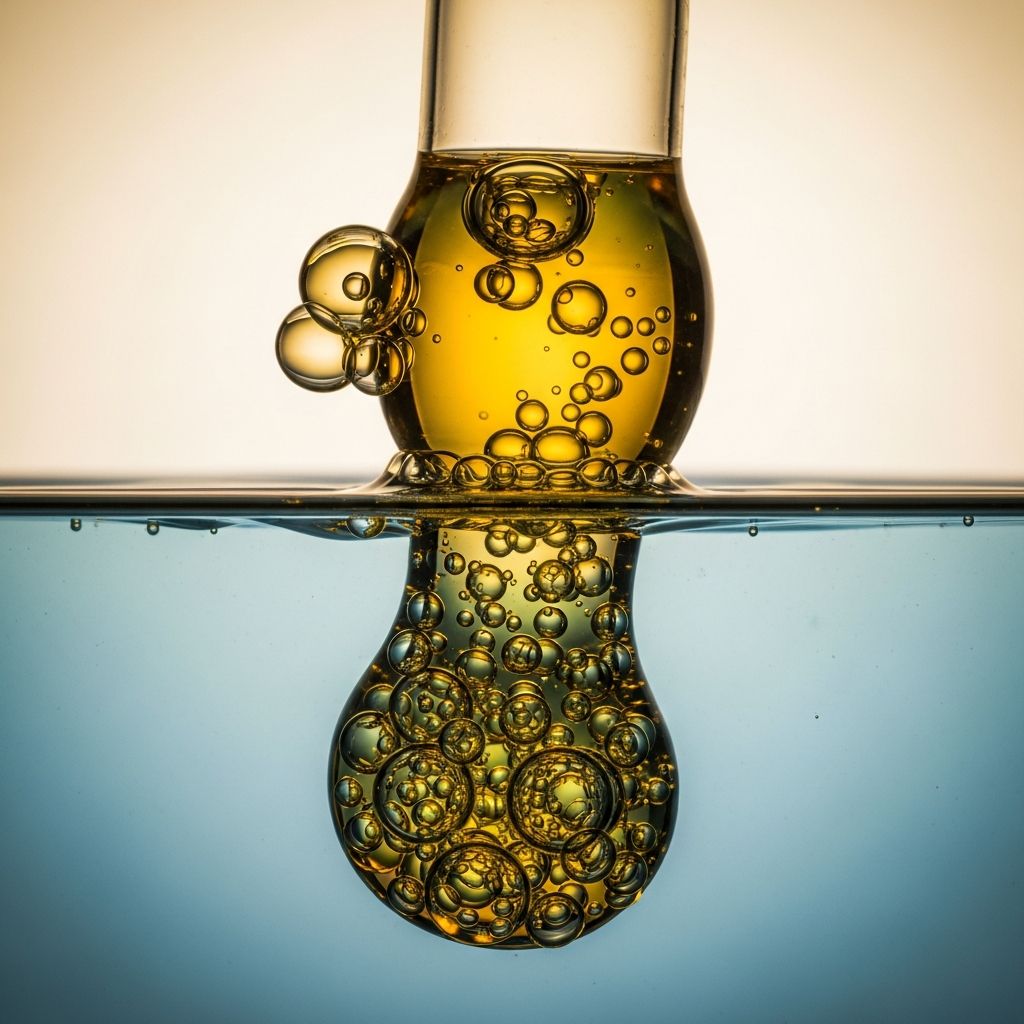
Oil and water consistently refuse to blend, forming distinct layers no matter how vigorously shaken. This separation arises from fundamental differences in their molecular structures, including polarity, density, and intermolecular forces that dictate their interactions.
The Building Blocks: Molecular Polarity Explained
At the heart of this phenomenon lies **molecular polarity**. Water (H₂O) is a polar molecule, with oxygen pulling electrons more strongly, creating a partial negative charge (δ⁻) near the oxygen and partial positive charges (δ⁺) on the hydrogens. This asymmetry allows water molecules to form hydrogen bonds, where the δ⁺ hydrogen of one molecule attracts the δ⁻ oxygen of another, creating a cohesive network.
In contrast, oil—typically hydrocarbons like those in vegetable or motor oil—consists of nonpolar molecules. These have symmetrical electron distribution, lacking distinct charges. Nonpolar oil molecules interact via weaker London dispersion forces, preferring bonds with similar nonpolar neighbors over polar water.
This “like dissolves like” principle governs solubility: polar substances mix with polar solvents, while nonpolar ones avoid them. When oil contacts water, water molecules prioritize hydrogen bonding among themselves, excluding oil and forcing it to coalesce separately.
Density’s Role in Layering
Beyond polarity, **density** contributes to visible separation. Density measures mass per unit volume; water’s is 1 g/cm³, while most oils range from 0.8–0.95 g/cm³, making oil less dense and buoyant on water.
Observe this in a simple experiment: pour oil into a glass of water colored with food dye. Oil floats atop, and dye sinks through oil into denser water, highlighting both immiscibility and density gradients. Shaking temporarily disperses droplets, but they soon reassemble due to inherent attractions.
| Property | Water | Oil (Typical Vegetable) |
|---|---|---|
| Density (g/cm³ at 20°C) | 0.998 | 0.91–0.92 |
| Polarity | Polar (Hydrogen bonding) | Nonpolar (Dispersion forces) |
| Boiling Point (°C) | 100 | 200–300+ |
| Surface Tension (mN/m) | 72.8 | 25–35 |
These properties explain why oil slicks float on oceans and why vinaigrette dressings require shaking before use.
Hydrogen Bonding: Water’s Exclusive Network
Water’s hydrogen bonds are transient yet powerful, forming a dynamic lattice in liquid state—fewer than in ice but sufficient to resist intrusion by nonpolar solutes. Oils lack polar groups to participate, so incorporating them demands breaking water’s bonds without compensatory interactions.
Water conserves energy by maintaining its network, expelling oil. This is evident in cleaning: grease (nonpolar) clings to fabrics until soap intervenes.
Beyond Basics: The Hydrophobic Effect and Entropy
Traditional explanations emphasize enthalpy (energy of bonds), but advanced views highlight **entropy** via the hydrophobic effect. Mixing oil into water doesn’t always cost energy (ΔH can be negative, exothermic); instead, entropy (ΔS) drives separation.
Water around nonpolar oil forms ordered, cage-like structures resembling clathrates—rigid hydrogen-bonded shells reducing randomness. This lowers system entropy, as fewer configurations are possible than in pure water’s fluid network. Thermodynamics dictates immiscibility: ΔG = ΔH – TΔS remains positive due to negative ΔS, favoring phase separation.
Visualize water molecules as dancers in a lively square dance; oil’s bulk disrupts fluidity, prompting waters to reorganize rigidly until oil exits, restoring entropy.
Forcing the Mix: Emulsifiers and Surfactants
Though naturally immiscible, oil and water can form stable mixtures via **emulsifiers**—amphiphilic molecules with polar (hydrophilic) heads and nonpolar (hydrophobic) tails.
- Soap Mechanism: Tails embed in oil droplets, heads interact with water, stabilizing dispersions for rinsing away grease.
- Food Applications: Lecithin in mayo or egg yolks emulsifies oil in vinegar.
- Industrial Uses: Creams, paints, and pharmaceuticals rely on emulsions for texture and delivery.
Without emulsifiers, mixtures revert; mayonnaise separates sans proper ratios.
Hands-On Experiments to Demonstrate Separation
Engage learners with these safe, accessible demos:
- Classic Layering: Mix equal parts water, oil, food coloring. Observe separation; shake and watch reformation (5–10 min).
- Fireworks in Glass: Layer colored water, oil, then add effervescent tablet. Bubbles carry color through oil into water.
- Density Tower: Stack honey, dish soap, water, oil, alcohol—each immiscible layer holds position.
- Soap Test: Add dish soap to oil-water; droplets disperse indefinitely.
Ideal for K-8 education, these reveal polarity and density intuitively.
Real-World Implications Across Industries
This principle permeates daily life and technology:
- Environmental: Oil spills float, complicating cleanup but enabling skimming.
- Culinary: Salad dressings stratify; vinaigrettes need emulsifiers like mustard.
- Medicine: Drug formulations use emulsions for fat-soluble actives in aqueous bodies.
- Energy: Crude oil-water separation in refining exploits immiscibility.
- Cosmetics: Oil-free lotions employ surfactants for even application.
Understanding drives innovation, like biodegradable emulsifiers reducing pollution.
Common Misconceptions Debunked
- Myth: Only density matters. Polarity/entropy dominate; same-density oil-water variants still separate.
- Myth: Shaking permanently mixes. Temporary emulsion forms, but entropy restores layers.
- Myth: All oils identical. Vary by chain length, but all nonpolar.
Frequently Asked Questions (FAQs)
Why does oil float on water?
Oil’s lower density (0.8–0.95 g/cm³) versus water’s (1 g/cm³) causes buoyancy, compounded by immiscibility.
Can oil and water ever truly mix?
Not without emulsifiers; natural forces drive separation via polarity and entropy.
How does soap clean oily dishes?
Soap’s dual nature surrounds oil in micelles, solubilizing it in water.
Is this relevant to ocean oil spills?
Yes, oil floats, aiding mechanical recovery but challenging dispersion.
What about emulsions in food like butter?
Fat globules stabilized by proteins or lecithin prevent coalescence.
Advanced Insights for Deeper Understanding
Thermodynamics quantifies: for oil in water, ΔG > 0 implies spontaneity of separation. Clathrate models predict cage formation increases water’s order, with ΔS ≈ -20–50 J/mol·K for hydrocarbons. Spectroscopy confirms structured water interfaces.
Quantum chemistry reveals dispersion forces in oil rival hydrogen bonds in strength but mismatch spatially, amplifying entropy penalties.
These concepts extend to biology: cell membranes’ lipid bilayers exclude water, enabling compartmentalization.
References
- Why don’t oil and water mix? – Science Questions for Kids — Science Sparks. 2023. https://www.science-sparks.com/why-dont-oil-and-water-mix/
- Why Don’t Oil and Water Mix? (Fun Science for Kids) — Little Bins for Little Hands. 2023. https://littlebinsforlittlehands.com/why-dont-oil-and-water-mix/
- Why oil and water do not mix — Florida State College at Jacksonville (FSCJ). 2024. https://web.fscj.edu/Milczanowski/psc/lect/Ch10/slide10.htm
- The Real Reason Why Oil and Water Don’t Mix — Journal of Chemical Education (ACS Publications). 1998-01-01. https://pubs.acs.org/doi/10.1021/ed075p116
- Why don’t oil and water mix? – John Pollard (TED-Ed) — TED-Ed / YouTube. 2014-10-20. https://www.youtube.com/watch?v=h5yIJXdItgo
- Why Oil and Water Doesn’t Mix – Science Explained — YouTube. 2023. https://www.youtube.com/watch?v=0Pdi8N2nhf4

Medha Deb is an editor with a master's degree in Applied Linguistics from the University of Hyderabad. She believes that her qualification has helped her develop a deep understanding of language and its application in various contexts. Medha specializes in the areas of beauty, health, sports, and wellness and is committed to ensuring that the content on the website is…