
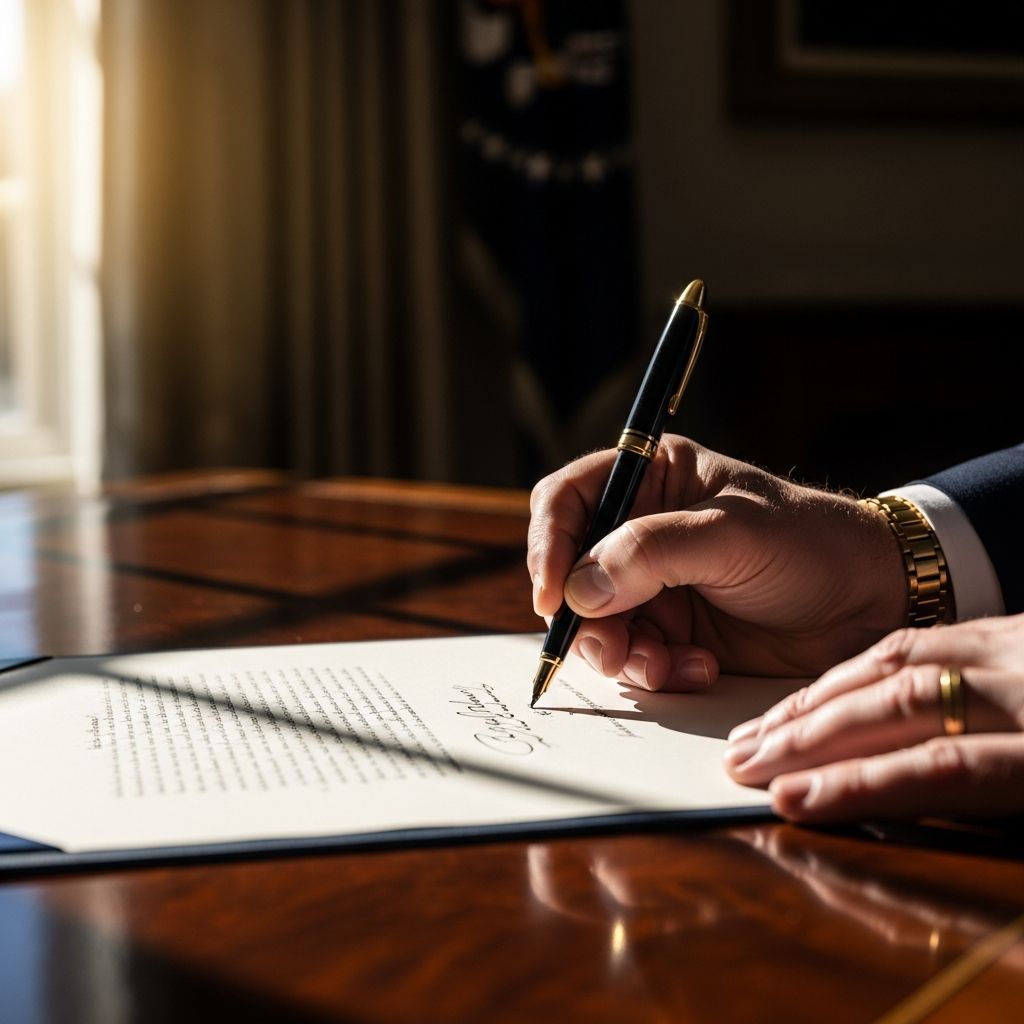
The Ceremonial Significance of Presidential Pen Signing
Throughout American political history, few moments capture public attention quite like a president signing landmark legislation into law. Yet beyond the cameras and speeches lies a curious ritual that has puzzled observers for decades: why do presidents use multiple pens to affix their signature to these historic documents? What might appear as mere eccentricity or superstition actually represents a deeply rooted Washington tradition with practical purposes and profound historical meaning. The practice of employing numerous writing instruments during a single signing ceremony reflects both the ceremonial importance of the moment and a thoughtful acknowledgment of the many individuals who contributed to the legislative achievement.
Tracing the Origins of Multi-Pen Legislation Signing
The tradition of using multiple pens to sign important legislation stretches back several decades into American political history. Historical records indicate that President Franklin Delano Roosevelt was among the earliest adopters of this practice, establishing a precedent that subsequent administrations would follow. The methodology became increasingly formalized over time, transforming from an occasional occurrence into an established Washington custom. What began as a practical concern evolved into a meaningful ceremony that acknowledges the collective effort required to shepherd legislation through the complex American democratic process.
The exact mechanics of why this tradition emerged remain somewhat obscure, but observers and historians have developed clear explanations for its continuation. As legislative initiatives grew more complex and required more extensive negotiations involving numerous stakeholders, presidents recognized the symbolic value of acknowledging these contributions through tangible tokens.
The Economics of Commemorative Artifacts
The primary rationale behind using multiple pens during signing ceremonies is elegantly straightforward: each pen used to sign historic legislation becomes a valuable memento. When a president completes their signature across a document using a particular writing instrument, that pen transforms into a piece of American political history. The White House capitalizes on this reality by intentionally using numerous pens during significant signings, thereby creating multiple commemorative items from a single legislative moment.
These pens are subsequently engraved with relevant details about the legislation or the signing ceremony itself. The engraving process adds an additional layer of prestige and personalization to each item. Recipients of these presidential pens typically include key legislators who championed the bill, committee members who shepherded it through Congress, prominent advocates who mobilized public support, and other influential figures whose efforts proved instrumental in bringing the legislation to fruition. This distribution strategy serves multiple purposes simultaneously: it honors those who deserve recognition, creates goodwill among political allies, and generates multiple thank-you gifts from a single document.
Notable Examples of Multi-Pen Signing Ceremonies
Several landmark legislative moments in recent American history illustrate the scope and significance of this pen-signing tradition. One of the most famous examples occurred in 2010 when President Barack Obama signed the Patient Protection and Affordable Care Act into law. This transformative healthcare legislation, which represented the culmination of over a year of contentious debate and political maneuvering, required the use of 22 different pens. The magnitude of this figure reflected both the historical importance of the legislation and the numerous individuals whose contributions warranted recognition through commemorative pens.
An even more striking historical example involved President Lyndon B. Johnson during the civil rights era. When Johnson signed the groundbreaking Civil Rights Act of 1964 into law, historical accounts suggest he utilized more than 75 pens during the signing ceremony. This extraordinary number underscored the momentous nature of the legislation and the diverse coalition of political figures, civil rights advocates, and policy supporters who made passage possible. One of the initial pens from this ceremony was famously presented to Dr. Martin Luther King Jr., recognizing his transformative leadership in the civil rights movement. Other pens were distributed to key senators including Hubert Humphrey and Everett McKinley Dirksen, both of whom played crucial roles in advancing the legislation through Congress.
Variations in Presidential Approach and Style
While multi-pen signing has become an established Washington tradition, not all presidents have embraced the practice with equal enthusiasm. Different chief executives have developed their own approaches to legislation signing, reflecting personal preferences and administrative philosophies.
President George W. Bush adopted a notably different strategy compared to his predecessors and successors. Rather than using numerous pens during the actual signing process, Bush typically signed legislation with a single pen. However, he would then provide several additional unused pens as commemorative souvenirs to those deserving recognition. This alternative approach achieved similar objectives—honoring contributors and creating keepsakes—while maintaining a more streamlined signing ceremony. Historical accounts suggest that Bush occasionally retained certain pens for his personal collection, adding an unconventional twist to the traditional practice.
President John F. Kennedy developed his own ingenious solution to the challenge of signing his name multiple times without exhausting pen supplies. Kennedy discovered that by spelling out his full middle name and adding a distinctive flourish beneath his signature, he could extend the length of his autograph. This expansion of the signature itself meant that fewer pens were required to cover the document while still creating multiple writing instruments that could be distributed as gifts. The elegance of this approach demonstrated how presidents could adapt the tradition to suit personal preferences and circumstances.
The Practical Challenges of Multi-Pen Signing
The logistics of signing legislation with dozens of pens present legitimate practical considerations. The actual mechanics require the president to sign their name repeatedly across a single document while switching writing instruments between each repetition. This process demands patience, coordination, and careful planning to ensure that each pen is used appropriately and the resulting signatures maintain consistency and legibility throughout the ceremony.
President Obama humorously addressed this challenge during a 2009 signing ceremony for the Lilly Ledbetter Fair Pay Act, for which he employed seven pens. In remarks to the assembled crowd, Obama joked that he had been “practicing signing my name slowly” in preparation for the multi-pen ceremony. His comment acknowledged the somewhat unusual nature of the task while demonstrating a willingness to embrace the tradition with good humor. The lighthearted approach helped contextualize the ceremony and made the process accessible to the broader public watching the proceedings.
The Afterlife of Presidential Pens
Once distributed, these ceremonial pens embark on varied journeys depending on their recipients and circumstances. Many pens find permanent homes in museums, where they are preserved as artifacts documenting significant moments in American legislative history. These museum pieces become educational resources that help future generations understand the political processes and personalities involved in passing transformative legislation.
Other pens are displayed prominently in the offices or homes of their recipients, serving as tangible reminders of individual contributions to historic achievements. These personal displays often become conversation starters and sources of pride for those who received them. The pens function simultaneously as personal mementos and public symbols of participation in important national events.
Occasionally, presidential pens resurface in unexpected contexts. During the 2008 presidential campaign, candidate John McCain famously referenced a pen that President Ronald Reagan had given him years earlier. McCain invoked this memento while discussing his commitment to fiscal responsibility and eliminating wasteful government spending, using the symbolic value of the presidential pen to reinforce his political messaging and connect his candidacy to Reagan’s legacy.
Understanding the Symbolic Value
Beyond the practical aspects of creating multiple commemorative items, the multi-pen signing tradition carries deeper symbolic significance. The practice acknowledges that significant legislation rarely emerges from the efforts of a single individual. Instead, major policy achievements represent the culmination of extensive collaboration, negotiation, compromise, and advocacy involving numerous participants across different branches of government and sectors of society. By using multiple pens and distributing them to key contributors, presidents implicitly recognize this fundamental democratic reality.
The tradition also transforms a single moment—the president’s signature—into multiple physical artifacts that preserve that moment across time and space. Rather than containing the historical record to a single signed document stored in archives, the distribution of pens democratizes access to tangible connections with history. This approach ensures that multiple individuals possess direct physical links to significant legislative achievements, each pen serving as a personal connection to a moment of national importance.
Frequently Asked Questions About Presidential Pen Signing
Q: How many pens does a president typically use when signing legislation?
A: The number varies considerably depending on the significance of the legislation and the number of people the president wishes to acknowledge. Recent examples have ranged from fewer than ten pens for moderate legislation to over 75 pens for transformative laws like the Civil Rights Act.
Q: Are the pens used for signing legislation considered official government property?
A: No, the pens become personal property once distributed as gifts. Recipients may donate them to museums, keep them privately, or display them in their offices at their discretion.
Q: How long does a typical multi-pen signing ceremony take?
A: The duration depends on the number of pens involved. A ceremony using 20 to 30 pens might require 15 to 30 minutes, though ceremonial elements and remarks from the president can extend the total event length considerably.
Q: Do all pens used in a signing ceremony have to be identical?
A: While traditionally pens are similar in appearance for aesthetic consistency, the White House may occasionally select pens of different styles or designs, particularly if the legislation has specific thematic significance.
Q: What happens to unused pens from a signing ceremony?
A: The White House may retain some pens for archival purposes or reserve them for future distribution. Some pens may be kept as institutional records within presidential libraries and archives.
Q: Has any president refused to participate in the multi-pen tradition?
A: Most presidents have participated in some form of the tradition, though they may modify it according to personal preferences. The flexibility of the tradition allows for adaptation while maintaining the essential practice of creating commemorative tokens.
The Enduring Nature of Governmental Traditions
The multi-pen signing tradition exemplifies how governmental ceremonies and practices persist across generations, even as political circumstances and public priorities evolve. Despite the seemingly frivolous nature of the practice—using dozens of pens to sign a document that could be signed with one—the tradition has survived and flourished because it serves meaningful purposes. It acknowledges collaboration, creates valuable historical artifacts, honors key contributors, and transforms singular moments into distributed memories preserved across multiple physical objects.
This unique Washington tradition demonstrates how even the most powerful office in American government remains embedded within institutional practices and ceremonial frameworks that reflect democratic values and historical continuities. The simple act of using multiple pens to sign legislation encapsulates broader truths about how laws are created through collective effort and how historical moments achieve permanence through both documentary records and symbolic artifacts distributed throughout the political landscape.
References
- Why Did Obama Use So Many Pens to Sign the Health Care Bill? — TIME Magazine. 2010-03-24. https://time.com/archive/6937409/why-did-obama-use-so-many-pens-to-sign-the-health-care-bill/
- All the President’s Pens — The White House Archives. 2010-03-24. https://obamawhitehouse.archives.gov/featured-videos/video/2010/03/24/all-presidents-pens

Medha Deb is an editor with a master's degree in Applied Linguistics from the University of Hyderabad. She believes that her qualification has helped her develop a deep understanding of language and its application in various contexts. Medha specializes in the areas of beauty, health, sports, and wellness and is committed to ensuring that the content on the website is…