
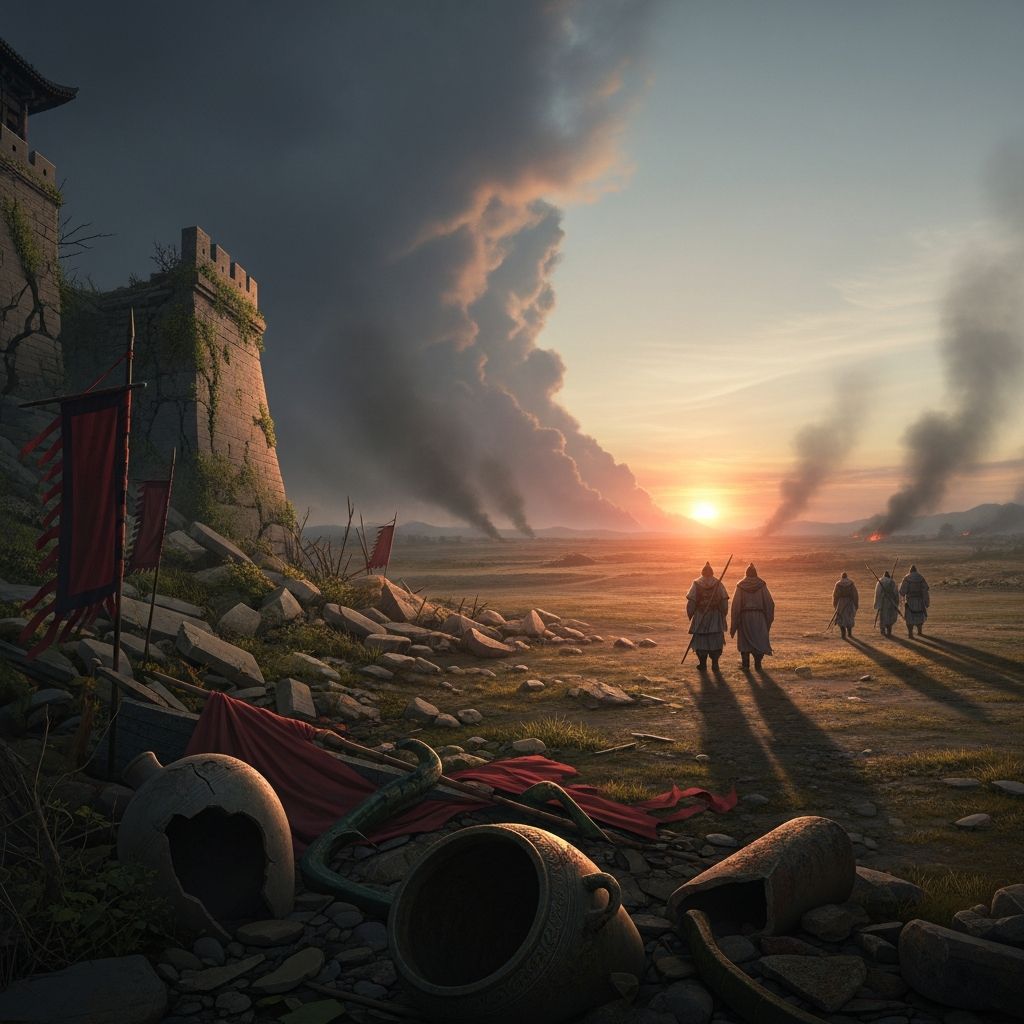
The Han Dynasty, one of China’s most enduring and influential imperial eras, spanned over four centuries from 206 BCE to 220 CE. Its downfall marked a pivotal transition in Chinese history, leading to centuries of division and warfare. This article examines the complex interplay of internal decay, social upheaval, and military power struggles that eroded the dynasty’s foundations.
Foundations of Han Prosperity and Early Signs of Decline
The Han Dynasty built upon the Qin unification, establishing a centralized bureaucracy, expanding trade via the Silk Road, and fostering Confucian ideals that shaped Chinese governance for millennia. However, by the late 2nd century CE, cracks appeared in this edifice. After the death of Emperor Zhang in 88 CE, a period of relative stability known as the Rule of Ming and Zhang gave way to escalating corruption and factionalism.
Imperial authority waned as court eunuchs amassed unprecedented influence. These castrated officials, initially servants, exploited their proximity to the throne to control policy and appointments. Emperor Ling (r. 168–189 CE) favored the ‘Ten Attendants,’ a clique that dominated the court, sidelining scholar-officials and breeding resentment among the aristocracy. This power imbalance fueled family feuds within the royal clan and alienated key stakeholders.
Social and Economic Pressures Fueling Unrest
Agrarian distress compounded political woes. Frequent natural disasters, including floods along the Yellow River, devastated farmlands and triggered famines. Heavy taxation and land consolidation by wealthy elites left peasants destitute, exacerbating inequality.
By 184 CE, these grievances ignited the Yellow Turban Rebellion, a massive peasant uprising led by Zhang Jue and his brothers. Adherents donned yellow headscarves, drawing from Daoist millenarian beliefs that promised salvation from corrupt rule. The rebellion, though ultimately suppressed, decentralized military power as regional governors raised private armies to combat the insurgents. These forces remained intact post-rebellion, sowing seeds for warlordism.
- Key triggers of the Yellow Turban Rebellion:
- Famines and floods displacing millions.
- Corrupt landholding by elites squeezing small farmers.
- Religious fervor promising a new ‘Great Peace’ era.
- Weak central response due to eunuch interference.
The rebellion’s suppression did not restore order; instead, it fragmented authority, empowering local commanders who prioritized personal loyalty over imperial allegiance.
The Rise of Warlords and the Erosion of Central Control
Emperor Ling’s death in 189 CE precipitated chaos. General-in-Chief He Jin, brother to Ling’s empress, plotted against the eunuchs but was assassinated, sparking a massacre of over 2,000 eunuchs. Amid the turmoil, the 13-year-old Emperor Shao was deposed by warlord Dong Zhuo, who installed the pliable Emperor Xian as a puppet ruler.
Dong Zhuo’s brutal reign alienated rivals, leading to his assassination in 192 CE by a coalition of warlords. This vacuum allowed figures like Cao Cao in the north, Sun Quan in the south, and Liu Bei in the west to carve out spheres of influence. Cao Cao, rising from Dong Zhuo’s successor, consolidated northern China, styling himself as a Han loyalist while building a formidable army.
| Warlord | Region | Key Strategies | Outcome |
|---|---|---|---|
| Cao Cao | North (Wei) | Military reforms, agricultural colonies | Near-unification, defeated at Red Cliffs |
| Sun Quan | South (Wu) | Naval prowess, Yangtze defenses | Co-founder of Eastern Wu |
| Liu Bei | West (Shu) | Alliance-building, Shu-Han legitimacy | Co-founder of Shu Han |
Pivotal Conflicts and the Battle of Red Cliffs
Cao Cao’s ambition to reunify China clashed with southern resistance. In 208 CE, he launched a massive campaign southward, capturing Jing Province and amassing an armada on the Yangtze River. Sun Quan and Liu Bei formed an unlikely alliance, leveraging naval expertise and terrain advantages.
The Battle of Red Cliffs (208–209 CE) proved decisive. Southern forces, under Zhou Yu and Zhuge Liang’s counsel, used fire ships—boats packed with incendiary materials—to devastate Cao Cao’s fleet amid unfavorable winds. Casualties numbered in the hundreds of thousands, shattering Cao Cao’s southern dreams and cementing the tripartite division.
This battle not only halted reunification but symbolized the shift from Han imperial unity to regional kingdoms, romanticized in literature like Romance of the Three Kingdoms.
Final Days of the Han and Birth of the Three Kingdoms
Cao Cao died in 220 CE, and his son Cao Pi seized the moment. Pressuring the powerless Emperor Xian to abdicate, Cao Pi declared the Wei Dynasty, formally ending the Han. Sun Quan established Eastern Wu, and Liu Bei founded Shu Han, initiating the Three Kingdoms period (220–280 CE)—an era of innovation in military tactics, poetry, and governance amid constant strife.
The Han’s collapse was not abrupt but a culmination of systemic failures: eunuch corruption undermined the bureaucracy, peasant revolts decentralized power, and warlords filled the void, prioritizing self-interest over unity.
Long-Term Impacts on Chinese Civilization
The Three Kingdoms era influenced military philosophy (e.g., Sun Tzu’s enduring legacy) and cultural output, including epic novels and Buddhist introductions. It also set precedents for future dynasties in balancing civil and military authority.
Economically, division spurred regional developments: Wei’s tuntian system boosted agriculture, Wu advanced shipbuilding, and Shu innovated irrigation. Yet, prolonged warfare depopulated regions and stalled grand projects like the Silk Road expansions.
Lessons from Han’s Downfall
Historians view the Han collapse through lenses of structural strain—overextension, elite overproduction, and declining state fiscal capacity. Modern analyses, like structural-demographic theory, draw parallels to other imperial falls, highlighting how inequality and elite competition erode legitimacy.
China’s reunification under the Jin Dynasty in 280 CE was short-lived, underscoring the Han’s legacy as a high-water mark of unity.
Frequently Asked Questions (FAQs)
What caused the Yellow Turban Rebellion?
Famines, floods, heavy taxes, and corrupt officials drove peasants to revolt under Daoist leaders seeking a new era of peace.
Who won the Battle of Red Cliffs?
The alliance of Sun Quan and Liu Bei decisively defeated Cao Cao’s forces using fire ships and naval tactics.
How did the Han Dynasty officially end?
In 220 CE, Cao Pi forced Emperor Xian to abdicate, establishing the Wei Dynasty and splintering China into three kingdoms.
Why did eunuchs gain so much power?
Emperors trusted them over scheming relatives and officials, allowing cliques like the Ten Attendants to control the court.
What followed the Han collapse?
The Three Kingdoms period (220–280 CE), marked by warfare among Wei, Shu, and Wu until Jin reunification.
References
- The Fall of the Han and the Three Kingdoms Period — Lumen Learning. N/A. https://courses.lumenlearning.com/suny-hccc-worldcivilization/chapter/the-fall-of-the-han-and-the-three-kingdoms-period/
- The Han Dynasty — History Guild. N/A. https://historyguild.org/the-han-dynasty/
- The Fall of the Han Dynasty: Overview, History & Timeline — Study.com. N/A. https://study.com/academy/lesson/video/the-collapse-of-han-china-causes-timeline.html
- End of the Han dynasty — Wikipedia (informational). N/A. https://en.wikipedia.org/wiki/End_of_the_Han_dynasty
- Structural-demographic analysis of the Qing Dynasty (1644–1912) — PMC (NCBI). 2023-08-15. https://pmc.ncbi.nlm.nih.gov/articles/PMC10437944/

Medha Deb is an editor with a master's degree in Applied Linguistics from the University of Hyderabad. She believes that her qualification has helped her develop a deep understanding of language and its application in various contexts. Medha specializes in the areas of beauty, health, sports, and wellness and is committed to ensuring that the content on the website is…