
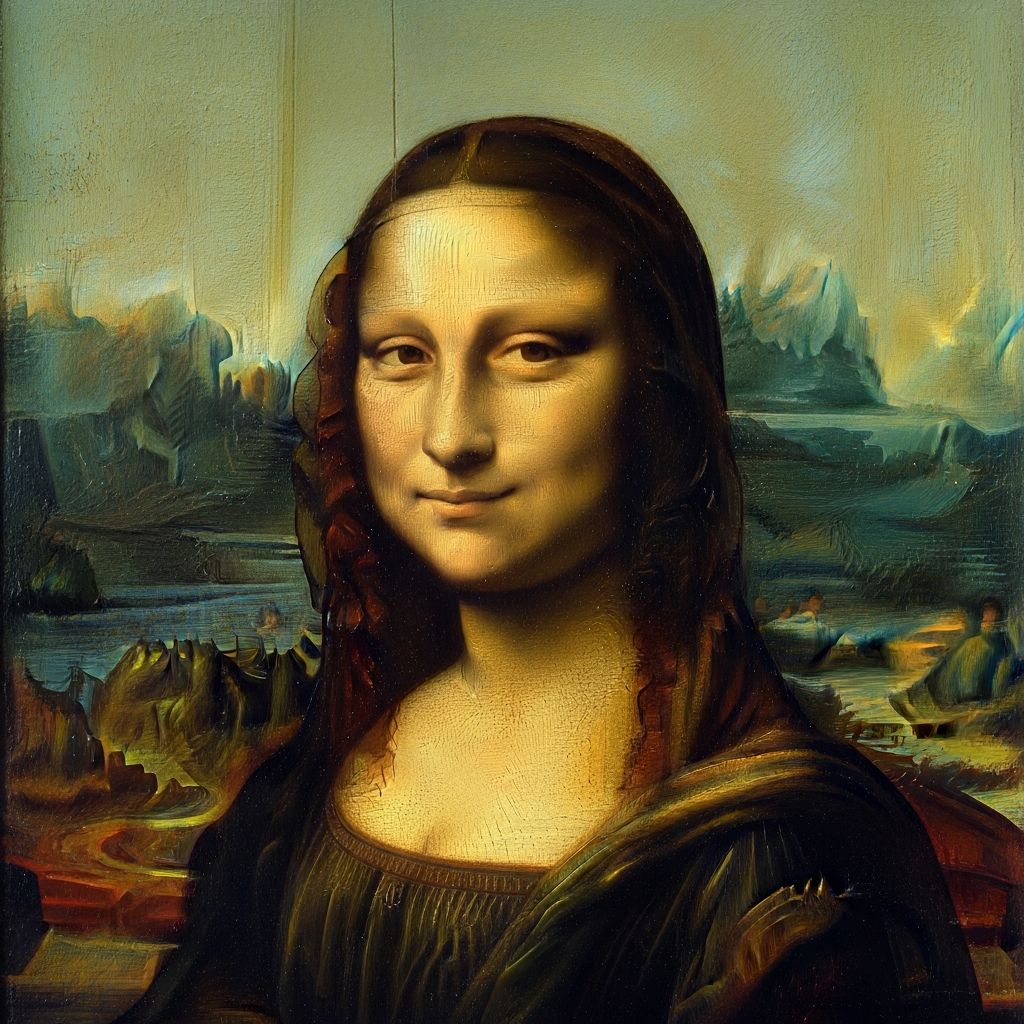
Leonardo da Vinci’s Mona Lisa stands as the pinnacle of artistic recognition, drawing millions to the Louvre annually. Its fame transcends mere aesthetics, rooted in a blend of innovative artistry, dramatic historical events, and relentless cultural propagation.
Leonardo da Vinci’s Artistic Revolution
Created around 1503-1506, the Mona Lisa emerged during the High Renaissance, a period of unparalleled artistic innovation. Da Vinci, a polymath blending art, science, and philosophy, infused the portrait with groundbreaking techniques that set it apart from contemporaries.
Central to its allure is sfumato, da Vinci’s signature method of subtle color gradations creating soft transitions without harsh lines. This yields the painting’s hazy landscapes and the subject’s elusive expression, evoking lifelike depth and emotional ambiguity. The subject’s gaze appears to follow viewers, a psychological effect achieved through masterful perspective and light manipulation.
Da Vinci’s anatomical precision reflects his scientific pursuits. Detailed studies of human anatomy informed the realistic hands, folded serenely, and the subtle vein patterns on the skin. The landscape backdrop, with winding paths and distant horizons, demonstrates atmospheric perspective, where elements recede into a misty infinity, pioneering realistic depth in portraiture.
- Sfumato technique: Blurs edges for a dreamlike quality.
- Atmospheric perspective: Conveys vastness through tonal fading.
- Psychological portraiture: Captures inner mystery via expression.
These elements transformed portraiture, influencing generations and embedding the work in art history canon.
From Royal Collection to National Treasure
Upon da Vinci’s death in 1519, King Francis I of France acquired the painting, housing it in royal residences. It symbolized Renaissance humanism, blending intellect and beauty. During the French Revolution, it entered the Louvre’s collection, becoming a republican emblem.
For centuries, it garnered scholarly praise. In the 19th century, French critics like Alfred Dumesnil described its ‘treacherous attraction,’ fixating on the smile’s seductive ambiguity. English aesthete Walter Pater’s 1878 essay poetically evoked its ‘strange thoughts and fantastic reveries,’ romanticizing it as a vessel of eternal desire.
Yet, pre-20th century, it was admired but not globally iconic. Its path to superstardom required a catalyst far removed from the easel.
The Pivotal 1911 Theft: A Fame Catalyst
On August 21, 1911, Vincenzo Peruggia, a Louvre employee driven by Italian patriotism, hid the Mona Lisa in his locker and walked out with it. For two years, it vanished, sparking international headlines and detective fervor. Newspapers dubbed it the ‘crime of the century,’ turning an art piece into a mystery thriller.
The theft elevated visibility exponentially. Global media frenzy introduced the portrait to mass audiences unfamiliar with Renaissance art. Upon recovery in 1913—Peruggia attempted to sell it to Florence’s Uffizi Gallery—it toured Italy, drawing riotous crowds in Florence, Rome, and Milan. Over 30,000 Florentines stormed barriers to glimpse it.
| Event | Date | Impact |
|---|---|---|
| Theft from Louvre | 1911 | Global media explosion |
| Recovery | 1913 | Tour in Italy; massive crowds |
| Return to Louvre | 1914 | Must-see attraction status |
This scandal ‘catapulted’ it into ‘famous for being famous’ territory, as historian Daniel J. Boorstin later termed. Absence bred obsession; recovery cemented legend.
Mass Reproduction and Pop Culture Domination
Post-theft, reproductions proliferated: postcards, posters, magazines. By the 1930s, it starred in films like The Theft of the Mona Lisa and inspired Nat King Cole’s 1950 hit ‘Mona Lisa.’ This saturation embedded it in collective consciousness, far beyond art enthusiasts.
Marcel Duchamp’s 1919 L.H.O.O.Q.—a mustached Mona Lisa—parodied it into Dadaist discourse. Andy Warhol’s silkscreens commodified it further. Dan Brown’s 2003 The Da Vinci Code wove conspiracy myths, boosting Louvre visits by millions.
Today, over 10 million visit annually, many solely for her. Merchandise—from mugs to memes—perpetuates ubiquity, creating self-reinforcing fame loops.
Technical Mastery Under the Lens
Modern analysis reveals more genius. Infrared scans show da Vinci reworked it over 16 years, layering philosophy into paint. Poplar panel preparation and underdrawings indicate meticulous planning.
X-rays detect pentimenti—initial changes—highlighting evolving composition. The smile’s ambiguity stems from asymmetric mouth curves: upturned left, neutral right, tricking perception based on viewpoint.
- Layered glazes: Up to 40 oil layers for luminosity.
- Underdrawing precision: Anatomical accuracy from dissections.
- Optical effects: Gaze follows due to elliptical positioning.
These confirm its status as technical pinnacle, justifying hype.
Psychological and Symbolic Power
The Mona Lisa’s gaze induces the ‘Mona Lisa effect,’ where eyes seem to track viewers—a universal phenomenon enhancing engagement. Her androgynous features and enigmatic smile evoke universal intrigue, mirroring humanity’s quest for self-understanding.
As a cultural brand, it transcends value: unsellable, priceless. Louvre attendance and da Vinci market values soar in its wake, proving fame as economic force.
Critiques and Enduring Mysteries
Not all praise it unreservedly. Some dismiss it as overhyped, fame outpacing merit. Restoration debates—1974 acid attack, 1956 rock throw—spark conservation controversies.
Identity debates persist: Lisa Gherardini or fictional ideal? Da Vinci self-portrait theory? These enigmas fuel discourse.
Frequently Asked Questions (FAQs)
What makes the Mona Lisa’s smile so mysterious?
The smile’s asymmetry and sfumato blending create shifting perceptions—voluptuous from afar, subdued up close—engaging viewer psychology.
Was the Mona Lisa always famous?
No, scholarly admiration grew in the 1800s, but the 1911 theft propelled it to worldwide stardom.
Why can’t the Mona Lisa be sold?
As French national property, it’s inalienable, its value symbolic rather than monetary.
How many visitors see the Mona Lisa yearly?
Approximately 10 million, though bulletproof glass and crowds limit close views.
What is sfumato?
A painting technique of soft, gradual tone transitions, masterfully used by da Vinci for lifelike subtlety.
References
- Mona Lisa — Wikipedia. 2026-04-01. https://en.wikipedia.org/wiki/Mona_Lisa
- Why Is Mona Lisa So Famous? — Jose Art Gallery. 2023-05-15. https://joseartgallery.com/articles/why-is-mona-lisa-so-famous
- Why the Mona Lisa Became Priceless: A Strategic Deconstruction — MoMAA. 2024-02-20. https://momaa.org/why-the-mona-lisa-became-priceless-a-strategic-deconstruction-of-fame-scarcity-and-perception-in-the-art-market/
- Why is the Mona Lisa so famous? – Noah Charney — TED-Ed (YouTube). 2017-11-06. https://www.youtube.com/watch?v=yRK_uCMwZPY
- Why is the Mona Lisa so famous? — SatPost by Trung Phan. 2023-08-12. https://www.readtrung.com/p/why-is-the-mona-lisa-so-famous

- Integrated M.A. in Applied Linguistics, University of Hyderabad
- 5+ years in editorial, instructional, SEO, and research-based writing
Sneha is a relationships and lifestyle writer with a strong foundation in applied linguistics and certified training in relationship coaching. She brings over five years of writing experience to theskillvault, crafting thoughtful, research-driven content that empowers readers to build healthier relationships, boost emotional well-being, and embrace holistic living. Her writing and insights reflect the belief that beauty, happiness, and wellness…