
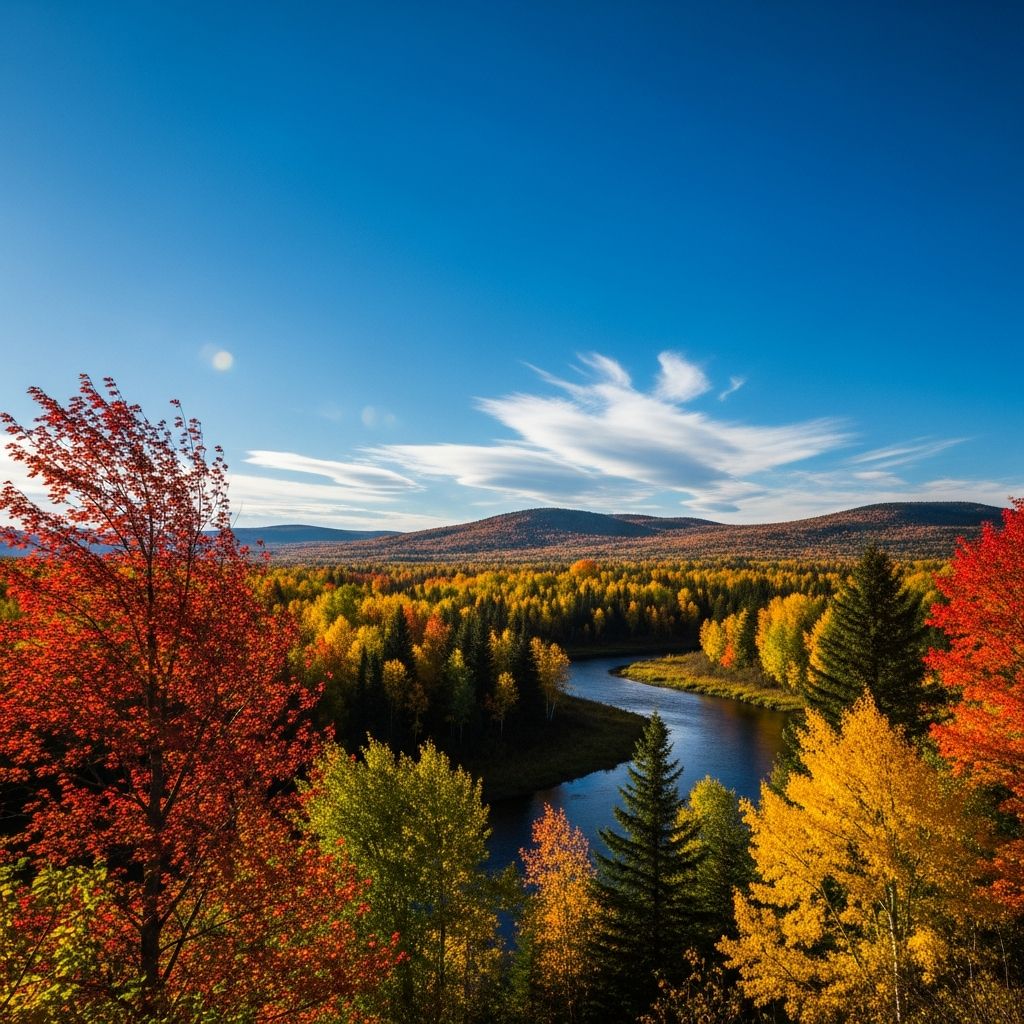
The transition from summer to fall brings not only colorful leaves but also skies that seem exceptionally vivid and blue. This phenomenon captivates observers, prompting questions about the underlying causes. In this comprehensive exploration, we delve into the atmospheric dynamics, light interaction principles, and seasonal factors that make autumn skies stand out.
The Physics of Sky Color
Sky color arises from how sunlight interacts with Earth’s atmosphere. Sunlight, appearing white to the human eye, comprises a spectrum of wavelengths from red to violet. When these rays enter the atmosphere, they encounter gas molecules like nitrogen and oxygen, which are smaller than visible light wavelengths.
This interaction leads to **Rayleigh scattering**, where shorter blue wavelengths scatter more efficiently than longer red ones. As a result, blue light disperses across the sky, creating its characteristic daytime hue.
- Shorter wavelengths (blue, violet) scatter up to 10 times more than longer ones (red, orange).
- Human eyes perceive blue prominently due to greater sensitivity to it compared to violet.
- Overhead skies appear deepest blue; horizons fade due to additional scattering through thicker air layers.
Seasonal Shifts in Atmospheric Clarity
Fall marks a pivotal change in weather patterns. Cooler temperatures reduce evaporation, lowering humidity levels significantly. Summer air, laden with water vapor and aerosols, promotes haze that diffuses light across wavelengths.
In contrast, autumn’s drier conditions minimize these particles. This reduction favors **Rayleigh scattering** over broader diffusion, allowing purer blue light to dominate.
| Season | Humidity Level | Dominant Scattering | Sky Appearance |
|---|---|---|---|
| Summer | High | Mie (equal wavelengths) | Pale, hazy blue |
| Autumn | Low | Rayleigh (blue preferential) | Deep, vibrant blue |
**Mie scattering**, caused by larger particles like dust or water droplets, scatters all colors equally, whitening the sky. Fewer such particles in fall enhance blue intensity.
Role of Solar Position and Clarity
Autumn’s lower sun angles amplify the effect. As the sun descends toward the horizon, its light path lengthens, but midday overhead positions still scatter ample blue directly to observers. Crisp air with fewer clouds permits unobstructed views, intensifying the color.
High-pressure systems common in fall stabilize weather, reducing cloud cover and pollution. This clarity lets more scattered blue light reach the ground without interference.
Psychological and Visual Enhancements
Beyond physics, perception plays a role. Autumn foliage in reds, oranges, and yellows—complementary to blue—creates stark contrast. This **simultaneous contrast** makes blue skies appear even deeper.
- Red leaves against blue sky heighten perceived saturation.
- Lower sun angles cast golden light, further emphasizing overhead blue.
- Cultural associations with clear fall days amplify subjective appreciation.
Comparing Skies Across Seasons and Locations
Regional variations influence observations. In temperate zones like New England, pronounced temperature drops yield dramatic shifts. Tropical areas see subtler changes due to persistent humidity.
| Location | Fall Humidity Drop | Blue Intensity Gain | Notable Feature |
|---|---|---|---|
| Maine, USA | Significant (50%+) | High | Foliage contrast |
| Central Europe | Moderate | Medium | Clear high-pressure |
| Mediterranean | Mild | Low | Persistent aerosols |
Elevations matter too: mountains offer darker blues from thinner air, akin to space transitions.
Global and Planetary Perspectives
Earth’s blue dominance stems from its nitrogen-oxygen mix. Compare to Mars, where CO2 and dust yield butterscotch daytime skies, shifting blue at sunset—reverse of Earth.
Volcanic events or wildfires introduce aerosols, temporarily muting blue via Mie effects, underscoring autumn’s natural purity.
Observing and Measuring the Phenomenon
To verify, photograph skies across seasons under similar solar angles. Spectrophotometers quantify scattering; apps like SkyView analyze color metrics. Personal logs noting humidity (via weather apps) correlate with perceived depth.
- Record midday sky RGB values.
- Compare summer vs. fall at 40-50% RH threshold.
- Note leaf color proximity for contrast bias.
Frequently Asked Questions (FAQs)
What causes the sky to look bluer in autumn?
Drier air reduces Mie scattering from water droplets, allowing Rayleigh scattering of blue light to dominate without haze interference.
Does location affect autumn sky blueness?
Yes, areas with sharp humidity drops, like northern latitudes, show strongest effects; humid regions see milder changes.
Why do skies pale near the horizon?
Light travels through more atmosphere, rescattering blue away, leaving whites and pastels.
Can pollution mimic or counter this effect?
Pollutants increase Mie scattering, dulling blue; clean fall air enhances it.
Is the sky equally blue on other planets?
No, atmospheres dictate color—Mars appears reddish due to dust scattering.
Implications for Climate and Observation
Tracking sky clarity aids climate studies. Drier autumns may signal shifting patterns; satellites monitor global scattering trends. For enthusiasts, it enriches seasonal hikes, blending science with sensory delight.
Understanding these dynamics reveals nature’s precision: subtle humidity tweaks yield profound visuals, reminding us of interconnected systems.
References
- Is the sky bluer in the fall? — Maine Audubon. 2023-10-01. https://maineaudubon.org/news/sky-bluer-fall/
- Why Is The Sky Blue? — National Weather Service. 2024-05-15. https://www.weather.gov/fgz/SkyBlue
- Why Is the Sky Blue? — NASA Space Place. 2023-08-20. https://spaceplace.nasa.gov/blue-sky/

Medha Deb is an editor with a master's degree in Applied Linguistics from the University of Hyderabad. She believes that her qualification has helped her develop a deep understanding of language and its application in various contexts. Medha specializes in the areas of beauty, health, sports, and wellness and is committed to ensuring that the content on the website is…